

B2B Insights

Lauren Daniels
August 21, 2026
%20.jpg)
Not every CRM works at enterprise scale. The difference is not just about price or feature count. It is about whether the platform can handle multi-team access, complex data structures, custom workflows, and deep integrations across a large, distributed organisation without creating more operational overhead than it removes.
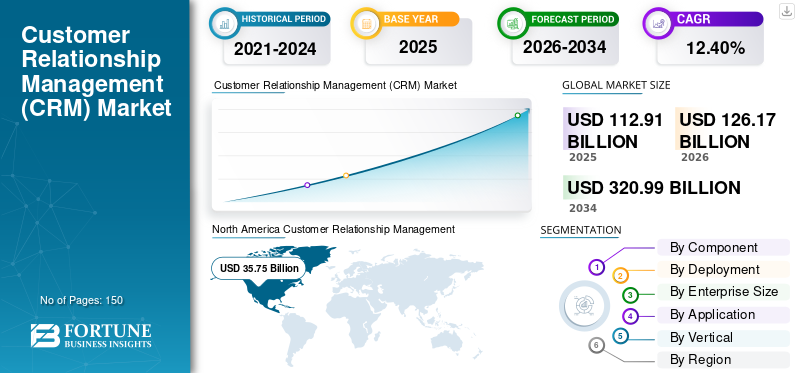
The CRM market reached an estimated $112.91 billion in 2025 and is projected to hit $126 billion by the end of 2026, growing at 12.4% annually. That makes it the largest category in enterprise software, larger than ERP, supply chain, and HR tech combined. The investment reflects how central customer data management has become to revenue operations, not just sales administration.
For B2B companies specifically, the stakes are higher. Building trust with customers, tracking interactions across long sales cycles, and giving every revenue-touching team like sales, marketing, and customer success access to the same data is what separates a functional CRM from one that actually drives growth.
Businesses that adopt CRM to its full potential report an 87% improvement in sales, a 74% increase in customer satisfaction, and a 73% improvement in overall business efficiency. Companies using CRM see an average return of $8.71 for every $1 invested, making it one of the highest-ROI technology decisions in the B2B stack.
But those numbers assume the CRM is properly implemented, consistently used, and connected to the other tools your team relies on. Picking the wrong one for your size and complexity does not produce those outcomes. It produces adoption problems, data silos, and a sales team that works around the system rather than through it.
The 6 platforms below represent the strongest enterprise CRM options for B2B sales teams in 2026. Each profile covers what the platform does well, where it fits best, and where it does not.
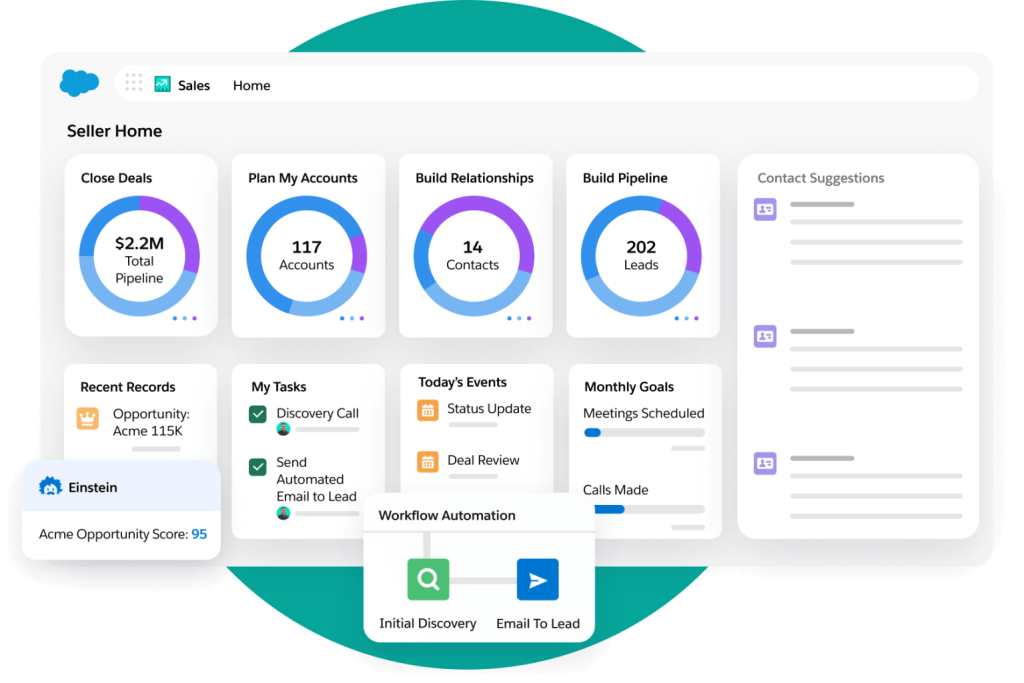
Best for: Enterprise B2B organisations that need a fully customisable CRM with deep AI capabilities, a vast integration ecosystem, and the infrastructure to run complex, multi-territory sales operations.
Salesforce is the reference standard for enterprise CRM software. It serves over 150,000 customers, with 83% of Fortune 500 companies running it. For large B2B organisations, that market dominance reflects something real: the platform's combination of customisability, integration breadth, and AI tooling is genuinely difficult to match.
The Enterprise Edition starts at $150 per user per month. At that tier, you get the full sales and pipeline management suite, advanced reporting, workflow automation, and territory management. The Agentforce AI line, which Salesforce reported surpassing $800 million in ARR through its FY26 earnings, sits on top of that and handles lead prioritisation, next-step suggestions, and automated summarisation across the pipeline.
The trade-off is implementation complexity. Initial setup and customisation require real technical resources, either internally or through a Salesforce partner. For companies without a dedicated admin or a managed services relationship, the gap between what Salesforce can do and what a team actually uses is often significant. Salesforce data shows a 29% average increase in sales revenue following adoption, but that figure assumes the implementation is properly managed and the team actually uses the system.
For B2B sales organisations with the headcount and resources to implement it properly, Salesforce remains the most capable enterprise CRM in the market.
Enterprise Edition price: $150 per user, per month.
Ideal for: Large B2B sales teams, multi-territory enterprise organisations, and companies that need a CRM capable of supporting complex RevOps architectures alongside their outbound SDR function.
Best for: B2B teams that want enterprise-grade capability without sacrificing usability, and need marketing, sales, and customer service data in one connected platform.
HubSpot holds 62% of SMB CRM installations and has moved increasingly into enterprise territory with Sales Hub Enterprise. The interface is significantly more approachable than Salesforce, which translates directly into faster adoption. A CRM that sales reps actually use consistently outperforms one that requires heavy admin oversight to maintain.
The Enterprise tier starts at $1,200 per month for 10 users and includes custom reporting, predictive lead scoring, conversation intelligence, and advanced automation. HubSpot's Breeze AI line expanded to 20+ agents between early 2025 and early 2026, covering tasks like call summarisation, email generation, and pipeline forecasting. The app ecosystem integrates with over 1,000 third-party tools, which means most B2B tech stacks are already covered.
The cost consideration is real. HubSpot's base Enterprise pricing looks manageable, but when marketing hub, service hub, and content hub features are added, the total spend climbs quickly. For organisations that want HubSpot's full all-in-one capability, pricing needs to be modelled against the full suite of required hubs before a comparison against Salesforce is meaningful.
For B2B companies where sales and marketing alignment is a core requirement and where CRM adoption has historically been a problem because the previous platform was too complex, HubSpot Sales Hub Enterprise is worth evaluating seriously.
Enterprise price: $1,200 per month for 10 users.
Ideal for: B2B sales and marketing teams that need a connected, easy-to-use platform and want CRM adoption to be a feature of the rollout, not a battle against it.
Best for: Large enterprises in manufacturing, financial services, and technology sectors that need industry-specific data management alongside a comprehensive CRM.
Oracle has been in the enterprise software market for decades. Their CRM solution runs inside the broader E-Business Suite, which means it connects natively to Oracle's financial, procurement, and operations modules. For large organisations already running Oracle infrastructure, that integration depth is a significant operational advantage.
The interface draws frequent comparisons to legacy software, which is accurate. It is functional but not intuitive by modern standards, and the learning curve is steeper than HubSpot or Pipedrive. What the platform delivers in exchange is highly secure cloud storage, deep industry-specific data management capabilities, and an extensive library of integrations across the Oracle ecosystem.
Oracle's approach is suited to organisations where the CRM is one component of a much larger enterprise architecture, not the centrepiece. For companies evaluating a standalone sales CRM, Oracle's complexity and pricing model will often make a more focused platform the better fit. For large enterprise organisations already embedded in Oracle's environment, the integration value justifies the investment.
Price: By request.
Ideal for: Enterprise organisations in manufacturing, technology, and financial services that run Oracle infrastructure and need CRM data connected to financial and operational systems.
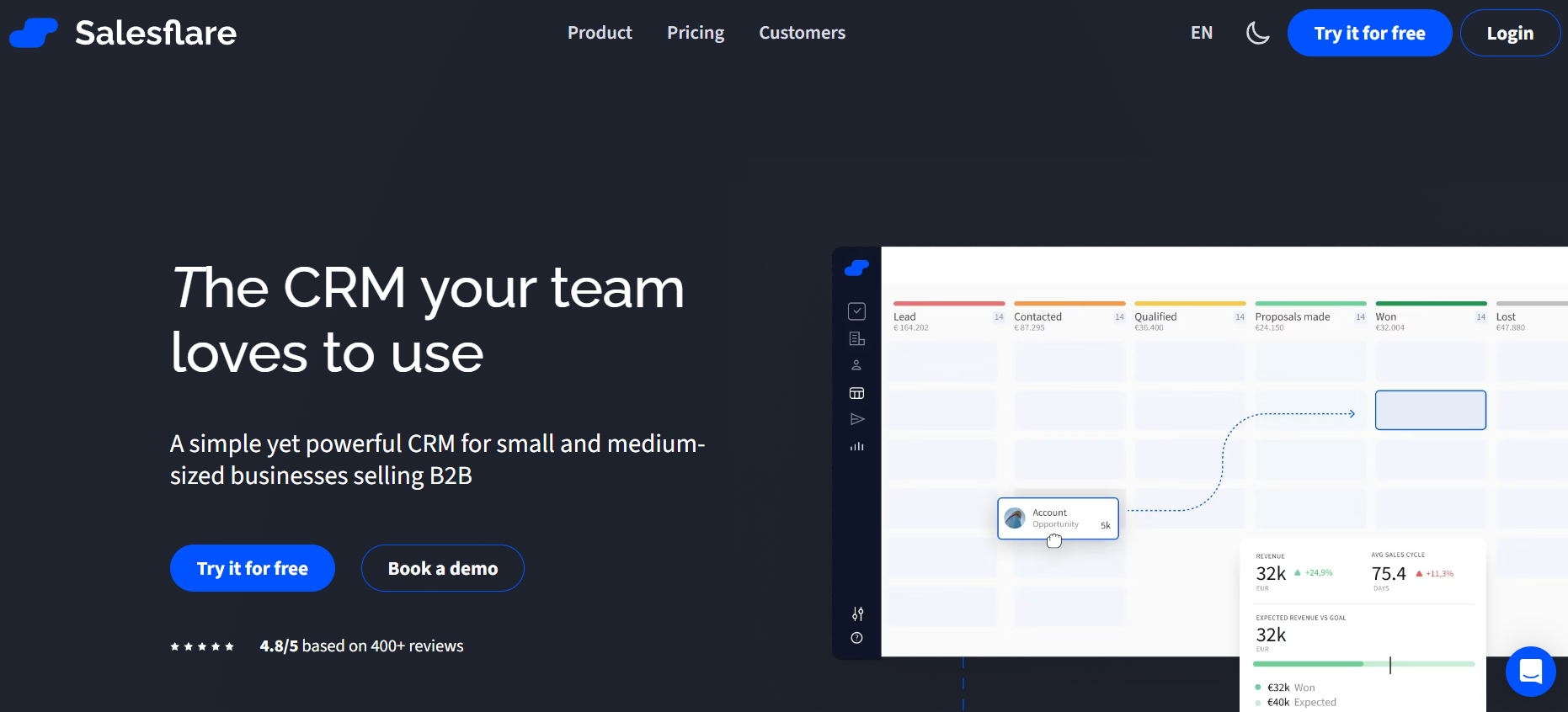
Best for: B2B sales teams that want maximum automation with minimal manual data entry, and need a CRM that keeps itself updated without requiring rep discipline to maintain.
Salesflare is built around one specific problem: most CRM data is inaccurate or incomplete because sales reps do not enter it consistently. The platform addresses this by pulling data automatically from email, calendar, phone, and LinkedIn interactions to populate contact records, track deals, and prompt follow-ups without manual input.
For B2B companies where reps are selling actively and cannot afford to spend time on data hygiene, that automation-first approach has real daily value. The average salesperson spends 13 hours per week on admin tasks according to SuperOffice research. Salesflare is designed to remove as much of that as possible.
The Enterprise version is priced at $99 per user per month. The limitation worth noting is scale. Salesflare works well for focused sales teams in B2B environments where the primary users are salespeople. For large organisations with complex multi-team access requirements, heavy marketing workflows, or sophisticated reporting needs, the platform's enterprise depth is thinner than Salesforce or HubSpot.
Enterprise price: $99 per user, per month.
Ideal for: B2B sales teams that lose data quality to inconsistent CRM usage and want a platform that maintains itself, rather than one that relies on rep discipline to stay accurate.
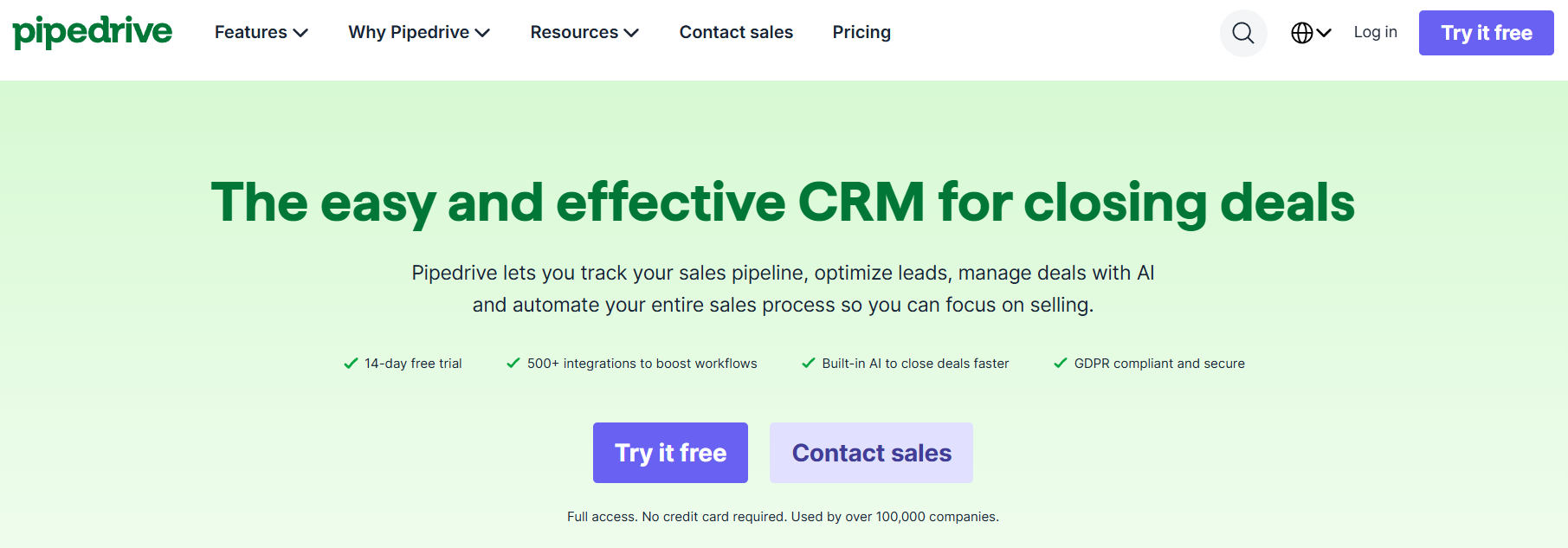
Best for: Sales-first B2B teams that want a visual, intuitive pipeline management tool that is easy to onboard and genuinely easy to use every day.
Pipedrive was built for salespeople, not for operations teams or marketers. The visual pipeline interface is the defining feature: every deal is represented as a card that moves through stages, giving reps and managers an immediate, clear view of where everything stands without needing to build a custom report.
For B2B sales organisations where the CRM's primary job is pipeline management and follow-up tracking, Pipedrive delivers that well. The platform is easy to onboard, easy to customise at the deal and contact level, and integrates with a wide range of third-party tools. The Enterprise version is priced at $99 per user per month.
The limitation is cross-functional breadth. Pipedrive is not built for marketing-sales alignment, complex customer success tracking, or multi-department data access. One reviewer noted directly that if your sales process requires others outside the sales team to use and share information from the CRM, Pipedrive is not designed for that. For organisations where the CRM needs to serve marketing, customer success, and operations alongside sales, a more expansive platform is the better fit.
Enterprise price: $99 per user, per month.
Ideal for: B2B sales teams whose primary CRM requirement is pipeline visibility and daily deal management, and where marketing and customer success have separate tooling.
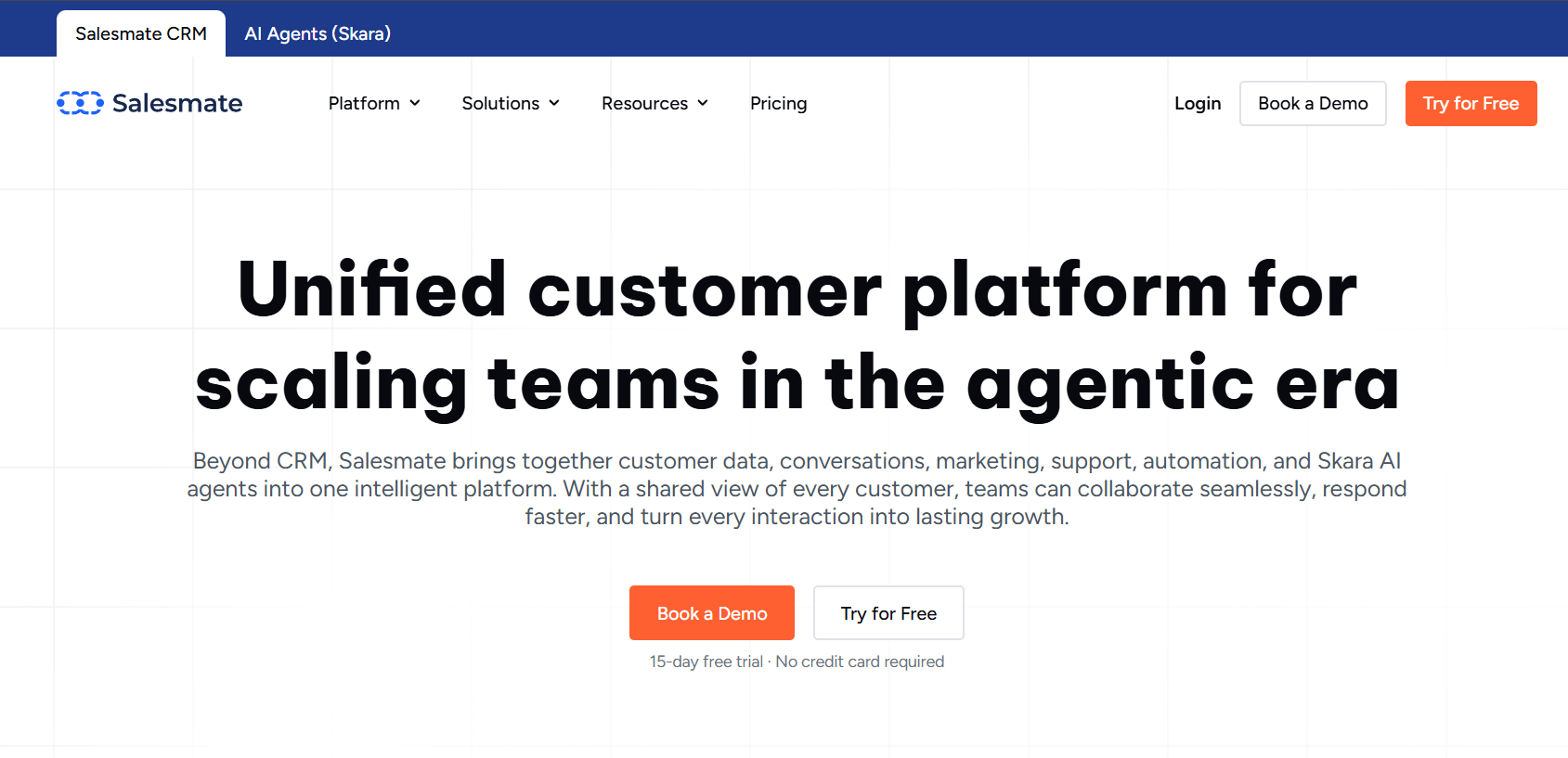
Best for: Distributed and remote B2B sales teams that need built-in calling, automated email campaigns, and mobile-first access to pipeline data from anywhere.
Salesmate is a cloud-based, mobile-first CRM built around the reality that many B2B sales teams are no longer office-bound. Built-in calling, personalised messaging, and sales automation features mean the platform functions as a combined CRM and outreach tool rather than a database that requires a separate dialling or email solution on top.
For teams running cold outreach alongside pipeline management, the automation capability is practical. Automated email sequences can be built and sent from within the platform, with open and engagement tracking included. That removes the need for a separate sales engagement tool for teams at earlier stages of their outbound infrastructure.
Salesmate's enterprise version is priced by request, which means total cost needs to be evaluated directly against your team size and required feature set. The trade-off versus Salesforce or HubSpot is depth of analytics and reporting. For organisations that need sophisticated forecasting, complex attribution, or multi-territory sales reporting, Salesmate's reporting capability is lighter than the top-tier enterprise platforms.
Enterprise price: By request.
Ideal for: Remote and field-based B2B sales teams that need CRM, calling, and email automation in one mobile-accessible platform without managing a separate outreach tool.
The feature list is the least important part of the decision. The questions that actually determine whether a CRM delivers ROI are operational.
1. Will your reps actually use it? CRM adoption is the most cited implementation problem across the market. Companies with full CRM adoption report a 30% productivity uplift. Companies with partial adoption leave the majority of that on the table. If the platform is too complex for consistent daily use, it will not perform regardless of its feature set.
2. Does it integrate with your current tech stack? A CRM that does not connect to your outreach tools, marketing automation, or customer success platform creates data silos that undermine the investment. Check integrations with the specific tools your team already runs rather than just general category support.
3. Who owns the data, and how clean is it? According to Gartner, 40% of agentic AI CRM projects will fail or stall by 2028, and in almost every case the cause is data quality rather than the AI technology itself. Whatever platform you choose, data hygiene is the prerequisite for performance. The best enterprise CRM in the market will underperform on dirty or incomplete data.
4. What does the full cost look like at your user count? Base pricing per user is rarely the total cost. Add-ons, integrations, onboarding, and admin overhead all affect the real number. Model the cost at your current team size and at where you expect to be in 18 months before making a comparison.
5. How does it connect to your outbound pipeline function? A CRM that is well-integrated with your SDR outreach activity gives sales managers continuous pipeline visibility rather than a static snapshot at the end of each week. CRM and outbound work better when they share the same data in real time. If your outsourced SDR team is updating leads directly in the CRM, that connection is the difference between a live pipeline view and a delayed one.
A CRM is only as valuable as the quality of the data going into it. For B2B sales teams running outbound prospecting, the handoff between SDR activity and CRM visibility is where pipeline accuracy is either maintained or lost.
When SDRs work directly within an organization's existing CRM, whether it's Salesforce, HubSpot, Pipedrive, or another platform, every touchpoint, call, email, and LinkedIn interaction can be logged in real time. Meetings appear in the pipeline as soon as they are booked, and qualification notes remain attached to the contact or opportunity record as it moves into the account executive's workflow. This eliminates the need for manual data entry and reduces the risk of incomplete or outdated records.
This level of integration enables sales managers to forecast with greater confidence, monitor follow-up on marketing-qualified leads (MQLs), and maintain a clear view of where opportunities sit within the sales funnel at any given time. Without accurate, timely data flowing from outbound sales activities, a CRM becomes a record of past activity rather than a reliable tool for managing active revenue generation.
When evaluating CRM software or optimizing an existing implementation, it is worth considering how well outbound prospecting workflows integrate with the platform. Strong CRM adoption depends not only on the software itself but also on consistent processes that keep customer data complete, current, and actionable across the sales organization.