

B2B Insights

Lauren Daniels
September 10, 2026

Revenue intelligence uses AI to turn sales and buyer interaction data into actionable insights for better forecasting and deal management. It is a fundamentally different approach to how the deal data gets into the system, how it gets analysed, and what happens as a result.
The problem it solves is specific and expensive. Sales reps do not update the CRM after every call. Research shows that up to 79% of deal-related data collected by reps never makes it into the CRM. Decisions rely on incomplete data and rep-reported activity rather than what buyer behaviour actually shows.
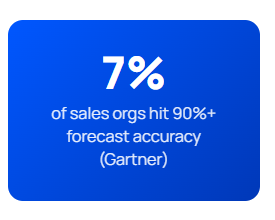
As a result, forecasts and decisions often rely on incomplete records and self-reported activity rather than actual buyer behaviour. Only 7% of sales organisations achieve forecast accuracy above 90%.
Revenue intelligence platforms address this by automatically capturing and analysing interactions for buying signals, objections, competitive mentions, and qualification gaps. They can update CRM fields, draft follow-ups, and flag deal risks without requiring reps to manually log every interaction.
In December 2025, Gartner published its first Magic Quadrant for Revenue Action Orchestration, recognising the convergence of sales engagement, conversation intelligence, and revenue intelligence. This reflects how revenue intelligence is becoming an increasingly important part of evidence-based sales management.
Revenue intelligence typically works across different stages, moving from capturing deal activity to analysing signals and automatically acting on them.
Platforms automatically capture data across buyer touchpoints. This includes call recordings and transcripts from Zoom, Teams, and phone. It also captures email content, response times, thread depth, and stakeholder engagement. Calendar activity, such as meeting frequency and attendee changes, is included too. So is CRM history.
Unlike traditional reporting, this happens without relying on reps to manually log activity.
The analysis layer turns raw conversations and activity into structured insights. It identifies buyer signals such as pain points, budget, timelines, and decision criteria, while also measuring engagement through talk-to-listen ratios, stakeholder involvement, and question depth.
It can also detect risks such as declining engagement or missing decision-makers, score deal health, flag MEDDPICC or BANT gaps, and compare deal progression with historical win/loss patterns.
These insights are translated into workflows people can act on. Reps get call summaries, CRM updates, follow-up drafts, and pre-meeting briefs. Managers get call-specific coaching, deal-risk alerts, and performance patterns, while revenue leaders get pipeline health assessments, conversation-based forecasts, and segment-level analytics.
Leading platforms go beyond surfacing insights by acting on them automatically. CRM fields are updated after calls, follow-ups are drafted in the rep’s tone, deal risks are flagged before pipeline reviews, and pre-meeting briefs are built from past interactions and CRM data. Analytics shows what happened. Intelligence shows what to do. Automation does it for you.
Revenue intelligence vs CRM
A CRM is a system of record that stores entered data. Revenue intelligence adds data from actual buyer interactions, analyses it, and triggers actions. It makes it more accurate and useful.
Revenue intelligence vs conversation intelligence
Conversation intelligence records and analyses sales calls. Revenue intelligence goes further by combining conversation data with emails, calendars, CRM history, and pipeline activity to provide a broader view of deal health.
Revenue intelligence vs sales engagement
Sales engagement tools automate outbound activities such as emails, calls, and tasks. Revenue intelligence analyses what happens across those interactions to identify signals, risks, and opportunities.
Revenue intelligence vs sales analytics
Sales analytics explains what happened using historical data. Revenue intelligence looks ahead by using current buyer behaviour, conversation signals, and engagement patterns to predict what is likely to happen next.
Gartner named Gong a Leader in its inaugural Magic Quadrant for Revenue Action Orchestration, placed highest on both completeness of vision and ability to execute.
Gong's core strength is the depth of its conversation analytics and the scale of its benchmarking data. It records and transcribes calls, surfaces coaching moments and competitive mentions. It also measures engagement quality across deals, and flags risk signals when buyer behaviour changes. Gong Forecast provides pipeline visibility and deal scoring. Gong Engage adds sales engagement automation.
The trade-off is cost and complexity. For early-stage or mid-market companies, the cost structure is prohibitive relative to the specific capabilities needed.
Best for: Enterprise sales organisations of 100 or more reps with dedicated RevOps teams and a CRO who prioritises cross-organisational conversation benchmarking and leadership-level pipeline reporting.
The Clari-Salesloft merger, closed in December 2025, created what the combined company describes as the largest Revenue AI company in the category. Clari brings best-in-class pipeline forecasting, deal inspection, and revenue management.
Salesloft brings sales engagement: sequencing, cadences, and workflow automation. Combined, they offer the broadest platform spanning outbound engagement through pipeline analytics to board-level forecasting.
Gartner named Clari a Leader in its inaugural Revenue Action Orchestration Magic Quadrant. Enterprise customers include Adobe, IBM, 3M, and Zoom. The platform's forecasting depth and revenue orchestration capabilities are the strongest in the category for organisations where the primary buyer is the CRO.
The trade-off is that the merger is recent and full platform integration is still evolving. Enterprise pricing requires a sales conversation. Implementation complexity makes it inaccessible for most mid-market teams. Conversation intelligence depth lags behind Gong's.
Best for: Enterprise revenue teams of 200 or more reps that need unified engagement and pipeline management under a single vendor, with forecasting accuracy and pipeline inspection as the primary revenue intelligence use case.
ZoomInfo combines B2B intelligence with revenue operations to provide prospecting, engagement, and deal tracking from one platform. The GTM Context Graph connects external intelligence with CRM data, conversation intelligence from Chorus, and engagement signals.
ZoomInfo Copilot acts as an AI assistant that surfaces account insights, recommends next actions, and automates workflow steps based on buying signals. GTM AI provides a model context protocol layer that connects ZoomInfo's B2B intelligence to any agent or LLM-based tool. Chorus conversation intelligence records and analyses sales calls to surface objections, competitor mentions, and coaching moments.
The primary differentiation is the combination of prospecting data and revenue intelligence in one platform, which removes the need for a separate data provider alongside a standalone revenue intelligence tool. ZoomInfo serves over 35,000 businesses and maintains enterprise-grade compliance including GDPR, CCPA, and SOC 2 Type II.
Best for: Enterprise and mid-market teams that need both prospecting data and deal intelligence, and want to reduce tool sprawl by consolidating data sourcing and revenue analytics under one vendor.
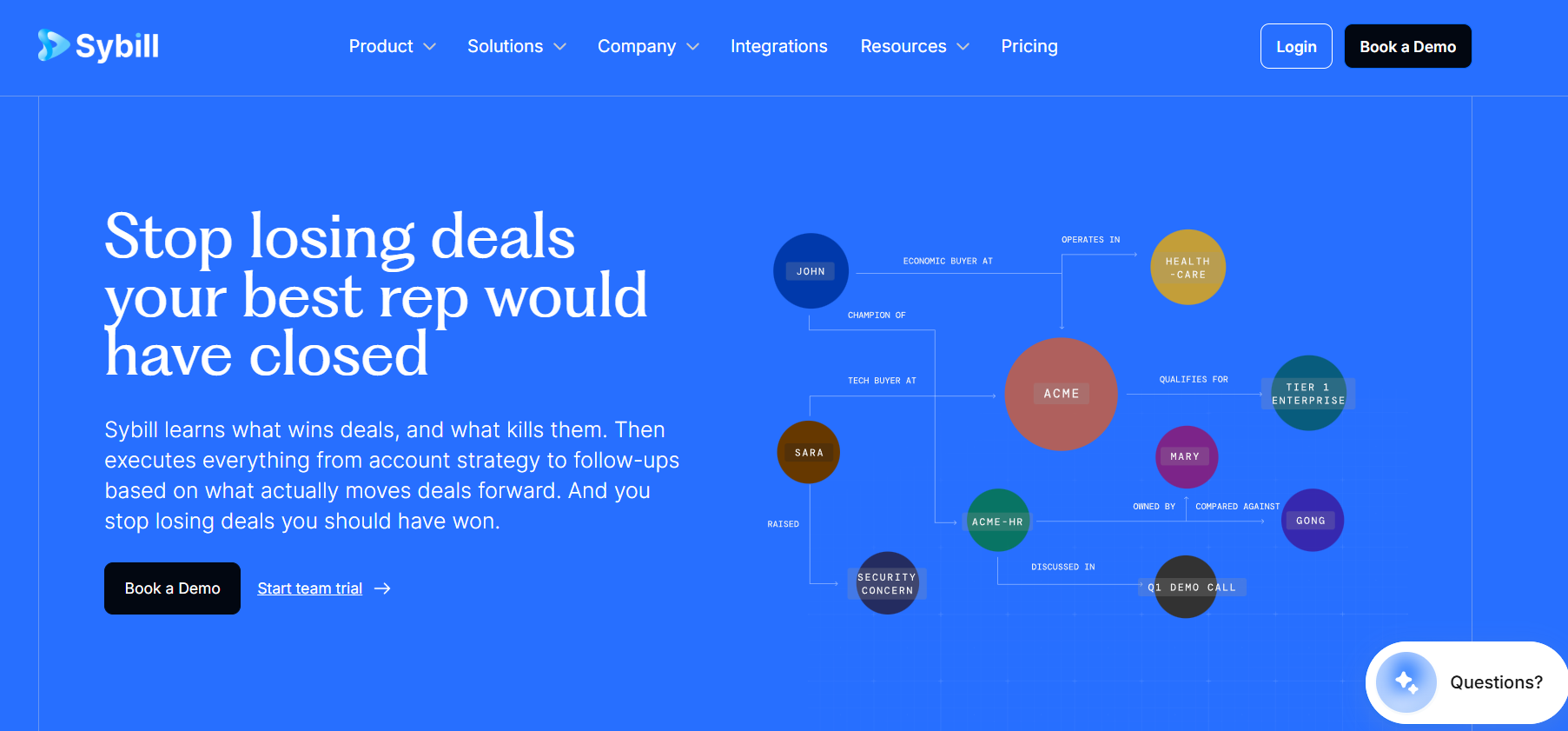
Sybill occupies a unique position in the revenue intelligence landscape. Sybill leads with the execution layer: the automated post-call workflows that make both analytics and forecasting work in the first place.
CRM Autofill writes structured updates into 30 or more fields in Salesforce, HubSpot, Zoho, or Dynamics 365 after every call and email. Magic Summary generates structured call outputs within minutes. AI follow-up emails draft in the rep's voice. Pre-meeting briefs assemble deal context automatically. Ask Sybill enables cross-deal querying in natural language.
The combination of capability and accessibility makes Sybill relevant for teams that cannot justify enterprise pricing but need the CRM data quality and execution automation that underpins everything else.
Best for: Sales teams of 5 to 200 reps that want every call to produce complete, structured CRM data, automated follow-ups, and deal intelligence without RevOps infrastructure or enterprise budgets.
People.ai specialises in automatically capturing seller activity from email, calendar, Zoom, Teams, and Slack, then using AI to map those interactions to accounts and opportunities in the CRM. It gives RevOps and leadership visibility into rep activity without requiring reps to log anything manually.
The distinction from conversation intelligence platforms is that People.ai captures activity metadata rather than conversation-level intelligence. It is a complementary layer for organisations where the primary gap is knowing how much activity is happening on each deal, not what was said in those conversations.
Best for: Large enterprise organisations of 500 or more reps that need comprehensive activity capture and CRM enrichment as the foundation for pipeline analytics, with RevOps teams who can operationalise the data.
HubSpot Sales Hub provides CRM-native revenue intelligence for teams already in the HubSpot ecosystem. Deal tracking, forecasting, conversation intelligence, and pipeline analytics are built directly into the CRM, eliminating integration complexity. Revenue intelligence capabilities are strongest in Professional and Enterprise tiers.
Aviso AI positions as an agentic AI platform combining predictive forecasting with AI-powered workflows and deal scoring. The platform claims 98% forecast accuracy and includes 30-plus agentic workflows for revenue use cases. Primarily serves data-driven sales organisations that want autonomous AI execution across their pipeline.
Revenue Grid provides guided selling capabilities within a Salesforce-native environment. Automated email sequences, activity capture, and pipeline management operate entirely within the Salesforce interface. Relevant for organisations where Salesforce is the primary working environment and the goal is guided selling without leaving that system.
The right platform depends on the revenue problem you need to solve most urgently.
If your priority is CRM data quality and post-call execution, look for automated CRM updates based on conversation data. Sybill and People.ai address this through automated field population and activity capture.
If your priority is forecast accuracy and pipeline visibility, choose a platform that uses deal progression and buyer engagement signals rather than rep-submitted data. Clari, Gong, and Aviso AI take this approach through forecasting and deal scoring.
If your priority is conversation quality and coaching, look for deep call analytics, coaching tools, and insights into which conversation patterns correlate with wins and losses. Gong, ZoomInfo’s Chorus, and Clari’s Copilot offer these capabilities.
If your priority is connecting prospecting with pipeline intelligence, consider platforms that combine buyer intent, contact data, conversation intelligence, and deal tracking to reduce data gaps between prospecting and pipeline management.
If cost and time to value matter most, consider implementation time and pricing alongside features. Platforms such as Sybill focus on faster deployment without the overhead of larger enterprise systems.
3 evaluation criteria that apply regardless of platform:
1. Data accuracy: Everything depends on the quality of the data captured and analysed. Ask about contact and company data refresh rates, transcription accuracy, and how the platform handles buyer activity outside its integrations.
2. Integration depth: The platform should fit into existing workflows without requiring reps to change their behaviour. Ideally, it should read from and write to the CRM automatically, with minimal direct interaction required from reps.
3. Action capability: The key difference between analytics and intelligence is what happens after insights are generated. Evaluate which actions the platform automates and which require human intervention, rather than focusing only on dashboards and reporting.
Three trends are shaping the next 12 to 24 months of this category.
From insights to autonomous execution
Revenue intelligence is moving from analysing deals to acting on them. The next wave will bring autonomous revenue agents that identify risks, recommend interventions, execute outreach, and adjust forecasts in real time. Gong, Clari, and Aviso AI are already moving in this direction.
Consolidation into fewer platforms
The Clari-Salesloft merger and Gartner’s Revenue Action Orchestration framework reflect a broader shift toward platform consolidation. Buyers increasingly want fewer tools, while vendors are combining capabilities through acquisitions and product expansion. Standalone conversation intelligence is increasingly becoming a feature rather than a category.
CRM as a data layer, rather than the primary interface
Revenue intelligence is shifting the CRM from a system reps actively manage to a data layer that AI platforms read from and update automatically. Salesforce’s Agentforce strategy reflects this direction. As AI becomes more capable of acting on CRM data, data quality becomes even more important.
Revenue intelligence platforms depend on the quality of the pipeline data that flows through them. A forecasting model is only as accurate as the deals it is analysing. A conversation intelligence platform is only as useful as the calls being recorded. An execution layer that auto-populates CRM fields is only as valuable as the qualification depth in those calls.
That connection directly impacts revenue intelligence. When SDRs add qualification notes, buying triggers, and stakeholder context, the platform has stronger signals to work with.
Without that context, re-qualification starts from scratch, and signal quality suffers.
If you want to understand how a structured outbound SDR function connects to better pipeline quality for your revenue intelligence platform, book a call with the Whistle team and we will map it out for your specific situation.