
B2B Insights

Kayla Tait
November 13, 2026

Your SDR agency is booking meetings, but your pipeline is going nowhere.
You have reviewed the reports, raised concerns and given the team another chance. The agency says it needs more time, more data or a different approach. Meanwhile, your account executives are still prospecting, your sales targets remain unchanged, and leadership wants answers.
For a founder or sales leader at a growing B2B software company, this creates an awkward decision. Do you keep trying to fix the relationship, or cut your losses and find another provider? Marketing leaders face the same problem when they own sales development and need to explain why activity is not translating into qualified opportunities.
But before you make that call, find out what is failing. The agency may be targeting the wrong accounts, using weak messaging, sending poorly qualified meetings to your sales team or working with inadequate data. Your internal team may also be contributing to the problem through unclear expectations, slow feedback, or inconsistent follow up.
Switching underperforming SDR agency relationships without a diagnosis can leave you with the same problems and a new invoice. A structured review gives you evidence to decide whether the current provider can recover, what needs fixing first, and whether a transition is justified.
This playbook gives you a 60-day framework to investigate performance, agree on corrective action and move to another provider if necessary. For businesses switching underperforming SDR agency partners, the priority is to establish whether the problem is recoverable before committing to a new provider.
Start by separating disappointing results from any evidence of a broken process. Recent outbound performance data reinforces why activity alone is a poor measure of success. In its State of Outbound Lead Generation report, published in May 2026, Abstrakt Marketing Group revealed a 28.1% year-on-year reduction in outbound dials in 2025, while qualified appointments declined by just 3.6%. Dials per qualified appointment fell from 191 to 142. Although these figures reflect one provider’s client portfolio rather than the wider industry, they demonstrate why businesses should assess targeting, qualification and conversion and not just how much outreach an SDR agency completes.
A slow month does not automatically mean the agency is failing. But, a repeated pattern of poor quality work, missing information, and no credible corrective action deserves closer attention. An underperforming lead gen agency will often show a disconnect between reported activity and actual pipeline contribution. Look beyond the number of meetings booked to understand whether the agency is reaching the right buyers and generating commercially relevant conversations. Look for these signals:
A full calendar can conceal a weak programme. Your team needs to know how many meetings are held, how many meet the agreed qualification criteria, and how many progress into sales opportunities. Read about qualified SDR agency meeting benchmarks to understand why these measures need to be assessed separately.
The good news is underperformance can be diagnosed. The not-so-good news is you may not yet know which part of the operation needs fixing.
Image 1:
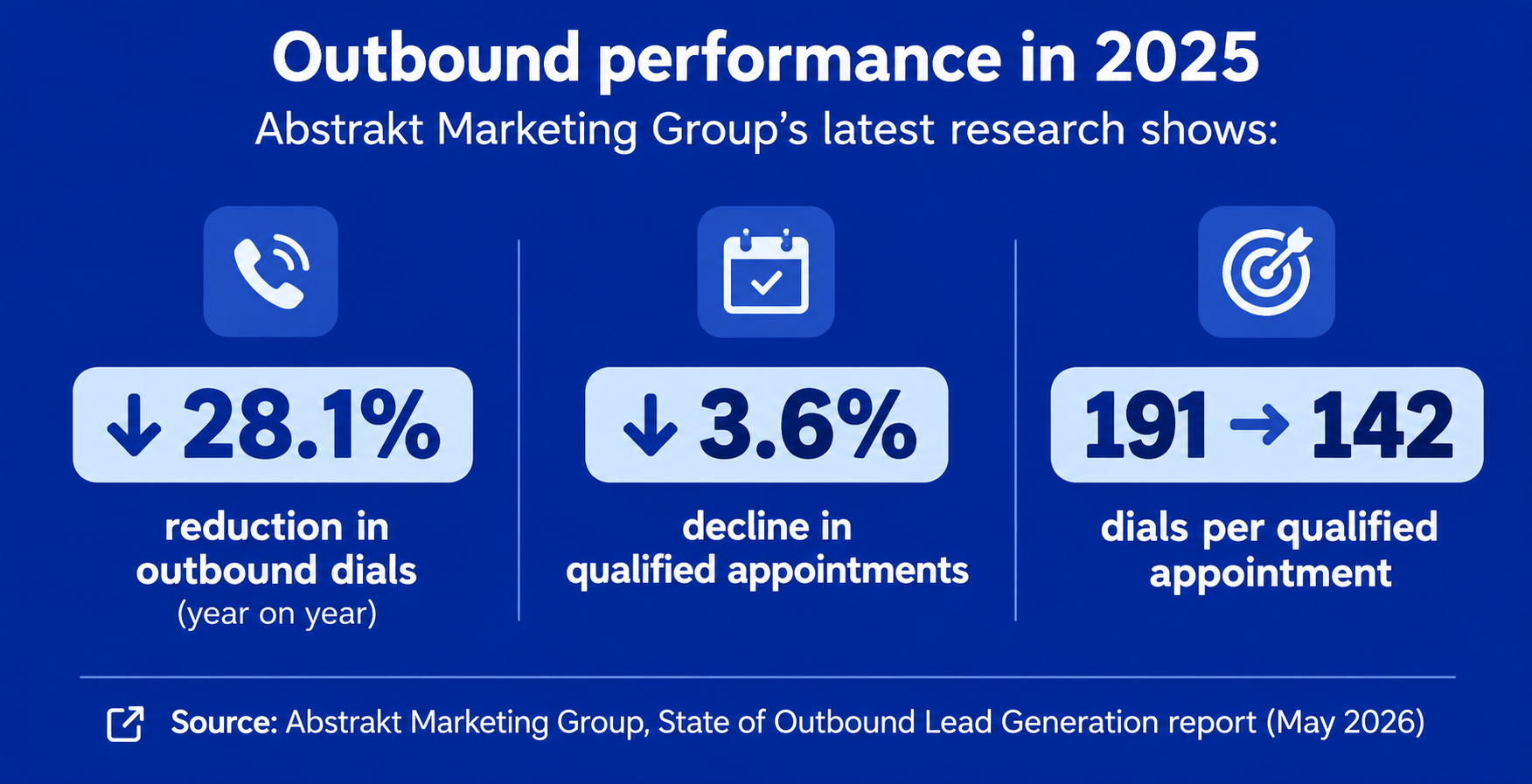
Alt text: SDR agency performance data showing declining outbound activity and qualified appointments, with improved dial efficiency in 2025.
Source
Treat the first month as an investigation and corrective-action period. Use the next month to establish whether the changes are working, and prepare an orderly exit if the evidence supports one. A structured approach to switching underperforming SDR agency partners starts with evidence, not a termination notice.
Setting realistic performance expectations also plays an important role. The Bridge Group’s SDR Motions, Models & Metrics research of 2025 found that only 60% of SDRs were achieving quota. This was reported to be the lowest share recorded in the study’s history. Although this benchmark covers SDR teams generally rather than outsourced agencies alone, it highlights the importance of measuring performance against clear targets and commercial outcomes, rather than treating activity levels as proof of success. The objective is to identify what needs fixing, establish accountability and make an informed decision about the next step.
Request four weeks of performance data before debating the agency's explanations. Ask for the numbers by rep, campaign, segment, and channel wherever the reporting supports it. At a minimum, collect:
Do not accept "it isn't working" as a diagnosis. Ask where conversion drops, when it began, and whether the problem affects every segment or only specific campaigns.
Agree on definitions before comparing results. A booked meeting is not the same as a meeting held, and neither does it automatically qualify as a sales opportunity.
Review the ICP the agency was given, the segments it is targeting and the accounts that have recently converted into customers. Ask whether the programme is reaching people with a plausible reason to buy.
For example, an IT Director at a software company may be a relevant contact, but relevance depends on the product, the company's requirements, and the problem being addressed.
Check for:
Review recent closed-won accounts alongside rejected meetings. The comparison may reveal a missing qualification criterion or an ICP that is too broad.
Listen to 10 to 15 calls across the team. Include calls that led to meetings, calls that ended quickly and conversations where the prospect raised an objection. Score each call against a consistent set of criteria:
Review emails and LinkedIn messages alongside calls. Check whether the copy reflects the buyer's role, references a credible problem, and gives the prospect a clear reason to respond. If the data is accurate but conversations consistently stall, adding more contacts will not solve the messaging problem.
Check whether the team can execute the agreed strategy with the systems available to it. Review contact accuracy, data enrichment, CRM integration, email deliverability, suppression lists, campaign setup and reporting access. Confirm who owns the sending infrastructure and prospect records, and whether the team can access the information needed to follow up properly.
An agency may be working hard with a poor list or an unreliable process. Fix those constraints before judging individual reps.
Image 2:

Alt text: Sales professionals auditing an SDR agencies strategy, execution quality and other tasks.
Ask who coaches the SDRs, reviews calls, approves messaging, and follows up on performance gaps. Clarify if there is a documented ramp plan and whether the agency has acted on previous feedback. Then review your own operating process.
Have you supplied accurate product information? Are the ICP and qualification criteria documented? Does your sales team attend meetings promptly, update the CRM and explain why leads are rejected? Are messaging approvals taking so long that campaigns lose momentum?
These questions are important because an agency cannot correct a problem it cannot see. You need clear ownership on both sides before deciding who is accountable for the failure.
Use this worksheet in your performance review. Record evidence rather than relying on impressions, and assign an owner to every corrective action.
For each gap, add four details to your working copy: the evidence, the likely cause, the agreed action and the date for reviewing the result.
Look for patterns across the worksheet.
If the list is wrong, fix targeting and data before judging the callers. If the list is sound but conversations fail, investigate messaging and rep skills. If meetings happen but opportunities do not follow, examine qualification and handover quality.
If several gaps appear together, prioritise the dependencies. Poor data can distort your messaging results. Weak qualification can make a capable rep look ineffective. Slow client feedback can leave the agency repeating a mistake for weeks.
The worksheet should lead to a specific diagnosis and a testable corrective action. If the agency cannot explain the cause, or repeatedly refuses to provide the evidence needed to assess it, that is part of the diagnosis too.
Once you know where performance breaks down, fix the constraints in the order that gives the rest of the programme a fair chance to work.
Start with problems that affect every sales rep or campaign. Correct the ICP, rebuild inaccurate lists, resolve access or deliverability problems, and check whether the assigned team has enough time to complete the work. These are foundational decisions. Coaching a rep to personalise outreach will not help if the contact list contains the wrong buyers.
Once the underlying inputs are reliable, address what happens during outreach. Rewrite weak messaging, practise call openings, review objection handling, and set clear expectations for next steps.
Change one major variable at a time where practical. If you change the list, script, channel mix, and team simultaneously, it becomes harder to identify what improved performance.
Finally, establish a repeatable review process. Decide who monitors the numbers, who coaches the reps, how feedback reaches the agency and when the two teams review corrective actions.
Do not confuse activity with recovery. Asking for more calls, adding another reporting meeting or replacing one rep without investigating the wider process can leave the root cause untouched.
Take the completed worksheet into the review meeting. Keep the conversation anchored to evidence and actions. Before you switch SDR vendor, make sure you have documented the reasons for the decision, the performance gaps that remain unresolved and the requirements your next provider must meet. Use this sequence:
Avoid turning the discussion into an argument about effort. The agency may be working hard. The question is whether its work is reaching the right people and progressing through your sales process.
You should leave the meeting with a shared diagnosis, a defined corrective action, and a date for reviewing the evidence. If the agency disputes the findings, agree on what data will settle the disagreement.
For a broader checklist of vendor accountability, explore the questions to ask an outsourced SDR company and red flags to watch out for.
A 60-day transition playbook needs decision points. These checkpoints are a suggested operating framework, not a guarantee that every sales cycle will show mature pipeline results within two months.
Review whether the agreed action has been completed. If the issue was poor targeting, inspect the revised list. If it was messaging, listen to new calls and review the responses. If it was qualification, examine the latest handovers against the written criteria.
Look for early evidence of improvement, such as better contact accuracy, more relevant conversations or fewer rejected meetings. Compare like-for-like segments and activity periods wherever possible.
If the agency has not completed the decided action, ask why. Record any dependencies or delays and decide whether there is a credible recovery plan.
Review the next set of results. Check whether the change is helping across the relevant reps or campaigns, or whether the improvement is limited to one isolated success.
Look for movement through the funnel, not just a rise in activity. Meetings should meet the agreed criteria, and the sales team should receive enough context to continue the conversation.
If the original problem persists, revisit the diagnosis. The proposed fix may have been insufficient, or the cause may have been identified incorrectly.
Use the evidence from both review periods to make a decision. Continue if the agency has corrected the main issues, reporting is transparent and performance is moving towards the targets you agreed on. Renegotiate scope if the programme is delivering useful work but the current model no longer fits your needs.
If you are considering an exit, use the warning signs listed below to assess whether the agency's performance issues justify ending the engagement. Document the decision and the reasons behind it. That record will help you evaluate the next provider without repeating the same assumptions.
One warning sign alone may warrant a conversation. But, a pattern of unresolved issues, missed commitments and missing evidence gives you a stronger basis to exit.
Check your agreement before giving notice. Review the notice period, termination provisions, outstanding payments, data-processing obligations, and any contractual restrictions.
A clean exit protects your prospect relationships, campaign history and ability to resume outreach with another provider.
First, give notice in writing. State the contractual basis, the effective date and the handover information you need. Keep the message factual and professional, even if the relationship has become frustrating.
Next, agree on a handover date and request the records required to continue the work:
Confirm ownership and access rights under your contract before transferring or retaining records. Revoke access to your systems when appropriate, and make sure data is handled according to your agreements and applicable requirements.
Do not agree to a paid extension simply because the agency says it needs more time. Consider one only if there is a specific deliverable, a defined end date, and a clear commercial reason to continue. Otherwise, put that time and money towards the transition.
Finally, avoid running overlapping outreach to the same prospects without coordination. Make sure the outgoing agency and incoming team understand which accounts are active, which contacts have been approached, and what follow up is due.
The next engagement should begin with fewer assumptions and clearer operating rules. If you need to replace outbound agency support, evaluate what the next provider can offer beyond meeting volumes. Look for a clearly defined operating model, transparent reporting, agreed qualification criteria and accountability for performance. Before signing, agree on:
Also decide which operating model fits your business. If you already have sales leadership, reliable infrastructure and a clear strategy, you may need an individual sales development rep to add capacity. If you need a team to manage outreach, data, messaging and reporting, a managed programme may be more suitable.
Do not select a replacement based on a promise of more meetings alone. Ask how the provider will define a qualified conversation, expose the work behind its reports and respond when the evidence points to a problem.
Replacing an underperforming SDR agency gives you an opportunity to reassess the operating model as well as the provider.
Whistle offers outsourced SDRs as a way to add sales development capacity. The fully managed programme is for businesses that want an SDR team supported by messaging and content strategy, multi-channel sequences, contact data, reporting, CRM integration support, a team leader and a dedicated customer success manager. The programme goes live in 10 business days, and most clients see their first meetings within two to three weeks of launch, though outcomes vary by segment and volume. Your internal sales team remains responsible for closing. SDRs available for hire suit teams that already have sales leadership and a working process. Whistle places a vetted SDR for you, and your team can set their daily priorities.
We recommend starting with the constraint you have identified. If your current agency is underdelivering, bring your diagnostic worksheet, the metrics you can share and the gaps you need to resolve. We can discuss whether our Outsourced SDR offering fits your requirements and what a practical engagement would need to cover.
Book a meeting with Whistle to discuss your current outbound setup and the next step for your team.
What does switching underperforming SDR agency relationships involve?
It means reviewing the current provider's results, identifying the cause of underperformance, agreeing on corrective actions and deciding whether to continue or move to another provider. A sound transition also includes contract review, data ownership and a documented handover.
When to replace an outsourced SDR agency?
Consider replacing the provider when agreed corrective actions repeatedly fail, qualification remains poor, reporting lacks transparency or the agency cannot explain how it will address the problem. Use performance evidence and contract terms to support the decision.
How long should you give an underperforming lead generation agency to improve?
There is no universal recovery period. The 60-day framework in this guide provides review points at days 30, 45 and 60, but the appropriate timing depends on onboarding, outreach volume, market complexity and sales-cycle length. Agree on milestones before the recovery period begins.
How to switch SDR vendors without losing pipeline?
Maintain access to CRM records, prospect history, meeting notes, campaign assets and follow-up tasks. Coordinate the outgoing and incoming teams, document which prospects have been contacted and prevent duplicate outreach. Check the contract and data-processing terms before transferring records.
Which metrics should you use to evaluate an SDR agency?
Track activity alongside connections, positive replies, meetings booked, meetings held, qualification, sales-accepted leads and opportunities created. Define each measure in advance and review conversion between stages, rather than relying on a single activity or meeting target.
Should you fix your current SDR agency or hire a replacement?
Try a corrective plan when the agency is transparent, responsive and able to identify a credible cause. Consider a replacement when the same issues persist, evidence remains unavailable or agreed actions are repeatedly missed. A diagnosis helps you avoid moving the same broken process to a new provider.
What should an SDR agency hand over when a contract ends?
The handover should cover prospect and account records, enrichment fields, CRM activity, campaign assets, call notes and recordings where available, meeting briefs, outstanding follow-ups and relevant reports. Confirm contractual ownership, access rights and any return or deletion obligations before the transfer.
Should you hire an individual SDR or choose a managed programme?
An individual SDR can suit a business with established strategy, data, tools and sales management. A managed programme can suit a business that needs the provider to coordinate outreach execution, messaging, data, reporting and operational support. Choose according to the capabilities your team already has and the work you need covered.