

Sales Development

Lauren Daniels
August 11, 2026

Buyers today receive dozens of cold emails, LinkedIn messages, and calls every day, and most of it looks identical. The SDRs who personalise are the ones who get replies.
Signal-personalised emails achieve 18% response rates compared to 3.43% for generic outreach, a 5.2x improvement. Yet only 5% of senders actually personalise every message, which means the opportunity is still wide open for teams willing to do it properly.
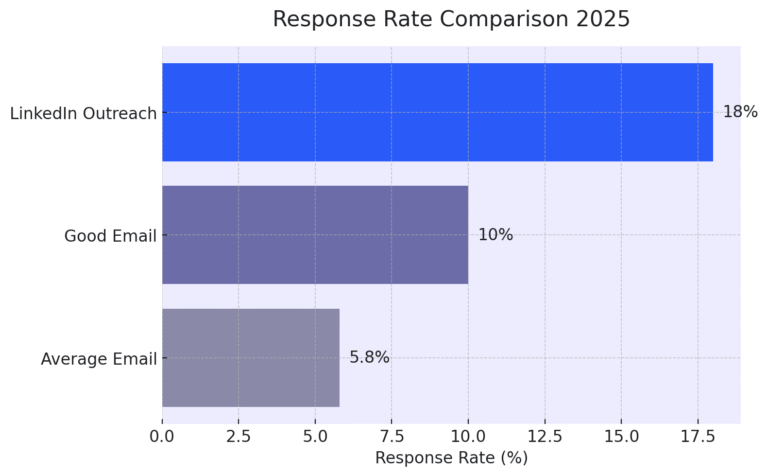
The question every SDR manager faces is not whether personalisation works. The data on that is clear. The question is how to personalise at scale without research eating the entire workday.
The average cold email reply rate sits between 3.43% and 5.1% across most B2B benchmarks, with generic campaigns at scale often falling below 2%. The gap between that baseline and what personalisation produces is not marginal. Highly personalised email bodies boost reply rates by 142% compared to non-personalised emails, moving from around 7% to 17%.
Smaller, targeted campaigns of around 50 to 100 recipients achieve an average reply rate of 5.5%, compared to 2.1% for campaigns over 1,000 contacts. Volume-first outreach is not just ineffective. It actively damages domain reputation and burns through total addressable market faster than the pipeline it generates can justify.
Only 5% of senders personalise every message. For teams willing to go beyond minimal effort, that gap represents a meaningful competitive advantage, because the inbox of any senior buyer is a place where genuinely relevant outreach stands out sharply against the background noise.
Personalisation also affects how prospects perceive the brand. Generic outreach does not just get ignored. It creates a negative association with the sender that is harder to recover from than a low reply rate.
SDR outreach personalisation works across a spectrum, and the right level for each prospect depends on account value, available data, and how much research time is justified. Applying the same depth of personalisation to every contact in a database is as much a mistake as applying none.
The baseline is showing that basic homework has been done before reaching out. This means referencing a recent company announcement, funding round, product launch, leadership hire, or expansion. It means tying the value proposition to the prospect's specific industry rather than using the same pitch across all verticals. If intent data shows the prospect has been visiting relevant content or a competitor's site, referencing it directly - something as simple as acknowledging they appear to be evaluating options in a specific category - tends to land well.
Tools that support this level include LinkedIn Sales Navigator for company updates, Bombora for intent signals, and Google Alerts for news tracking. The investment per prospect is low, which makes it the right default for high-volume outreach where individual research time cannot be justified.
Role-based personalisation moves beyond the company to the individual. The question it answers is what this specific person cares about given their role, not just what their company does. CFOs care about cost efficiency and ROI. VPs of Sales care about pipeline and conversion. Directors of Marketing care about attribution and lead quality. Every message should reflect which of these problems is actually relevant to the recipient.
Practical ways to understand a persona deeply include speaking to the same role internally, following relevant professional communities, and attending industry events where that persona gathers. What to reference in outreach: past company experience, shared connections, or recent activity on LinkedIn. Tools that support this level include Apollo.io for job history and enrichment and Crystal Knows for personality context.
This is the level that separates SDRs who consistently book meetings from those who generate activity without pipeline. It requires more effort but produces materially better results, with stacked signals, combining company trigger, personal context, and behavioural data, capable of pushing reply rates to 25 to 40%.
What it looks like in practice: engaging with a prospect's content before reaching out, because commenting on a LinkedIn post or article before the first message creates recognition that makes the subsequent outreach feel like a continuation rather than a cold approach. Quoting something specific the prospect said. Making the CTA feel personal rather than transactional, where asking whether something is worth a brief conversation consistently outperforms asking for a specific block of calendar time, because it requires less commitment to agree to.
Tools that support this level include Vidyard for personalized video, Lavender for email refinement, and Hyperise for custom images in outreach.
The most common objection SDR managers hear from reps is that there is not enough time to research every prospect at this depth. It is a fair concern if research is being done without a system. The fix is a structured three-minute process that looks for specific signals rather than attempting to learn everything about a prospect before reaching out.
LinkedIn, sixty seconds: check recent activity for posts, comments, or articles. Look at the About section for keywords related to the solution being sold.
Company website or careers page, sixty seconds: are they hiring for roles the solution supports? Did they publish a recent case study or announce a new product or expansion?
Intent data or tech stack, sixty seconds: are they using a competitor tool? Does a data source show above-average research activity in the relevant category?
If no strong hook surfaces in three minutes, the fallback is a role-based observation relevant to the prospect's function. That is still materially more relevant than a generic pitch, and it keeps the research investment proportionate to the account value.
AI tools used for research can save an average of 6.2 hours per SDR per week on manual writing and research tasks. The right framing is using them to surface signals faster, not to generate the final message wholesale. The distinction between AI-assisted research and AI-generated outreach matters more than most teams appreciate. For more on where AI genuinely improves the outbound process, Whistle's guide to B2B lead intelligence covers the signal layer that makes personalisation possible at scale.
Structure matters as much as the personalised detail. A strong hook with a weak transition loses the reader before the value proposition lands, which means the research investment produces no return.
The four-part message architecture that works: the hook, which is the personalised opening that signals specific knowledge about the recipient; the bridge, which connects what was noticed to why the outreach is happening, and where most SDRs drop the thread; the value, a single clear statement of what is solved and for whom rather than a feature list; and the ask, low friction and easy to say yes to.
Email length matters as much as structure. Emails between 50 and 125 words see 50% higher reply rates than longer messages. Say the relevant thing and stop.
The personalised P.S. line is underused and consistently effective. A custom P.S. referencing a LinkedIn post or piece of company news is the strongest single personalisation lever available in email, because a significant portion of recipients scroll to the end before deciding whether to read the body. A genuinely specific P.S. earns that read.
SDR outreach personalisation should extend across every channel in the sequence, not just the first email. Multi-channel outreach produces 250% better results than single-channel approaches, but only when the personalisation feels consistent across all of them. Three disconnected cold approaches on three different channels do not compound. They dilute.
A 10-day multi-channel sequence that keeps the personalisation thread consistent:
60% of replies in cold campaigns come after the first follow-up. Dropping off after one touch is where most pipeline is lost, not because the prospect was never interested but because the outreach stopped before the timing was right.
AI is genuinely useful in the personalisation workflow when it is doing the research and production work, not writing the final voice. 65% of B2B sales teams are now using AI for scalable personalisation, and AI-powered SDRs can send 300 or more personalised emails per day per rep compared to what is achievable manually.
What AI does well in the personalisation process: analysing LinkedIn profiles and surfacing relevant hooks quickly. Generating personalised images, showing a prospect's website on a laptop screen in the email thumbnail, which creates a pattern interrupt that boosts click-through. Producing personalised video where the background is dynamically replaced with each prospect's website or LinkedIn profile, creating the impression of a bespoke recording at scale. Summarising long documents like earnings reports or press releases into role-specific takeaways, so reps arrive at a conversation already knowing what matters to that specific prospect.
What AI should not do: write the final message without human review. Prospects can tell when a message was generated rather than written, and the trust damage is harder to recover from than a low reply rate. The right framing is AI as the research assistant and production engine. The human SDR provides judgment, tone, and the relationship that actually books the meeting.
Personalisation that feels intrusive backfires as reliably as outreach that feels generic. The practical boundary is publicly available professional information: company news, LinkedIn activity, industry content, job history. These are signals a prospect would reasonably expect a diligent seller to have noticed.
Referencing personal details from non-professional social accounts, private life events, or anything that would feel strange to bring up face-to-face crosses a line that creates a negative response rather than a meeting. The goal is for outreach to feel like someone did their homework on the professional context. Not like someone has been conducting surveillance.
Most SDR teams are not failing at outreach because they are not working hard enough. They are failing because they are running high-volume, low-relevance sequences and measuring success in emails sent rather than conversations started.
SDR outreach personalisation at scale is a system problem as much as a skill problem. It requires the right research process, the right message architecture, and the right tools working together. Any one of those elements in isolation produces improvement. All three together produce a different category of result.
Whistle's SDRs are trained to work this way: research-first, role-specific messaging, multi-channel sequences built on verified contact data, and accountability to meetings booked rather than activity metrics. If your outbound motion is generating activity but not generating pipeline, it is worth a conversation with the team about where the personalisation breakdown is happening.
What is SDR outreach personalisation?
SDR outreach personalisation is the practice of tailoring cold emails, calls, and LinkedIn messages to a specific prospect based on their role, company context, recent activity, or buying signals, rather than sending the same generic message to every contact on a list. It ranges from basic company-level references through to hyper-personalised outreach that combines multiple data points about a specific individual.
How much does personalisation actually improve cold email reply rates? Signal-personalised emails achieve an 18% response rate compared to 3.43% for generic outreach, a 5.2x improvement. Highly personalised email bodies specifically boost reply rates by 142% compared to non-personalised emails. Smaller, targeted campaigns of 50 to 100 recipients achieve average reply rates of 5.5%, compared to 2.1% for campaigns over 1,000 contacts.
How long should an SDR spend researching a prospect before reaching out?
Three minutes is the practical ceiling for most prospects. A structured process covers LinkedIn activity in sixty seconds, the company website or careers page in sixty seconds, and intent data or tech stack signals in sixty seconds. If no strong hook surfaces in that window, fall back to role-based personalisation rather than spending more time searching for a hook that may not exist.
How do you personalise outreach at scale without sacrificing quality?
The answer is a tiered approach matched to account value. High-value enterprise accounts justify hyper-personalisation with deep individual research. Mid-market volume plays work well with role and industry-level personalisation combined with strong segmentation. AI tools that surface signals and generate draft frameworks, reviewed and refined by the rep before sending, extend the reach of a personalised approach without requiring hours of manual research per contact.
Where does AI fit into SDR personalisation?
AI works well as a research assistant and production engine. It can analyse LinkedIn profiles and surface relevant hooks, generate personalised images or video backgrounds, summarise earnings reports and press releases into role-specific takeaways, and produce draft outreach frameworks for reps to refine. What it should not do is write the final message without human review. Prospects can tell when a message was generated rather than written, and recovering from that impression is harder than recovering from a low reply rate.
What are the best tools for SDR outreach personalisation?
For company-level personalisation: LinkedIn Sales Navigator, Bombora for intent signals, and Google Alerts for news tracking. For role-based personalisation: Apollo.io for job history and enrichment, Crystal Knows for personality context. For hyper-personalisation: Vidyard for personalised video, Lavender for email refinement, and Hyperise for custom images in outreach.
How do you personalise outreach across LinkedIn, email, and phone in a sequence?
The personalisation thread needs to feel consistent across all three channels rather than like three separate cold approaches. The first email carries the deepest personalisation. The LinkedIn connection request follows on the same day with a brief relevant note. The day three call references the email in the voicemail. Subsequent touches add new angles or value rather than repeating the same message. 60% of replies in cold campaigns come after the first follow-up, so the sequence needs to run long enough for timing to work in the SDR's favour.