

Sales Development

Lauren Daniels
September 21, 2026


Here is a scenario worth examining. An SDR books 200 meetings in a quarter. 42 turn into real opportunities. The AEs attribute the gap to poor qualification. The SDRs say the AEs are not following up fast enough. The CFO is looking at $293,000 spent on an SDR/AE pair and asking why so little of that pipeline is closing.
79% of leads die during SDR-to-AE handoffs because ownership is unclear, context does not transfer, and the prospect has to repeat their situation to someone who was not in the original conversation. The SDR built rapport and understood the pain. The AE walks in cold. The prospect's interest, which was real and time-sensitive, has cooled by the time the AE's calendar opens up.
The problem is that the model is often applied to sales motions where it creates more friction than it removes. A full-cycle sales rep who owns the deal from first call to signed contract does not have this problem. There is no handoff. There is no ownership gap. There is one person who knows everything about the account and is accountable for the outcome.
Choosing between a full-cycle sales model and an SDR/AE split is one of the highest-leverage decisions a sales leader can make.
The right answer depends almost entirely on your ACV, your sales cycle length, your deal complexity, and your team size. Get it right, and pipeline flows more predictably. Get it wrong, and you are paying for infrastructure that creates the exact inefficiencies it was supposed to eliminate.
A full-cycle sales rep owns every stage of the revenue process. They prospect, qualify, run discovery, present and demo, negotiate, close, and in many cases manage the account through initial onboarding.
The practical job description includes several responsibilities. Reps own the full sales cycle from prospecting and qualification to demos, negotiations, closing, and early customer relationship management.
The full-cycle sales rep model puts all that responsibility on one person and one relationship with the buyer. The buyer never has to meet someone new mid-deal. The rep never has to trust a handoff. The pipeline visibility is complete and continuous.
The tradeoff is real: full-cycle sales reps must balance prospecting activity with active deal management simultaneously.
When the pipeline is full, prospecting slows. When prospecting takes priority, deal quality can suffer. This is manageable at lower volumes and shorter cycles, but becomes difficult as deal complexity, cycle length, or volume increases.
Pros
Cons
The SDR/AE model divides the sales process at the qualification stage. SDRs handle outbound prospecting, inbound qualification, and meeting booking. AEs handle everything from the first qualified conversation through close.

The purpose of this division is specialisation. An SDR who only does outbound gets better at it. An AE who only runs discovery and closes gets better at those stages. Each role develops deeper capability in a narrower function than a full-cycle rep who splits attention across everything.
This specialisation produces measurable output when the conditions for it are right. SDR quota attainment sits at 63% on average, which is actually above the broader sales population average. Narrower focus drives better outcomes on both sides of the division when the division is correctly applied.
The median B2B SaaS team in 2026 runs 0.8 SDRs per AE. Enterprise teams selling above $100K ACV run a median ratio of 1.8:1. SMB teams selling under $20K ACV run 0.4:1. That spread directly reflects where the SDR/AE model adds value and where it does not.
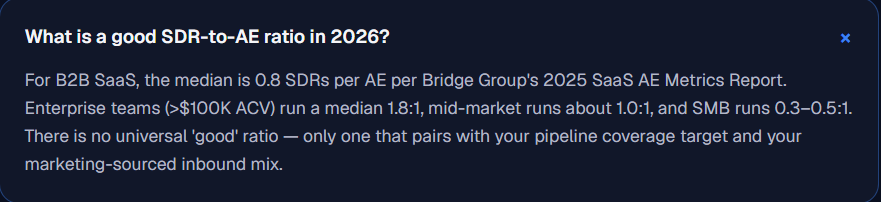
Enterprise deals with long cycles, large buying committees, and complex procurement need sustained prospecting and deep discovery happening simultaneously. The specialisation pays for itself. Short-cycle, lower-ACV deals do not have enough deal complexity to justify the handoff overhead.
Pros
Cons
The choice between a full-cycle sales rep structure and an SDR/AE split is a function of four variables: ACV, sales cycle length, team size, and deal complexity.
Go Full-Cycle when: Your ACV sits below $25,000, your sales cycle runs under 90 days, and your team has fewer than 10 reps. Below those thresholds, a full-cycle sales rep handles the end-to-end motion efficiently. The coordination overhead of a split SDR/AE structure is not yet worth the investment. A full-cycle AE also saves $85,000 to $110,000 annually versus an SDR/AE pair at equivalent output levels, and eliminates the handoff stage where most leads disappear.
Go SDR/AE when: Your sales cycle stretches past 90 days, your deal size crosses $100K, and your buying committee involves three or more stakeholders who need sustained, parallel outreach over months. Once cycles stretch past 30 days with multiple stakeholders, the split pays for itself because no single person can prospect at the required volume and run complex deals simultaneously without something slipping. The enterprise SDR/AE ratio of 1.8:1 reflects the prospecting volume required to keep AEs' calendars full in a 90-180-day cycle environment.
Go hybrid when: Your product serves multiple segments at different ACVs, your team is scaling past 10 reps, or your deal mix includes both transactional and enterprise motions. Tier 1 and Tier 2 accounts and complex deals go to AE-led relationships. Shorter-cycle and lower-ACV accounts go to full-cycle reps. Inbound high-intent leads go to fast qualification regardless of model. This is where most scaling B2B companies end up.
The SDR/AE model became the standard between 2015 and 2022 because the conditions that justified it were broadly present: scaling outbound volume, growing deal sizes, and the assumption that specialisation at every stage would compound performance.
Those conditions have shifted.
AI and automation have removed most of the administrative grunt work that made having a separate SDR function feel necessary. One GTM engineer running AI-assisted prospecting workflows can automate what 10 SDRs used to do manually.
AI handles account research that took 20 minutes in under 2 minutes. Waterfall enrichment delivers 80% or more of contact coverage automatically. Signal-based routing surfaces high-intent accounts and delivers them to reps ready for a conversation rather than requiring an SDR team to manually work a cold list.
In this environment, the full-cycle sales rep model has better economics for most mid-market B2B SaaS companies. The Cargo GTM analysis found that at the same $1.4 million headcount cost, a full-cycle team generates 28% more ARR than an SDR/AE split team and achieves 24% better cost per closed deal. The win rate improvement comes from a single rep owning the account from first conversation to signature, with no context lost and no trust rebuilt after a handoff.
The SDR/AE model remains the right structure when the scale of prospecting required genuinely exceeds what an AE can sustain alongside an active deal load. Enterprise teams with 90-180 day cycles and 10 or more active deals per AE need SDRs keeping the top of funnel moving while AEs focus on strategic selling. The ratio of 1.8 SDRs per AE at enterprise ACV reflects that genuine specialisation need.
The mistake is applying the enterprise model to SMB and mid-market motions where the same headcount investment in full-cycle reps produces better outcomes faster.
If your team is running an SDR/AE model and losing pipeline at the handoff stage, the issue is almost always structural rather than a performance problem with individual reps.
A functional SDR-to-AE handoff requires four things in the record before the AE's first call:
BANT works for shorter cycles. MEDDPICC provides the depth enterprise deals need.
When that information is not in the CRM before the handoff happens. The AE re-qualifies from scratch, the prospect repeats themselves, and the trust the SDR built erodes in the first five minutes of the AE's first call. The prospect's experience is of a disorganised vendor, rather than a specialist team.
The fix is operational: make the four fields above mandatory in the CRM before an SDR can mark an opportunity as qualified and hand it off.
If the information is not there, the handoff does not happen. That standard removes the ambiguity that causes pipeline loss and gives AEs what they need to continue the conversation rather than restarting it.
Same-day AE follow-up after a handoff is the minimum acceptable standard. Companies responding to qualified handoffs within one hour are significantly more likely to progress the deal than those where the AE picks up the file two or three days later.

One of the structural challenges for companies deciding between a full-cycle sales model and an SDR/AE split is that building either internally takes time and capital before pipeline output is visible.
A full-cycle rep who is also prospecting needs 60 to 90 days to reach productive output. An internal SDR hire costs more than $100,000 fully loaded before they have booked their first qualified meeting, and meaningful ROI from an internal SDR build typically takes six to twelve months.
Whistle's outsourced SDR model sits cleanly between both structures. For teams running a full-cycle model, Whistle's SDRs handle the prospecting and qualification layer that frees full-cycle reps to focus on discovery, demo, and close without the prospecting burden disrupting their deal momentum.
If your team is deciding between models and you want to understand how an outsourced SDR function connects to your specific ACV, cycle length, and deal complexity, book a call with the Whistle team and we will map it out for your specific situation.
The model a company runs should evolve as ACV, deal complexity, and team size change. An early-stage team of five reps selling a $15,000 ACV product with a 45-day cycle should run full-cycle. That same company at $50 million ARR selling a $90,000 ACV product into six-person buying committees should run an SDR/AE split.
The decision criteria are concrete.
If your average deal closes in under 90 days and your ACV sits below $25,000, start with full-cycle sales reps. The handoff overhead of an SDR/AE split costs more than it contributes at those parameters.
If your average deal takes more than 90 days, involves more than three stakeholders, and carries an ACV above $50,000, the SDR/AE model produces better outcomes. The specialisation at each stage genuinely compounds at that deal complexity.
If you have a mixed deal portfolio, run a hybrid. Full-Cycle reps handle lower-ACV, shorter-cycle segments. SDR/AE pairs handle enterprise and complex accounts. Do not force a single structure onto a motion that genuinely requires two.
The underlying principle is that the model should reduce friction in the buyer's experience and maximise the time each rep spends doing the thing they do best.
A full-cycle sales rep who spends 60% of their week prospecting while carrying an active deal load is doing neither thing well. An SDR/AE pair where the handoff produces a five-minute re-qualification call for the prospect is also doing neither thing well. The right model, properly implemented, removes both problems.