
Go-to-Market

Kayla Tait
October 16, 2026

Imagine you're the founder of a 30-person SaaS company. You’ve just signed an outsourced SDR contract with an agency after two strong calls. Three months in, your dashboard looks busy, but your pipeline does not. The report shows meetings booked, but only a few prospects actually show up, and fewer still match your ideal customer profile you defined. Then your team asks who owns the contact data, and nobody has a clear answer to give.
No, the agency did not lie. A promising sales development partnership can easily go off track when the contract says ‘qualified meeting’ without ever defining it, or lists activity targets without setting expectations for show rates and handovers.
The problem is most buyers ask for case studies and end up skipping the actual mechanics when it comes to deciding on an outsourcing agency. The management, alignment, ownership and what constitutes as an actual qualified meeting are all lost in translation at this point, and three mistakes show up repeatedly.
When you’re hiring a sales outsourcing company, the pitch deck is only the beginning. You need to understand who will do the work, how prospects will be shortlisted, what gets reported and what happens if results fall short.

Source: Unsplash
When hiring a sales outsourcing company, an agency can sell its service well and still be a poor fit for your sales motion. Case studies show what happened for another client. They do not tell you whether the agency can reach your buyers, use your CRM properly or work with your account executives. The fix is to ask about mechanics and get all the answers in writing. This guide gives you ten questions that do exactly that, along with outlining the answers that should worry you and a way to comprehend what you hear. It is written for founders, marketing leaders and sales leaders who own the result, irrespective of who manages the SDRs on a day-to-day basis.
Ask whether the sales development reps are employees or contractors. Find out where they sit, and which time zones they cover. Find out whether they have worked with companies like yours and whether staffing will stay stable. Figure out how long the team has been running outreach in your market and who will be leading your account. Location alone is not a warning sign, but unclear answers about staffing, coverage or responsibility are. Meet the account lead and, if possible, the people representing your brand.
A good answer reveals: Named roles, tenure and time zones.
Red flag to watch out for: Claims of a ‘dedicated team’ with no further details.
Ask how the outsourced SDR agency translates your ICP into a list of accounts and contacts, who approves the list before outreach begins, which channels they will use, what is the sequence and how will messaging change for different buyer roles?
Request to see a redacted sample list or campaign plan from a comparable engagement. It should explain account selection, along with list names. If your ICP is narrow, ask how the team will avoid filling the funnel with poor-fit companies.
A good answer reveals: A method that begins with your buyer.
Red flag to watch out for: Any answers that start with their database.
Ask the agency to name its data sources, explain how contact details are checked and describe how opt-outs are recorded. Establish who handles complaints, how long records are retained, and what happens to data when the engagement ends.
Rules around compliance depend on where you and your prospects operate. In the United States, the FTC says CAN-SPAM makes no exception for business-to-business email, and each non-compliant email can carry a penalty of up to $53,088. Hiring another company to send your email does not move your legal responsibility to them. In the UK, the ICO says a controller stays accountable for its processor irrespective of what the contract may state.
Get the relevant data-processing terms reviewed for your markets before launch. This is a commercial checklist, not legal advice.
A good answer reveals: Named sources and a written data processing agreement.
Red flag to watch out for: If the answer begins and ends at “We’re fully compliant.”
Define what a qualified meeting is before the first prospect is contacted. Your definition can include the prospect’s role, company size, relevant business problem, buying context, and what they have agreed to discuss. Criteria should reflect your ICP and sales process.
Put the definition in the contract or statement of work. Specify how exceptions are handled; including duplicate contacts, existing opportunities, wrong-fit prospects, and meetings booked without the required context. If the agency and your account executives disagree about the definition of a qualified meeting, there should be a documented way to resolve it.
A good answer reveals: Criteria you can benchmark against your own ideal customer profile.
Red flag to watch out for: A vague definition that only states ‘a meeting the prospect agreed to’.
Booked meetings alone do not tell you whether outreach is working. Ask the agency to report meetings booked, meetings held, show rate and ICP fit separately. Find out who follows up with no-shows and whether rescheduled meetings are counted again.
Before signing the outsourced SDR contract, ask for comparable campaign results, including the period and definitions used. Audience, deal size, channels and market maturity affect outcomes, so look at benchmarks as context, rather than guarantee. Do not simply settle for an industry average, agree on a baseline that works for you and ask them how they measure it.
A good answer reveals: A tracking method.
Red flag to watch out for: You only know about the number of meetings booked.
Request for a sample report, with client and prospect details removed. This should help you see what happened and what needs to change, including outreach activity, replies, meetings booked and held, ICP match, objections and next steps.
Ask about CRM access or a live dashboard, who updates records and how often performance is reviewed. If reply quality drops, you need enough detail to assess the list, offer, timing or messaging.
Whistle’s guide to managing and tracking outsourced SDR teams covers the role of CRM visibility in keeping external and internal teams aligned.
A good answer reveals: Reports that help you decide something.
Red flag to watch out for: A report that only shows activity volume.
The contract should state exactly what triggers payment. Is it a meeting booked, a meeting held, or a meeting that meets the agreed qualification criteria? What happens if a prospect cancels, does not attend or turns out to be outside the ICP?
Ask how duplicate meetings, reschedules and disputed outcomes are handled. The commercial model shapes behaviour, so make sure the billing event matches the outcome you want. If payment is tied to bookings, you will need separate quality measures to avoid rewarding volume alone.
A good answer reveals: A trigger that helps you verify something.
Red flag to watch out for: Answers changing in between calls.
The person taking a meeting needs to understand why it exists. Ask what your account executive receives beforehand: prospect details, the problem discussed, outreach history, qualification notes and contact source.
Confirm where those notes live and how quickly they are added to your CRM. Agree on who handles rescheduling and who follows up after the meeting. A clean handover also needs a feedback loop so account executives can flag poor-fit meetings and help improve targeting. At the end of the day, no matter how good a meeting was, if the handover is poor, it’s a wasted meeting.
A good answer reveals: A well documented process.
Red flag to watch out for: A casually disbursed email.
Ask who reviews results, how often those reviews happen and what the team will examine before changing the programme. Find out whether the agency will test new messaging, revisit targeting, coach the SDR or adjust channel mix. Ask when you can request a staffing change and how termination works.
A defined pilot can make the decision easier. Agree on the period, activities to test, quality measures and decision date. The goal is to learn enough to decide whether to continue, and not to simply force a guarantee of meetings that do not land.
A good answer reveals: A structured review, named owners and a clear exit in place.
Red flag to watch out for: If the agency’s solution is to simply give it more time.
Ask where AI is used in research, personalisation, call summaries or reporting. Find out what a person checks, who handles unusual replies and who owns mistakes. Ask how the agency protects your brand voice and catches inaccurate personalisation.
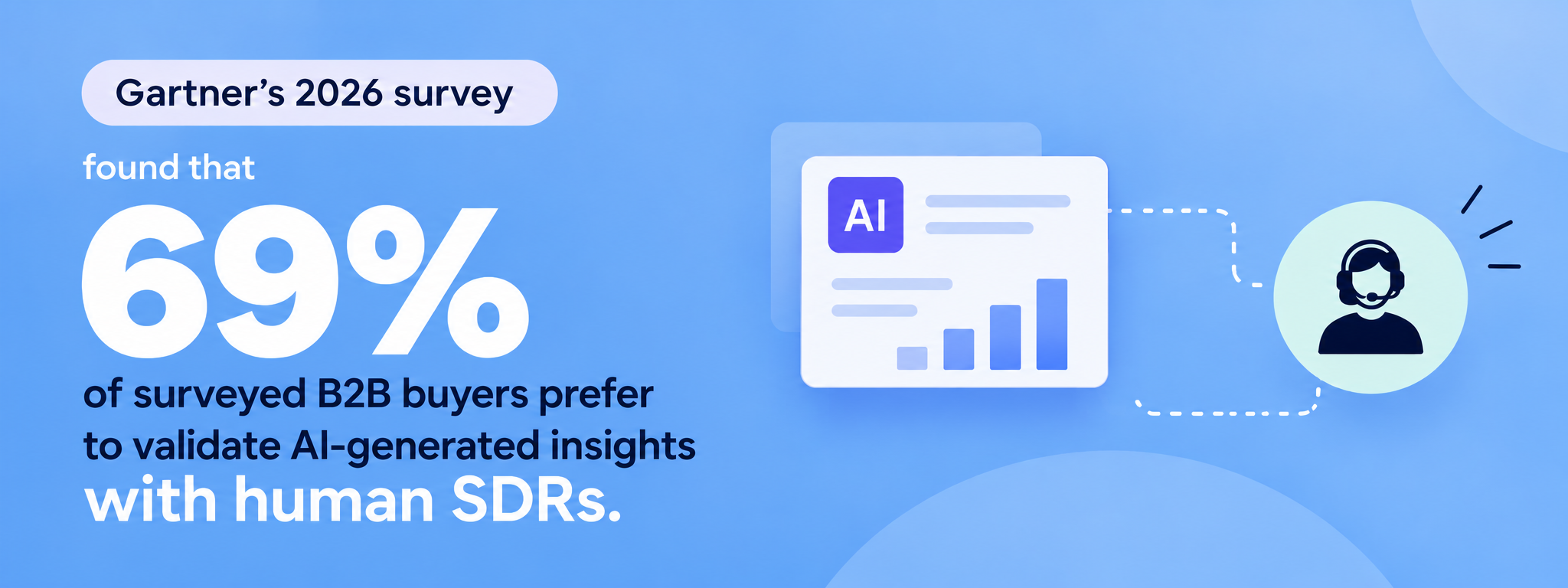
Gartner’s 2026 survey found that 69% of surveyed B2B buyers prefer to validate AI-generated insights with human SDRs. The finding does not mean every sales task needs a person, but it is a useful reason to ask how automation and human judgement work together.
A good answer reveals: A clear split of tasks with ownership trickling up to a named human.
Red flag to watch out for: Be wary of statements like ‘It’s all proprietary.'
The questions above are useful because they make the process visible. They help you gauge what works and what doesn’t work for you. The outsourced SDR red flags below are easier to assess when the same standards apply to every provider. Watch how the agency responds, too. These are the main outsourced SDR red flags to follow up in writing:
A single unclear answer may reflect a rushed sales call. A red flag in the answers isn’t a verdict on whether or not the agency is weak or a good match. Ask for clarification in writing, post the call and keep an eye out for patterns in their responses to help you make an informed decision. Several unresolved gaps around data, qualification and money make for a stronger reason to walk away.
The questions work as a scorecard for you to gauge every agency you speak to and compare the written answers side by side. Once you agree on a pilot, with a defined qualified meeting, a billing trigger and a review date, the agency that welcomes this approach is usually the one worth hiring. This makes it easier to compare the substance of the answers rather than the confidence of the salesperson.
Score each agency against your requirements, and note where evidence is missing. You do not need a complicated procurement model. A short written comparison can reveal whether an agency is prepared to be accountable.
When deciding how to choose an outsourced SDR, prioritise a partner that shows its working, and agrees on definitions before launch. This is a useful test when hiring a sales outsourcing company. A clean scorecard does not guarantee success, but it helps you avoid signing a contract built on assumptions.
Before signing the outcourced SRD contract, make sure the agreement covers the people doing the work, the ICP and outreach process, data responsibilities, qualification criteria, reporting, billing, handovers, performance reviews and exit terms. Ask for any promise that influenced your decision to appear in writing. Then compare the final contract with what the salesperson described.
Use these questions when hiring a sales outsourcing company, whether for a pilot or a longer engagement. If an agency can answer them clearly, you have a stronger basis for deciding whether its operating model fits your team.
Put these questions to Whistle, too. They are the questions to ask an outsourced SDR company, and we expect to be asked.
At Whistle, WhistleOS is a managed SDR programme with an SDR team, customer success manager, team lead, messaging, multi-channel sequences, data, reporting and CRM support. The programme goes live in 10 business days.
If you prefer to manage the SDRs in-house, Whistle Talent matches you with a vetted SDR in as little as 24 hours, with placement within five days and month-to-month contracts.
Book a meeting with Whistle and bring your scorecard.