
Sales Development

Kayla Tait
November 19, 2026

The short answer? Yes.
Your CRM should not become a black box when you outsource sales development.
You need to know which prospects are being approached, what happens when someone responds, and how qualified conversations reach your internal sales team. You also need confidence that your customer data is being handled responsibly. That does not mean an outsourced SDR team must run every call, email or LinkedIn message through your CRM. Providers use different technology setups. Some work directly in a client's CRM. Others manage outreach through their own systems and transfer the agreed upon information into the client's platform.
This distinction affects the access you grant, the information your team can see, the reporting you receive, and the security controls you need. Understanding how outsourced SDR CRM access works should be a priority.
If you're evaluating an outsourced SDR provider, ask exactly how its technology works before agreeing to an integration. The right setup should give your team the visibility it needs without creating unnecessary access to your systems.
CRM access can mean several different things. It might involve giving an external sales development rep a user account, connecting a provider's outreach platform to your CRM, or transferring specific information such as booked meetings into your system. These arrangements are not interchangeable.
The operational burden on internal sales teams is worth considering, too. Salesforce's 2024 State of Sales research found that sales representatives spend 70% of their time on non-selling tasks. For businesses looking to outsource sales development, the goal is not simply to add more outreach activity. It is to establish a delivery model that gives the internal team visibility into outcomes without creating additional operational overhead.
For example, an outsourced SDR provider might use its own technology to manage prospect research, contact data, calls, emails, and LinkedIn outreach. Your CRM may only receive information when a meeting is booked and ready to be handed over to your sales team.
That is a different arrangement from one where an SDR logs into your CRM, updates contact records and records every outreach interaction there. Before discussing permissions or integrations, establish which model the provider uses. Ask for a clear explanation of:
There is an important intersectionality between the workflows for an outsourced SDR, HubSpot and Salesforce functionality. The question isn't simply whether an agency can work with HubSpot or Salesforce. It is whether its operating model gives your team the information and control it needs.
There is no single way for an outsourced SDR team to work with a client's CRM. Understanding the differences helps you assess the arrangement before onboarding.
Your choice of CRM platform also matters when evaluating how external sales development activity fits into your existing sales process. If you're comparing platforms, explore our guide to the top enterprise CRM software for B2B sales teams.
A provider may use one model or a combination, depending on its service and the client's requirements. The important thing is to avoid assuming that the phrase CRM integration means every prospect, message and activity will appear in your CRM. Ask the provider to define exactly what integration covers.
Whistle’s Outsourced SDR programme follows the third model: meeting or outcome handover. Our SDRs manage prospecting and outreach through Whistle’s own technology, then send booked meetings into your CRM so your internal sales team can take the conversation forward. You also get access to live campaign reporting, giving you visibility into outreach performance without requiring every prospect interaction to be managed inside your CRM.
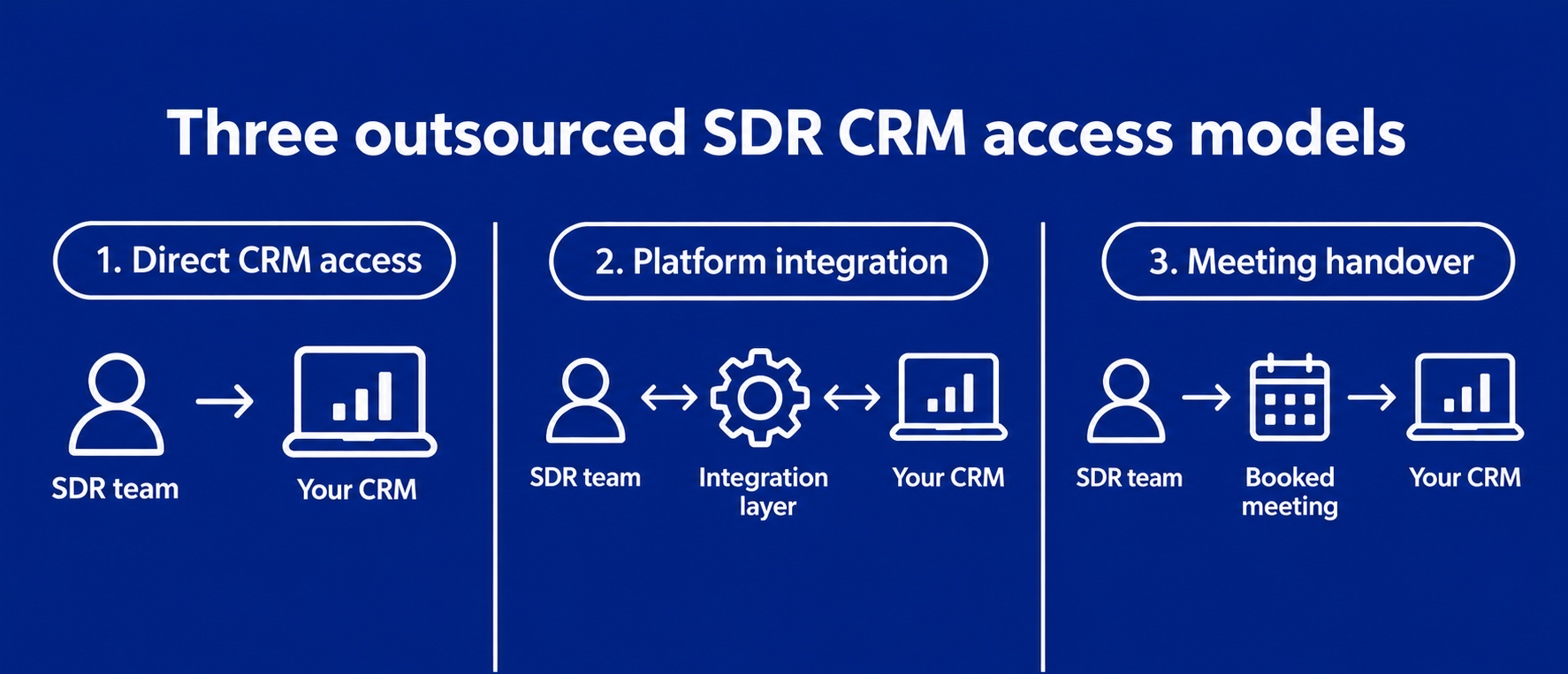
Alt text: Three outsourced SDR CRM access models showing direct access, platform integration and meeting handover.
Your internal team needs enough information to understand the conversations being passed across and decide what should happen next. That does not necessarily require every outreach record to sit in your CRM. It does require an established handover process and a clear reporting arrangement.
Start by identifying the information your sales team needs when a meeting is booked.
A useful meeting handover should give the receiving sales development or account executive team enough context to prepare for the conversation. Depending on the process agreed on, this may include:
Agree on the required information before the programme launches. If your sales team needs a particular qualification detail to prepare for a meeting, make that requirement part of the handover process.
Meeting information is only one part of performance visibility. You should also understand how the provider reports on sales development outreach. Depending on its technology, reporting may cover activity volumes, calls, emails, LinkedIn engagement, positive responses, meetings booked, and other agreed campaign measures.
Ask where those reports are available and who can access them. Do not assume that campaign-level activity will automatically appear in your CRM.
A provider should be able to explain how it tracks performance, how often results are reviewed and how your team can raise questions about targeting, messaging or meeting quality.
A booked meeting needs a defined destination.
Decide who receives the meeting, who owns follow up, how cancellations or rescheduling are handled, and how feedback reaches the outsourced SDR team.
Your internal sales team should also know how to flag a meeting that does not meet the agreed qualification criteria. Without that feedback loop, the provider has limited information to improve future targeting and qualification.
The answer depends on the delivery model.
If a provider's SDRs work directly in your CRM, they may need access to selected contacts, accounts, activities and other records relevant to their responsibilities. That access should be limited to the work they are expected to perform.
If the provider manages outreach through its own technology and only transfers booked meetings into your CRM, direct CRM access may not be required for the outreach team. The integration and handover process should be assessed separately.
Access should follow the principle of least privilege, which is to give people and systems only the permissions required to perform their agreed tasks.
Whistle’s Outsourced SDR programme works on this very principle. Our SDR team manages outreach through Whistle’s own technology, so your team does not need to provide individual CRM access for SDRs to conduct prospecting. When a meeting is booked, the relevant information is sent into your CRM for your sales team to follow up. You retain visibility into campaign performance through Whistle’s reporting, while your CRM receives the booked-meeting handover.
For a direct access arrangement, consider whether the provider genuinely needs permission to:
These permissions should reflect the provider's responsibilities, not simply mirror the access available to your internal sales team.
Unless there is a specific, documented reason, an outsourced SDR provider should not need unrestricted access to:
The same principle applies to integrations. A connection should not be granted broader access to your CRM than the agreed data transfer requires.
CRM security is not a one-time onboarding task. It should be considered throughout the relationship, from initial setup to offboarding.
Start by documenting what information is shared, where it is stored, who can access it, and how it is used.
If external users need direct access, create dedicated roles rather than assigning them the same permissions as internal administrators.
Restrict access to relevant records and functions. Review those permissions if the provider's responsibilities change.
For an integration, ask which permissions the connection requires and whether they can be limited to the relevant data and actions.
Use multi-factor authentication where supported. Avoid shared credentials and make sure every external user has an identifiable account if direct access is required.
Your IT or security team should also review authentication requirements for connected platforms and service accounts.
Your agreement should explain what prospect information the provider collects, how it is used, where it is stored, who can access it, and what happens when the engagement ends.
It should also address relevant privacy requirements, contact preferences, suppression lists and opt-outs.
Do not rely on a general promise that data is secure. Ask for the provider's actual data handling process and make sure it aligns with your organisation's policies.
Access should not remain active after it is no longer required.
Agree on how user accounts, integration permissions and credentials will be revoked when the engagement ends. Clarify what happens to campaign records, prospect information and meeting handover information.
If your organisation uses a formal vendor review or access recertification process, include the provider in it.

Alt text: Security team reviewing CRM access permissions for an external sales development provider.
Outsourcing sales development introduces another organisation into your data and technology environment. That does not make it inherently unsafe, but it does mean responsibilities need to be explicit. Verizon's 2025 Data Breach Investigations Report found that third-party involvement had doubled to 30% of breaches. While this figure covers a broad range of third-party relationships and is not specific to outsourced SDR providers, it underlines why businesses should assess vendor access, data handling and security controls before sharing information with an external team.
Watch for these common risks.
Excessive permissions. A provider receives broader access than its work requires. This increases the amount of information exposed if an account is compromised or misused.
Shared user accounts. Several people use the same login, making it harder to identify who accessed or changed information.
Unclear data storage. You do not know where prospect information is held, which systems process it or how long it is retained.
Uncontrolled exports. Contact lists or customer information can be downloaded without an agreed business need or suitable controls.
Unclear third-party access. The provider uses subcontractors or additional technology vendors, but you have not established what information those parties can access.
Incomplete offboarding. User accounts, connected applications or access credentials remain active after the contract ends.
The best way to reduce these risks is to ask for documented answers before launch. Your security team should review the proposed arrangement where required, particularly if your business handles sensitive or regulated information.
Monitoring should cover two separate things: the provider's outreach performance and the information transferred into your CRM. They are related, but they are not necessarily visible in the same place.
Ask for reporting that explains what the team is doing and what response it is receiving. Depending on the provider's reporting system, this could include:
Activity volume alone is not enough. A large number of calls or emails does not tell you whether the team is reaching the right people or creating relevant sales conversations. The structure and timing of outreach matter just as much as activity volume. Read our guide to sales sequences that actually convert for a closer look at follow-up frequency, channel mix and the elements of an effective outbound sequence.
Before launch, agree on the measures that are crucial to your business. Set a regular review cadence and decide who is responsible for discussing changes to targeting, messaging and qualification.
Your CRM should provide a clear record of the meetings transferred into it.
Review whether the agreed meeting information is present, whether the correct internal owner receives it and whether the handover happens within the agreed process.
For a meeting-handover model, do not expect your CRM to function as a complete record of every outbound touch unless that has been explicitly agreed and implemented.
Where direct CRM access or integrations are involved, use the audit and access logs available in your systems. Review relevant changes, connected applications and user activity according to your internal security policies. Also establish a process for reporting missing meeting information, incorrect records or integration issues. Someone should own resolving these problems rather than leaving them between the provider and your internal operations team.
When it comes to SDR agency CRM integration, a provider should be able to explain its technology and handover process without relying on vague statements about integration. Use the following questions during your evaluation:
| Question | Why it matters |
|---|---|
| Which technology do your SDRs use for outreach? | Establishes where calls, emails and LinkedIn activity are managed. |
| Do your SDRs need individual accounts in our CRM? | Clarifies whether direct access is part of the delivery model. |
| What information is transferred into our CRM? | Prevents assumptions about full contact and activity synchronisation. |
| Are records transferred automatically or manually? | Helps establish how the handover works. |
| What information accompanies a booked meeting? | Confirms whether your sales team receives enough context. |
| Where can we review campaign performance? | Clarifies how you will monitor outreach beyond the CRM. |
| What security and data handling controls do you follow? | Helps your team assess the provider's approach to information security. |
| What happens to data and access when the engagement ends? | Establishes ownership, retention and offboarding responsibilities. |