

B2B Insights

Lauren Daniels
July 21, 2026

Most sales leaders think about their prospect list as something they buy once, file somewhere in the CRM, and pull from whenever the pipeline needs a top-up. That is where the problem starts.
A bad list does not just produce bad outreach. It drives up bounce rates, damages sender reputation, erodes SDR confidence, and quietly kills pipeline before a single conversation happens. The damage is largely invisible until it is significant, because the consequences show up downstream in deliverability metrics, AE frustration, and close rates rather than in the list itself.
The good news is that B2B list building services solve this systematically, and the ROI case is clearer than most teams realise once real numbers are put behind the status quo.
At the most basic level, a B2B list building service answers one question: who should we be talking to, and how do we reach them? Then it does the work to answer it accurately, repeatedly, and at a scale that in-house research cannot match.
The core functions of a quality B2B list-building service cover five areas. Targeting and segmentation define the ICP by industry, company size, revenue, geography, tech stack, and buying signals, then find companies and contacts that match. Contact discovery identifies the actual decision-makers and surfaces verified emails and direct dials rather than a generic inbox. Data enrichment appends verified contact details, job titles, firmographics, and technographics to existing records that are incomplete or outdated. Verification confirms that emails are deliverable and phone numbers connect before a single rep touches the list. Ongoing maintenance keeps the list accurate as data decays, because it always does.
Two models exist in the market, and they serve different needs:
The right choice depends on team bandwidth, ICP specificity, and how much ongoing maintenance is built into the workflow. Both models are legitimate. The mistake is treating them as interchangeable.
Filing list building under operations or IT is the mistake most sales organisations make. List quality maps directly to pipeline, and the numbers behind it are concrete enough to bring to a budget conversation.
Organisations with high-quality B2B data are 2.5x more likely to exceed revenue targets, yet 44% of companies still rely on a single data provider. Clean data drives measurable downstream outcomes: 20% better campaign response rates, 15% higher close rates within six months, and 12% higher conversion rates overall. Organisations using AI for data quality see a 30% accuracy improvement in year one.
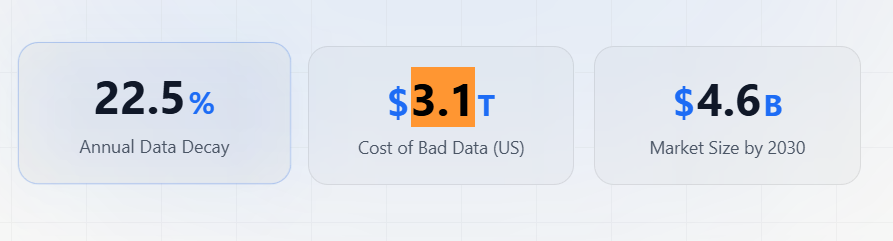
The cost of bad data is equally concrete. Poor data quality costs US businesses $3.1 trillion annually, with the average organisation losing $12.9 million per year according to a 2025 IBM Institute for Business Value report. 43% of chief operations officers now identify data quality as their most significant data priority.
For sales teams specifically, bad data shows up in wasted SDR time, inflated bounce rates, and AI-driven workflows that produce personalisation errors when the underlying data is stale. A personalisation tool referencing the wrong job title or a company the prospect left eight months ago does more damage than a generic message would have.
The B2B data marketplace is projected to grow from $863.2 million in 2024 to $3.2 billion by 2030, a 24.6% compound annual growth rate, because companies are voting with their budgets after learning firsthand what bad data costs them.
This is the concept most sales teams underestimate: a prospect list starts decaying the moment it is built, and the rate is faster than most planning models account for.
B2B contact data decays at approximately 2.1% per month, compounding to roughly 22.5% annually. That means nearly a quarter of a database can be outdated within a year, even when starting from verified records. In high-churn environments, the rate is far worse: Gartner research indicates decay can reach 70.3% per year under certain conditions.

The primary driver is job changes. Between 15 and 20% of professionals change roles annually, and each change invalidates a direct dial, an email address, and a job title simultaneously. Company acquisitions, office relocations, and domain changes compound the problem by invalidating multiple records at once. When a VP of Sales becomes a CRO at a new company, every data point attached to their old record becomes obsolete at the same time.
What makes decay more than a CRM inconvenience is its effect on deliverability. Stale lists generate hard bounces, spam complaints, and inactive contacts, all signals that damage domain reputation. High bounce rates from outdated emails reduce inbox placement rates for the good contacts on the same list, meaning decay poisons future sends, not just the current one. Most email service providers flag accounts sustaining bounce rates above 2%, and repeated violations put domains on blocklists that take weeks to resolve.
The practical conclusion is that a one-time list purchase decays into a liability. Continuous verification built into the workflow is the only model that holds up against the rate at which B2B contact data moves.

A lot of teams assume in-house list building is essentially free because the SDRs are already on payroll. That assumption does not hold up once the numbers are run.
Sales reps spend 60% of their time on non-selling tasks according to Salesforce's 2026 State of Sales report, and prospect research and contact discovery sit squarely in that bucket. SDRs specifically dedicate 30 to 40% of their working hours to prospecting tasks. For a single SDR earning $60,000 annually, approximately $22,200 per year is spent on research time alone. For a team of ten SDRs, this escalates to $222,000 annually before accounting for the cost of the tools they are using to do that research.
The selling time gap has a direct performance consequence. Top performers spend 34% of their time selling. Bottom performers spend 23%. That gap correlates directly with quota attainment, which means the teams spending the most time on manual research are the same teams most likely to miss their numbers.
Manual list building also produces lower-quality output than a dedicated service, because reps working from free tools or basic subscriptions are building on inaccurate data without knowing it. The errors are not visible until they surface as bounce rates, wrong-person replies, and conversations that start from incorrect assumptions about the prospect's role or company.
Every hour reclaimed from manual list building is an hour that can go toward conversations that actually move pipeline. That is the real ROI of a list building service, and it connects directly to the broader argument for outsourcing the prospecting function rather than absorbing it into the most expensive seats on the sales team.
Most buyers evaluate on database size and price. Neither is the right primary criterion.
1. Accuracy beats database size
Vendors lead with contact volume. Ignore it. A provider with 700 million contacts and poor verification will consistently underperform a smaller, well-maintained database. Industry standards indicate that 97% or above represents high-quality B2B contact data. The average provider delivers around 50% accuracy, meaning roughly half of an average list's outreach can fail before a single message is sent.
2. Test before committing
The gap between claimed accuracy and real-world accuracy is typically 15 to 20 percentage points. Pull a sample of 30 to 50 records and run them through a real campaign or a verifier, then measure actual bounce and connect rates before signing anything.
3. Ask the right verification questions
How the provider handles catch-all domains, how frequently existing records are re-verified, and whether suppression list integration is available to automatically exclude known-bad addresses from exports. These operational details separate providers who talk about data quality from those who have built systems to maintain it.
4. Check your bounce rate threshold
Most email service providers flag accounts with bounce rates above 2%, and repeated violations can land a domain on blocklists that take weeks to resolve. Any provider whose list consistently pushes past that threshold is actively damaging the outbound infrastructure, not supporting it.
5. Confirm compliance coverage
GDPR in Europe and CAN-SPAM in the US are non-negotiable. A reputable list building service will be upfront about how they handle data privacy across jurisdictions. Vagueness on this point is a disqualifying signal.
6. Confirm integration with your existing stack
A clean list that does not flow into the CRM or outbound tools creates friction that erodes the value of the data. Native integrations or documented API access should be confirmed before committing.
List Building Best Practices That Produce Pipeline
Getting verified data onto a list is the first step. Making sure the list actually generates qualified conversations is the second.
Nail the ICP before building the list
The ICP should define targeting criteria before the list is built: industry, company size, revenue band, geography, tech stack, and growth signals. Every contact pulled should be screened against those criteria automatically. ICP filtering done upfront saves reps from spending hours researching poor-fit accounts that were always going to be a waste of time, regardless of how accurate the contact data was.
Layer in intent and trigger signals
A static list tells you who to call. Timing signals tell you when, and timing drives the difference between a well-received first touch and one that lands cold. The best moment to reach a prospect is within days of a trigger event: a funding announcement, a new leadership hire, a product launch. Those windows close fast. Pairing a core list with funding, hiring, and technology adoption signals means outreach lands when something has actually shifted in the buyer's world rather than on an arbitrary cadence.
Build verification into the workflow, not as an afterthought
Manual re-verification does not scale. The only model that keeps up with a 2.1% monthly decay rate is automated verification baked into the data workflow. A practical cadence runs real-time validation at entry, weekly refresh for active sequences and open opportunities, and immediate refresh triggered by hard bounces, wrong-person replies, and detected job changes.
Maintain the list as an ongoing system
New data expands reach. Maintained data protects sender reputation and the investment already made in the list. Both are necessary. The mistake is treating a list as a static asset and only refreshing it when the pipeline problem becomes undeniable, at which point the deliverability damage has often already been done.

AI has changed the economics of B2B list building materially, particularly on the research and verification side.
Sellers using AI agents expect a 34% reduction in prospect research time and a 36% reduction in email drafting time according to Salesforce's 2026 State of Sales report. 45% of teams are already using AI for account research, a high adoption rate given that 49% of teams cited account research as the toughest part of prospecting. Teams using AI saw 83% revenue growth in 2025 compared to 66% for teams that did not. The gap is real and widening.
What AI does well in list building: ICP filtering at scale, screening thousands of accounts against predefined criteria in seconds rather than having reps do it manually. Contact discovery, surfacing decision-makers and verifying details without manual research time. Intent signal detection, flagging accounts showing buying activity so outreach lands at the right moment. Automated data refresh, triggering re-verification when records hit a defined age threshold or when a hard bounce is detected.
The winning model is hybrid. AI handles the repetitive, high-volume data tasks. Human SDRs handle personalisation, judgment calls, and live conversations. The goal is to remove the part of prospecting that a machine can do faster and more accurately, so reps spend their time on the part that actually converts.
For sales leaders and VPs
Run a verification sample on the current CRM. Pull 50 to 100 active contacts and measure real accuracy and bounce rate. If 20% fail, that is a concrete number to bring to a budget conversation. Then do the build-versus-buy cost calculation: if SDRs are spending 30 to 40% of their day on research, the team is likely burning six figures a year on the most expensive list-building method available.
For SDR managers
Audit where rep hours actually go for one week. The goal is to push the selling-time number up, because top performers sell 34% of the time versus 23% for the bottom of the pack, and that gap maps straight to quota attainment. Offloading the research workload is one of the fastest ways to move that number without adding headcount.
For everyone running outbound
Protect deliverability. Keep bounces under 2%, build suppression lists into every export, and set a real verification cadence. Stop treating the list as something that gets bought and filed. Treat it as a living system that needs continuous maintenance to hold its value.
The companies winning at outbound are not necessarily running more activity. They are running the same activity against cleaner, more ICP-aligned, more current data, and the downstream effects compound across every part of the pipeline.
A B2B list building service is one of the highest-leverage investments a sales organisation can make, because getting the list right makes everything downstream work better. Calls land with the right people. Emails hit real inboxes. SDRs spend their time on conversations rather than contact validation. And the compliance and deliverability infrastructure that most teams only think about when something goes wrong is maintained as a matter of course rather than as emergency remediation.
The companies that struggle with outbound are rarely short of effort. They are usually working from a list that was never quite right to begin with, or one that was right when it was built and has been decaying ever since. Both problems are solvable, and both are worth solving before the next campaign goes out. If you want to see what a clean, ICP-aligned prospect list looks like in practice for your specific market, Whistle is worth talking to.