

B2B Insights

Lauren Daniels
May 12, 2026

Healthcare sales development in 2026 operates under a completely different set of conditions than most B2B markets.
A SaaS company selling workflow software might close a deal after a few demos and a procurement review. Healthcare sales rarely move that quickly. Buying cycles regularly stretch from six to eighteen months. Decision-making often involves physicians, procurement teams, IT leaders, finance departments, operations managers, and legal stakeholders, all with competing priorities.
That changes the role of the SDR healthcare team significantly.
Healthcare SDRs are not simply booking meetings. They are navigating layered buying committees, strict compliance requirements, overloaded decision makers, and markets saturated with vendors promising similar outcomes. Generic outreach fails fast in this environment.
At the same time, demand for healthcare innovation continues to grow. Hospitals, clinics, healthtech companies, medtech providers, and healthcare SaaS platforms are investing heavily in digital transformation, operational efficiency, and patient experience improvements. That creates opportunity for sales teams that understand how to approach the market properly.
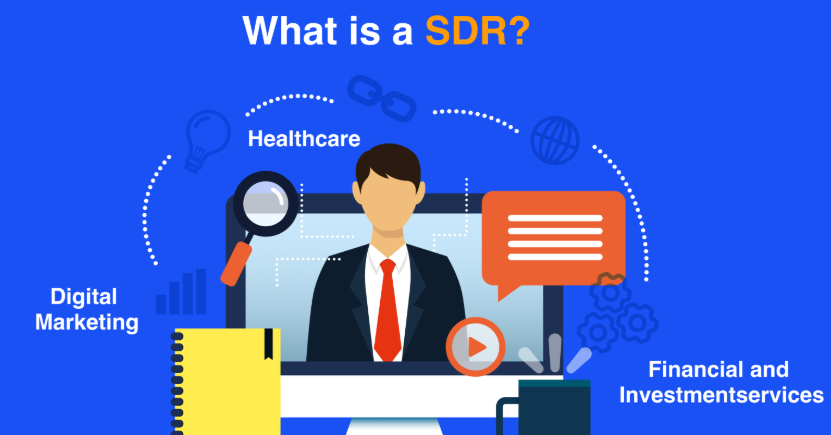
An SDR in healthcare sales is responsible for outbound prospecting, lead qualification, and appointment setting for account executives or senior sales teams.
On paper, that sounds similar to SDR roles in other industries. In practice, healthcare introduces far more complexity.
Healthcare buying committees now average between nine and ten stakeholders. Meanwhile, roughly 30% of B2B contact data becomes outdated every year, making accurate targeting an ongoing challenge. Healthcare SDR teams spend significant time researching organizations, validating contact data, and understanding reporting structures before outreach even begins.
Research and list building are foundational parts of healthcare sales development. SDRs rely heavily on platforms like LinkedIn Sales Navigator, ZoomInfo, Apollo, and healthcare-specific databases to identify relevant decision makers and keep lists current.
Outreach itself also requires more persistence. In medical sales development, securing a qualified meeting often takes between eight and twelve touches across multiple channels. That includes email, LinkedIn engagement, phone calls, and occasionally SMS or event follow-up.
Qualification conversations must also go deeper than surface-level discovery.
Healthcare SDRs need to understand:
All while remaining careful not to cross regulatory boundaries or mishandle sensitive information.
Appointment setting becomes more complicated too. Scheduling one executive is manageable. Coordinating calendars across physicians, administrators, and IT stakeholders is another challenge entirely. Successful healthcare SDR teams act more like project coordinators than traditional cold callers.
Healthcare sales development has become more demanding over the past few years because buyer expectations changed faster than many sales teams adapted.
Healthcare organizations now expect informed conversations from the very first interaction. SDRs who rely on generic pitches or templated messaging rarely make it past gatekeepers.
One major factor is the length of healthcare buying cycles. Most B2B healthcare purchases now take between six and eighteen months to close. During that period, purchasing committees may include clinical leaders, operations teams, finance executives, IT departments, compliance officers, and procurement specialists.
Compliance requirements add another layer of complexity.
Healthcare SDR teams operating in the United States must remain aware of HIPAA considerations, while European outreach requires GDPR compliance. Contact handling, messaging practices, data storage, and follow-up processes all need tighter oversight than standard B2B outreach.
The market itself is also more crowded.
Healthtech, medtech, and healthcare SaaS companies have flooded the market with competing solutions. Decision makers receive constant outreach, making differentiation increasingly difficult. Broad claims around “improving efficiency” or “streamlining workflows” no longer stand out.
Digital transformation accelerated significantly after 2020, and that changed how healthcare buyers evaluate vendors. Buyers now expect virtual engagement, educational content, telehealth familiarity, and proof of industry understanding before agreeing to meetings.
Remote and hybrid engagement models are now standard. Healthcare SDR teams spend far more time building relationships through LinkedIn, virtual meetings, webinars, and digital touchpoints than relying on traditional in-person sales motions.
AI and intent data are also becoming central to healthcare prospecting. SDR teams increasingly monitor buying signals such as:
These signals help prioritize accounts more likely to enter active buying cycles.
Healthcare buyers are highly sensitive to irrelevant outreach.
The industry operates on trust, credibility, and risk management. That means personalization matters far more than volume.
Before contacting a prospect, effective healthcare SDR teams conduct meaningful research into the organization’s current priorities. That might include reviewing recent EHR upgrades, expansion plans, staffing changes, merger activity, or operational challenges affecting the facility.
Even small contextual details improve credibility.
An SDR referencing a hospital’s newly opened outpatient center or a clinic’s telehealth rollout immediately separates itself from generic outreach campaigns.
Hyper-personalization consistently outperforms mass outbound messaging in healthcare sales development. Emails tailored to the recipient’s role, department priorities, or organizational initiatives can significantly increase response rates.
Segmentation also matters.
Biotech buyers care about different challenges than medtech companies. Healthcare software buyers evaluate different outcomes than hospital procurement teams. Messaging needs to reflect those differences instead of treating healthcare as a single market category.
Data-driven messaging performs particularly well in healthcare sales.
Healthcare executives are trained to evaluate evidence. Claims without proof feel weak or exaggerated. SDRs who support outreach with measurable outcomes build trust faster.
For example:
“Helped a peer hospital reduce ICU stays by 15%.”
will always land better than:
“Improved operational efficiency”
Tone matters too.
Healthcare is fundamentally built around care, responsibility, and ethics. Aggressive sales tactics often create resistance rather than urgency. Consultative, honest language tends to generate stronger engagement over time.
Healthcare executives are busy, heavily protected by gatekeepers, and constantly interrupted.
Relying on a single outreach channel rarely works.
Modern healthcare sales development depends on coordinated multi-channel cadences that combine email, LinkedIn, phone calls, and occasional SMS or event-based engagement. Research consistently shows coordinated multichannel outreach can improve conversion rates significantly compared to single-channel approaches.
A typical healthcare SDR cadence:
The key is that every touchpoint must contribute value.
Healthcare buyers quickly ignore repetitive “just checking in” messages. Effective follow-ups introduce useful insights, relevant case studies, benchmark data, webinar invitations, or industry trends.
Persistence remains important because healthcare prospecting requires patience. Many first meetings only happen after eight, ten, or even twelve touches.
At the same time, persistence without awareness becomes counterproductive.
Strong SDR teams track engagement carefully. If a prospect consistently responds through email, there is little reason to continue aggressive phone outreach. Likewise, opt-out requests should always be respected immediately.
Healthcare buyers are highly research-oriented.
Most healthcare IT decision makers consume large amounts of educational content before engaging with vendors directly. That changes how SDR healthcare teams should approach outreach.
Rather than pushing products immediately, effective SDRs position themselves as informed guides.
Healthcare SDR teams should have access to:
This content helps establish credibility before sales conversations begin.
Problem-insight messaging works particularly well in healthcare sales development.
Instead of leading with product features, SDRs can begin conversations around operational challenges healthcare organizations already recognize. Topics like radiology backlogs, staffing shortages, patient scheduling inefficiencies, reimbursement pressure, or telehealth adoption create more relevant entry points.
The strongest outreach avoids sounding scripted or overly promotional.
Healthcare decision makers respond better to practical insights than exaggerated promises.
Industry knowledge also matters. SDRs who stay informed about healthcare trends, reimbursement changes, compliance updates, and operational pressures naturally sound more credible during conversations.
Active listening becomes a major differentiator here.
Open-ended discovery questions often reveal far more than aggressive qualification frameworks. Understanding how a hospital currently manages workflows or where operational friction exists creates stronger opportunities for future sales conversations.
Healthcare buyers rarely want to feel “sold to.” They respond better to teams that help them evaluate options thoughtfully.
Healthcare gatekeepers are not obstacles to bulldoze through.
Administrative assistants, coordinators, and department managers often control access to decision makers for good reason. Treating them professionally and respectfully improves outcomes considerably.
Experienced healthcare SDR teams build rapport with gatekeepers by being concise, transparent, and considerate of timing. Gatekeepers frequently provide valuable information about preferred contact methods, scheduling windows, or alternate stakeholders involved in purchasing decisions.
Compliance also plays a major role in healthcare prospecting.
All outreach should follow CAN-SPAM regulations, include clear unsubscribe options, and avoid handling protected health information improperly. SDRs should never include sensitive patient information in messaging under any circumstances.
Timing affects response rates more than many teams realize.
Calling hospital departments during Monday morning rounds or peak operational periods usually fails. Many healthcare SDR teams find better engagement during lunchtime windows or late afternoons when operational pressure decreases slightly.
Compliance awareness can also become a credibility advantage.
Mentioning HIPAA-compliant infrastructure or demonstrating awareness of healthcare regulatory concerns signals industry understanding early in conversations.
Patience remains essential throughout the process.
Even after a prospect expresses interest, healthcare procurement cycles involve legal review, compliance checks, security assessments, and internal approvals that can extend timelines significantly.
Healthcare sales development requires a different view of SDR performance metrics.
Meeting volume alone rarely tells the full story.
Lead conversion rates remain important because they measure how many contacted leads become qualified appointments. Typical healthcare SDR benchmarks range between eight and fifteen qualified meetings per month per rep, depending on deal complexity and market focus.
Touches per lead also matter.
Healthcare SDR teams should monitor cadence health carefully to understand how many touches typically generate responses. Many successful teams standardize around at least eight touches before disqualifying an account.
Pipeline quality matters more than raw activity.
Not all booked meetings create revenue opportunities. SDR leaders should track how many appointments convert into qualified pipeline and eventually progress into active sales opportunities.
Message performance analytics help optimize outreach over time.
A/B testing subject lines, call opening scripts, email formats, and content offers provides valuable insight into what resonates with healthcare audiences.
Compliance-related metrics should not be ignored either.
High bounce rates, unsubscribe spikes, or poor data quality often indicate targeting problems or messaging fatigue within healthcare campaigns.
The strongest SDR healthcare teams operate with a continuous improvement mindset. Small insights compound over time.
Something as simple as discovering that Tuesday afternoon emails outperform Friday outreach can materially improve campaign performance across an entire pipeline.
Technology now plays a central role in healthcare sales development efficiency.
CRM platforms like Salesforce and HubSpot act as the operational backbone for healthcare SDR teams. Long sales cycles require centralized visibility into every interaction, stakeholder, and follow-up.
Data intelligence platforms like ZoomInfo, Apollo, and Definitive Healthcare help SDRs maintain accurate healthcare contact databases and identify relevant organizations.
Sales engagement platforms such as Outreach and Salesloft automate multi-channel cadences, ensuring prospects receive consistent follow-up without SDRs manually managing every sequence.
Conversation intelligence tools like Gong and Chorus help teams analyze calls, coach SDR performance, and monitor compliance-related risks.
AI and automation are increasingly embedded throughout healthcare sales workflows.
Modern SDR teams use AI-assisted email drafting, lead scoring models, intent monitoring, and scheduling tools like Calendly to reduce administrative overhead.
The most effective tech stacks work because they remove repetitive operational work, allowing SDRs to spend more time building genuine relationships with prospects.
Building an internal healthcare SDR team requires significant time and investment. Recruitment alone can take months, and it often takes six months or more before consistent pipeline generation is achieved.
Outsourcing healthcare SDR work can speed this up considerably. Experienced partners can launch campaigns within weeks thanks to established infrastructure, tools, and trained talent.
Cost efficiency is another factor, with many organisations reducing SDR costs by 25% to 40% compared to in-house teams once salaries, benefits, software, and hiring overhead are included.
Healthcare-focused SDR agencies also bring industry expertise. Teams that already understand hospital structures, procurement cycles, and compliance requirements typically ramp faster and perform sooner.
Scalability is simpler as well, allowing companies to increase or reduce outbound activity without long hiring cycles or headcount commitments, which is useful during launches or expansion phases.
Outsourced providers also bring ready-made infrastructure, including data tools, engagement platforms, reporting systems, and AI capabilities from day one.
They can also support market expansion. For example, a US healthcare company entering the UK can benefit from SDR partners with local knowledge and established regional experience.
Not every SDR outsourcing provider understands healthcare.
Vetting partners carefully is critical.
Strong healthcare SDR partners should demonstrate:
Teams overly focused on activity volume instead of engagement quality should raise concern quickly. Generic email blasts and poor targeting damage sender reputation and weaken long-term pipeline performance.
Even experienced outsourced teams still require onboarding.
Healthcare companies should invest time in educating external SDRs on their product positioning, buyer personas, competitive differentiation, and compliance requirements.
The best partnerships operate collaboratively rather than transactionally.
Regular strategy reviews, shared dashboards, messaging refinement, and open communication create stronger results over time.
Shorter pilot engagements often make sense initially.
Three-to-six-month testing periods allow companies to evaluate performance before scaling investment further.
Organizations that approach outsourcing collaboratively and strategically often see meaningful improvements in lead generation performance within the first six months.
Healthcare sales development is unforgiving. Long cycles, complex buying committees, strict compliance, and saturated markets mean generic outbound fails quickly.
The SDR healthcare teams that succeed take a different approach. They personalise outreach, run coordinated multi-channel cadences, and lead with education rather than pressure. They also understand the operational reality of healthcare buyers and adapt accordingly.
Technology strengthens this foundation. When CRM systems, engagement tools, data platforms, and AI work together, SDRs spend less time on admin and more time on meaningful engagement and better targeting.
For many organisations, outsourcing SDR work adds further leverage through faster ramp time, flexibility, and access to healthcare-specific expertise.
In 2026, the teams winning in healthcare sales are not the loudest. They are the most consistent. They build trust through relevance, persistence, and disciplined execution across every stage of the sales development process.
If you want to improve your healthcare pipeline, explore how Whistle helps teams build consistent SDR engines.