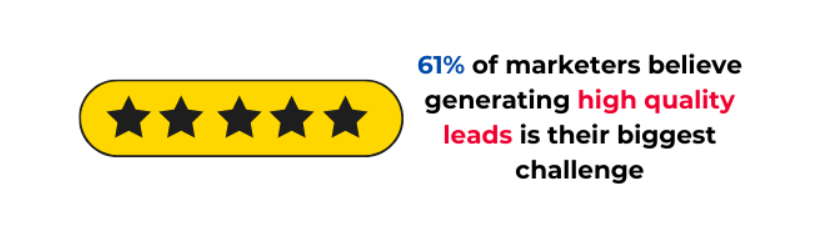
These 101 B2B lead generation statistics reveal the current state of pipeline generation across channels, costs, and conversion metrics. 61% of marketers cite generating high-quality leads as their biggest challenge, even as organizations generate an average of 1,877 leads per month. Critical benchmarks: AI-powered lead scoring improves conversions by 30%, SEO leads close at 14.6% versus 1.7% for outbound, and companies with mature lead gen processes report 133% more revenue.
Data quality crisis: 70% of CRM data is outdated or inaccurate, costing sales reps 500 hours annually, with 23-30% of email addresses becoming outdated yearly. Technology shifts: 75% of sales leaders call AI critical to GTM strategy, marketing automation drives 451% increase in qualified leads, and 84% of marketers rely on first-party data. Follow-up matters: 6-8 touchpoints needed to generate viable leads, yet 44% of reps give up after one attempt.
Privacy concerns are growing: 73% of consumers are more worried about data privacy, forcing a shift to permission-based strategies. The 2026 landscape rewards precision over volume, verified data over purchased lists, and systematic multi-touch nurturing over single-channel outreach. B2B marketing statistics confirm that companies investing in data quality, automation, and omnichannel execution capture disproportionate pipeline growth while competitors struggle with declining conversion rates and rising acquisition costs.
Most B2B lead generation statistics share a common story: the gap between volume and quality keeps widening. Your marketing team generates hundreds of leads monthly. Sales contacts fewer than one-third of them. The majority never convert. The cycle repeats. 61% of marketers say generating quality leads is their biggest challenge, a figure that has held steady for three consecutive years. The problem isn't finding prospects. It's finding prospects who actually buy.
Here are 101 lead generation statistics organized by category, with benchmarks, costs, and conversion data that separate effective strategies from wasted budget.
70% of CRM data is outdated, incomplete, or inaccurate.
Sales representatives lose 500 hours annually from bad prospect data.
23-30% of email addresses become outdated each year, alongside 18% annual telephone number changes.
Companies with accurate data see 66% higher conversion rates than those using outdated information.
High-accuracy data providers cost 16.5% less overall despite higher per-contact prices, due to reduced waste.
Data quality issues can affect revenue by up to 20%.
Most B2B data providers deliver only 50% accuracy on average.
Privacy, Compliance, and First-Party Data
73% of consumers are more concerned about data privacy than previously.
84% of global marketers rely on first-party and transactional data for audience insights.
67% of B2B marketers prioritized data compliance and accuracy in 2024.
Lead Nurturing and Follow-Up
6-8 touchpoints needed to generate a viable sales lead.
Companies nurturing leads generate 50% more sales-ready leads at 33% lower cost.
47% of larger purchases were made by nurtured leads versus non-nurtured.
Only 5% of leads are sales-ready when first generated, meaning 95% require additional nurturing.
Conversion Rate Statistics
Average B2B website conversion rate is 2.23%.
73% of B2B leads aren't sales-ready when first generated.
What These Statistics Mean for 2026
The pattern across these 101 lead generation statistics points to three clear realities:
Quality matters more than volume. Companies with accurate data see 66% higher conversion rates, while 79% of leads never convert to sales due to poor qualification and nurturing. Multi-channel execution wins. Email plus phone plus LinkedIn generates 3x more replies than single-channel approaches, and 6-8 touchpoints are required to create viable leads. Technology amplifies strategy. AI-powered lead scoring improves conversions by 30%, marketing automation drives 451% increase in qualified leads, and intent data cuts sales cycles by 23%.
The gap between companies investing in verified data, systematic nurturing, and coordinated multi-channel outreach versus those relying on purchased lists and single-touch tactics continues widening. Only 22% of businesses report satisfaction with conversion rates, yet companies with mature processes report 133% more revenue. For sales development teams seeking to apply these B2B marketing statistics to actual pipeline growth, Whistle provides training frameworks that teach SDRs how to execute multi-touch sequences, qualify leads using behavioral signals rather than demographic guesses, and maintain systematic follow-up across channels.
Our approach emphasizes understanding these benchmarks not as targets to hit but as context for building processes that consistently convert strangers into qualified opportunities through coordinated outreach, genuine value delivery, and persistent professional follow-up that respects buyer preferences while maintaining presence throughout research and evaluation cycles.
Explore more from our blog
Unlock the B2B sales playbooks, outreach strategies, and closing techniques we’ve refined across more than 1,000 successful campaigns.
Let’s figure it out together. Book a quick call and we’ll walk you through the best-fit options based on your goals, team structure, and current setup.
Latest posts
Demo content
Interviews, tips, guides, industry best practices, and news.