

Sales Development

Lauren Daniels
July 24, 2026

Building an in-house sales team sounds straightforward until you start adding it up. Salary, benefits, recruiting fees, tool licenses, onboarding time, and the almost inevitable turnover inside the first 18 months. When you factor everything in, the true cost of an internal SDR sits between $80,000 and $120,000 per year. And that is before they book their first qualified meeting.
The average SDR takes 60 to 90 days to ramp fully. Most companies underestimate the management overhead that comes with that period, and most also underestimate how quickly reps churn. Annual SDR turnover runs at roughly 35% across B2B companies, and can hit 45% specifically for SDR roles. Every departure restarts the clock.
Sales outsourcing in the USA addresses those friction points directly. An outsourced partner comes with trained reps, established workflows, and a tech stack already running. Instead of building the infrastructure, you access it. Instead of waiting months for ramp, you can have qualified meetings landing in the first two to three weeks.
According to a study, outsourcing SDRs can reduce costs (CAC) by up to 40% while maintaining lead quality. That is the headline number. The detail behind it is that cost savings compound over time as messaging is refined, targeting tightens, and reps build familiarity with your ICP.
For most B2B companies at the growth stage, the economics are hard to argue with. The question is which partner fits your situation.
Best for: B2B companies in SaaS, cybersecurity, fintech, healthcare, and enterprise tech that need qualified pipeline without building an in-house SDR team.
Whistle delivers fully managed outsourced SDR programs with multi-channel outreach across cold calling, email, LinkedIn, and inbound MQL follow-up. Campaign launch is faster with vetted SDRs integrated into your CRM and sales workflow.
Whistle has run 800+ campaigns for 200+ clients, generating $15M+ in monthly pipeline. Clients also benefit from its built-in tech stack, saving up to $15,000 annually on sales tools.
Key services: Outsourced SDR, SDR talent placement, cold calling, email and LinkedIn outreach, inbound MQL follow-up, and RevOps support.
Ideal for: Growth-stage and enterprise B2B companies looking to build predictable pipeline in weeks, not quarters.
Best for: Teams with a strong closing process that need more qualified conversations with senior decision-makers.
Belkins has built a strong reputation in the US B2B market on the back of one core capability: appointment setting through hyper-personalised outreach. Their emails are written to feel individually crafted, which is why they are effective at reaching executives who typically ignore volume-based outreach.
Belkins fill your calendar with qualified conversations and hand off from there. That narrow focus is an advantage if your closing process is already dialled in. If it is not, the bottleneck shifts from pipeline to conversion, and Belkins will not solve that.
Key services: Appointment setting, outbound email campaigns, lead research, CRM enrichment.
Ideal for: B2B sales teams that close well and need a steady volume of senior-level meetings to work from.
Best for: Larger companies running comprehensive campaigns that need to reach prospects across multiple channels and geographies simultaneously.
Callbox has been running multi-channel outbound campaigns for B2B companies for a long time. Their approach coordinates phone, email, social media, and chat into a single outreach motion, which reflects how modern B2B buying actually works.
Their global delivery capability makes them relevant for US-based companies with international expansion requirements or for businesses that need to run simultaneous campaigns across North America and other markets. The scale required to do that well is something Callbox has built over time.
The downside of that scale is that smaller companies or those with very specific, niche ICPs may find the model less tailored than they need. Callbox is built for volume and breadth.
Key services: Multi-channel outbound (phone, email, social, chat), lead generation, appointment setting, international campaign management.
Ideal for: Larger B2B organisations that need comprehensive outreach across multiple channels and, in some cases, multiple markets at once.
Best for: Companies that want a single outsourced partner managing the hand-offs between marketing, sales, and customer success rather than coordinating multiple vendors.
EBQ takes a broader view of the revenue function. Rather than focusing on one part of the funnel, they offer services that span marketing, sales development, and customer success. The appeal is coherence: one partner managing the transition from lead to customer to renewal, with consistent data and shared context throughout.
For companies where the biggest revenue problem is not a lack of leads but a leaky hand-off process between functions, that full-funnel perspective is genuinely useful. For companies that specifically need to scale outbound prospecting and have everything else working, it is more than they need.
Key services: Marketing, SDR outreach, customer success outsourcing, full-funnel revenue support.
Ideal for: B2B companies where the bigger challenge is alignment between revenue functions rather than volume at the top of the funnel.
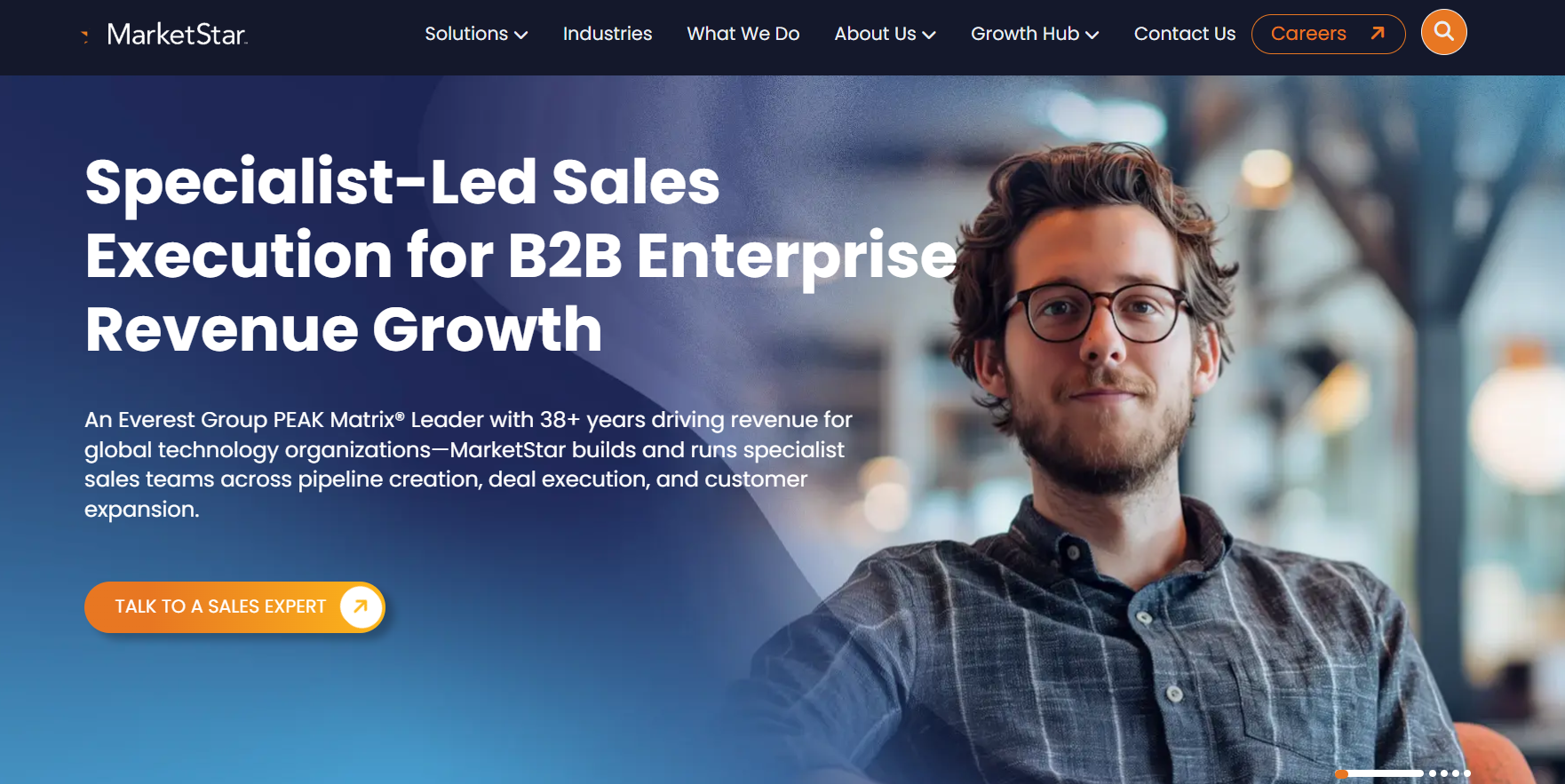
Best for: Global enterprises that need a partner managing complex direct and partner sales channels at scale.
MarketStar works at the enterprise end of the market. Their client roster includes Google Cloud, Amazon, and Reddit, which signals the level of program complexity they are built to handle. They operate across 90+ countries, support 100+ languages, and bring an average client tenure of 8 years, which is high relative to the industry standard.
Their model goes beyond lead generation into sales enablement, channel management, and customer success. That makes them a strong fit for large organisations running multi-territory sales programs with significant partner channel complexity. It also makes them a poor fit for companies at the growth stage that need fast, focused outbound pipeline without the overhead of a full enterprise engagement.
Key services: Outsourced inside sales, demand generation, channel and partner enablement, customer success programs, end-to-end revenue operations.
Ideal for: Global enterprises managing large-scale sales programs across multiple regions and partner channels.
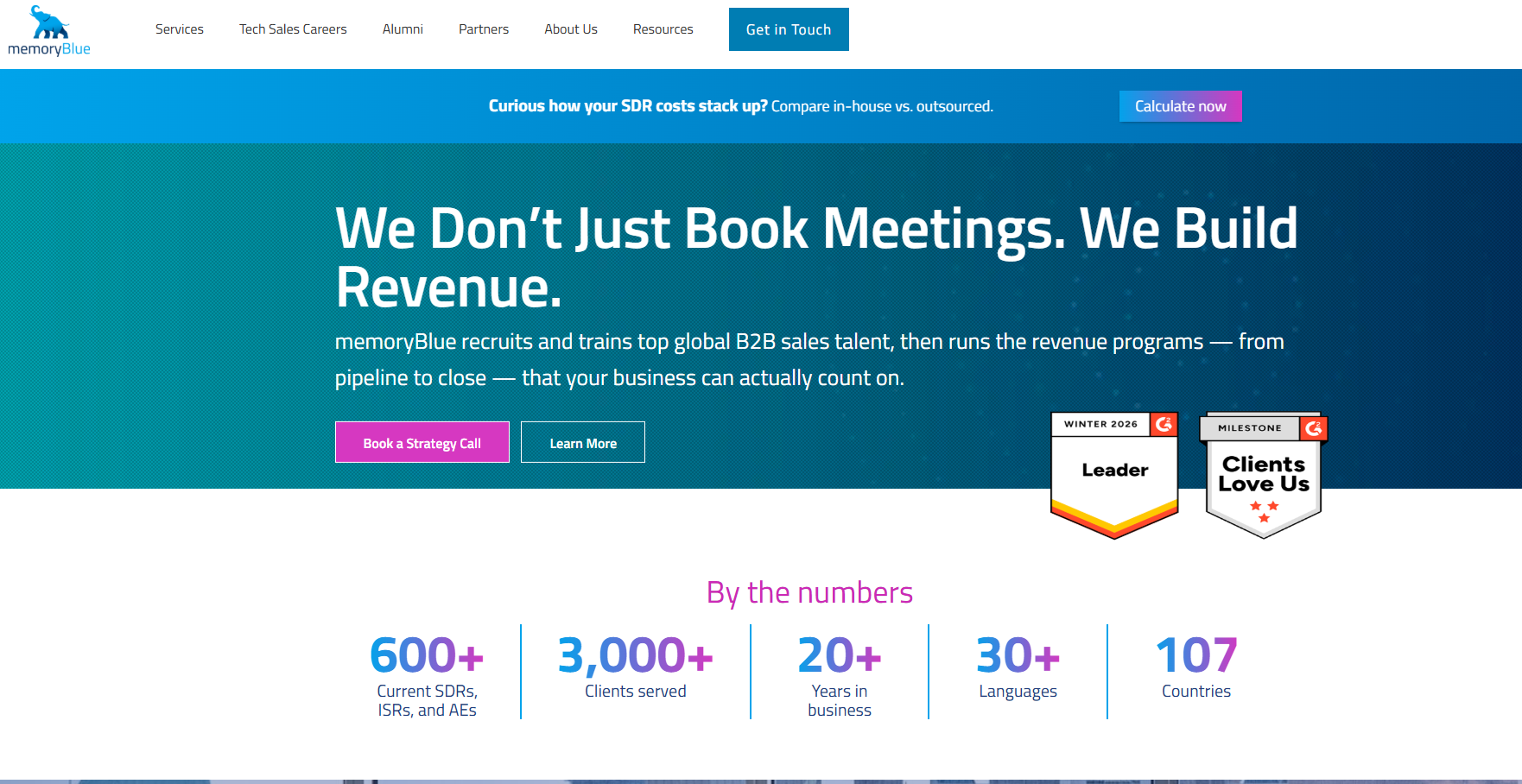
Best for: Companies that need qualified pipeline now and want the option to convert top-performing SDRs into permanent hires over time.
MemoryBlue runs a B2B inside sales outsourcing model with a differentiating feature: the option to hire the reps who perform best on your account. For companies building an internal sales team alongside their outsourced pipeline, that path-to-hire model reduces the risk of the transition. You are not hiring blind. You are hiring someone who has already proven themselves on your specific ICP, messaging, and market.
The trade-off is that the model is oriented more toward talent development than toward maximum outbound velocity. If the priority is filling the pipeline fast with an experienced team, a specialist SDR outsourcing partner may be a better fit. If the priority is building a pipeline now while simultaneously identifying future internal hires, MemoryBlue's approach is worth evaluating.
Key services: Outsourced SDR and inside sales, B2B lead generation, rep-to-hire conversion option.
Ideal for: Companies that need leads today and want to build their internal sales team over a 12-to-24-month horizon.
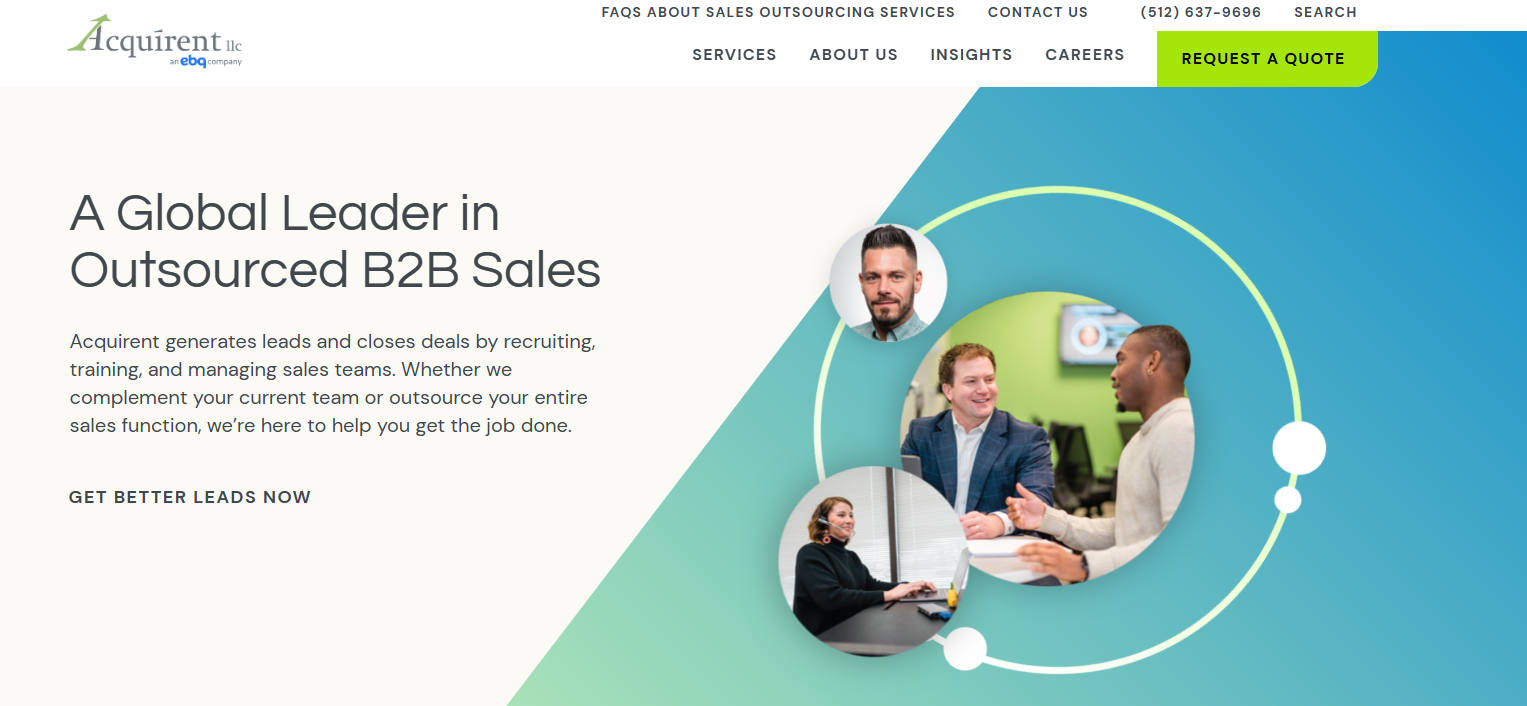
Best for: Businesses that want to outsource the entire sales process, not just prospecting, including navigating long and complex enterprise deal cycles.
Acquirent manages the full sales cycle from first contact through to close. For companies that lack an internal closing function, or that are dealing with complex enterprise deals requiring sustained relationship management and multi-stakeholder navigation, that end-to-end capability matters.
Most outsourcing providers draw a clear line at booking a meeting and handing off to an internal closer. Acquirent does not draw that line in the same place. That is useful for specific situations: early-stage companies without a dedicated AE function, organisations expanding into new verticals without in-house expertise, or companies with very long deal cycles that need consistent coverage across months of nurture.
The model is not right for companies that already have strong closers and simply need more pipeline at the top. For those teams, a focused SDR outsourcing partner will deliver faster results at lower cost.
Key services: Full-cycle sales outsourcing, B2B appointment setting, enterprise deal management, lead generation.
Ideal for: Companies looking to outsource the complete sales motion, particularly where deal complexity or cycle length makes full-cycle management a genuine requirement.
In-house teams become more cost-effective when a company has a mature SDR engine with 10+ reps and strong retention.
The difference between a sales outsourcing engagement that works and one that does not usually comes down to decisions made in the first two weeks. Here is what to look at before committing to any provider.
1. Ask who specifically will work on your account. Average SDR experience matters. A team averaging 18 months of experience will perform differently from one averaging 3 to 5 years. Ask to meet the reps assigned to your campaign.
2. Get clarity on the qualification standard. What does a qualified meeting actually mean to this provider? What criteria does a prospect have to meet before hitting your calendar? If the answer is vague, the meetings will be too.
3. Understand the reporting cadence. Weekly visibility into outreach activity, response rates, and pipeline metrics is the minimum. Monthly summaries obscure the problems that develop early in a campaign and compound quickly.
4. Run a short pilot before committing long-term. 8 to 12 weeks with defined success criteria gives you enough data to evaluate message-market fit, conversion benchmarks, and whether the partner's communication style matches your expectations. Providers that push back hard on pilots without clear justification are worth reconsidering.
5. Confirm what you own at the end of the engagement. Sequences, prospect lists, and contact data built during the campaign have value. Understand upfront who retains that material if the relationship ends.
At Whistle, we run outsourced SDR programs for B2B companies that need a pipeline function up and running quickly, without building it from scratch. The model is multi-channel: cold calling, cold email, and LinkedIn outreach coordinated as a single sequence rather than three separate activities.
Our SDRs are vetted, trained, and assigned to your account based on vertical familiarity. Engagements go live in days. Your CRM, your reporting, your qualification criteria. We run the function, you own the pipeline.
Over 800 campaigns. More than $15 million in monthly pipeline generated across 200+ clients. Clients see qualified meetings within the first 14 business days on average.
If you want to understand what a structured outsourced SDR motion would look like for your specific market and ICP, book a call and we will walk through the numbers with you.