

Sales Development

Lauren Daniels
September 8, 2026

In 2022, a particular B2B SaaS company was closing deals in an average of 78 days. By 2026, the same company, same product, same ICP, same price point, was averaging 167 days. Same everything except the buying environment. Nobody on the sales team had noticed because the CRM averages were blending fast SMB deals with extended enterprise cycles into a single misleading number.
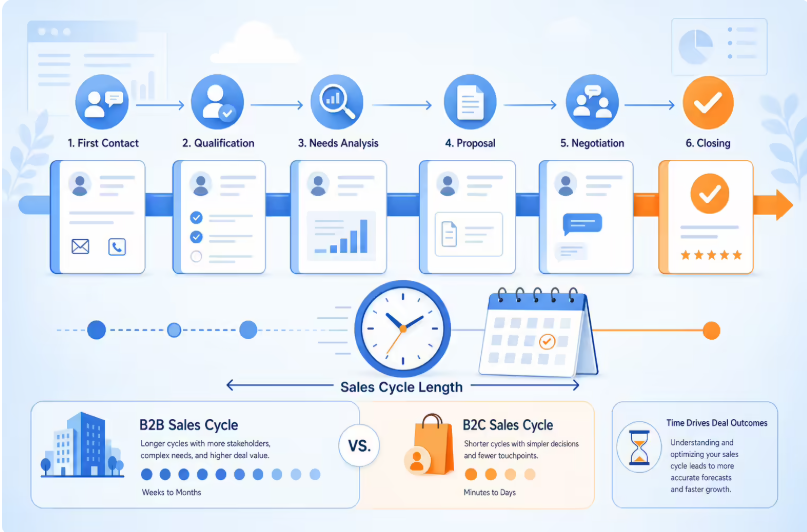
That pattern plays out across hundreds of revenue teams. B2B sales cycle length has increased 22% since 2022, driven by structural forces that are not reversing. Buying committees are larger, budget scrutiny is tighter, and procurement processes are longer.
The teams running pipeline forecasts based on 2021 or 2022 cycle assumptions are forecasting with broken assumptions, which is why 87% of enterprises missed their sales forecasts in 2025.
The median B2B sales cycle is now 84 days. But that median conceals a distribution that runs from 14 days on an SMB deal to 270 days on a complex cybersecurity enterprise contract. A blended average that covers both describes neither.
The number that matters for forecasting is the median for your specific ACV segment, ICP, and stage-by-stage breakdown.
When sales cycles start stretching out, it’s easy to blame the sales team. But often, the real problem is where deals get stuck. Here’s what the numbers tell us, where cycles tend to break down, and what you can do to shorten them without cutting corners or discounting your way to a close.
| Deal Size | Typical B2B Sales Cycle Length | Change vs 2022 |
|---|---|---|
| SMB (under $15K ACV) | 14 to 30 days | +10 to 15% |
| Mid-market ($15K to $50K ACV) | 30 to 60 days | +20 to 25% |
| Upper mid-market ($50K to $100K ACV) | 60 to 90 days | +20 to 25% |
| Enterprise ($100K to $500K ACV) | 90 to 180 days | +25 to 30% |
| Strategic ($500K+ ACV) | 180 to 365 days | +30%+ |
Every $10,000 increase in deal size adds approximately 5 to 10 days to the close timeline. The $100K threshold is the most significant step change: deals crossing that mark trigger formal procurement processes at 78% of enterprise companies, adding 30 to 45 days to the average B2B sales cycle.
The negotiation-to-close stage alone accounts for 35 to 40% of total enterprise cycle time, driven almost entirely by legal redlines, security questionnaires, and procurement approval gates.
The lengthening is not uniform. Enterprise and strategic deals have been hit hardest because they involve the most stakeholders and the most procurement overhead. SMB cycles have lengthened the least because the decision process involves fewer people and smaller budgets.
| Industry | Average B2B Sales Cycle Length |
|---|---|
| SaaS (horizontal) | 60 to 90 days |
| SaaS (vertical or industry-specific) | 90 to 120 days |
| HR technology | 45 days |
| Cybersecurity | 90 to 270 days |
| Financial services technology | 120 to 180 days |
| Healthcare technology | 150 to 240 days |
| Non-profit | 162 days (longest sector) |
| Retail | 70 days (shortest sector) |
The industry variation is significant enough to make cross-industry benchmarking almost meaningless. For vertical-specific playbooks, see our guides to lead generation for logistics, PropTech and biotech companies. A cybersecurity deal runs a cycle up to six times longer than an HR tech deal at the same ACV.
Inbound channels produce B2B sales cycles 2 to 3 times shorter than outbound channels at comparable deal complexity, because buyers arriving through search or referral have already completed a significant portion of their evaluation before the first conversation.
The benchmark that matters for forecasting is the 4-quarter trailing median for each ACV segment within your own pipeline, tracked separately and compared against current open deals stage by stage.
Three structural forces are driving the lengthening, and none of them are reversing.
Buying committees have expanded. The average B2B deal now involves 6.8 stakeholders, up from 5.4 in 2020. Enterprise deals average 13 decision-makers. CFO involvement in software purchases is up 40% since 2023. Purchases that previously closed on a VP's discretionary budget now require SVP or C-level sign-off.
Each additional stakeholder adds compounding complexity at every stage. A deal with three stakeholders might move from demo to proposal in two weeks. The same deal with seven stakeholders might take 6 weeks for the same transition because the champion needs to align everyone before any next step happens.
Security and compliance reviews are now standard. SOC 2, GDPR, and vendor risk assessments add 2 to 4 weeks to the average mid-market B2B sales cycle, and significantly more to enterprise deals. This used to be an enterprise-only requirement. It is now standard even for deals in the $15,000 to $50,000 ACV range. Most sales teams discover this at Stage 4 when it should have been mapped at Stage 1.
Buyers complete more evaluation before speaking to sales. B2B buyers now complete 60 to 70% of their evaluation before engaging a sales rep. They arrive with competitive comparisons, peer reviews, and pricing estimates from three to five vendors simultaneously. Informed buyers have more questions, more specific requirements, and more comparison points. The evaluation is more thorough, which extends the timeline even when it improves deal quality.
Budget scrutiny has not relaxed. ROI justification that was optional in 2021 is now a procurement gate. Deals that used to close on a VP's discretionary budget now need CFO review with a quantified business case. This adds 2 to 6 weeks to the average cycle, and the additional time happens inside the buyer's organisation, invisible to the rep, which is where deals appear to "go quiet."
The overall B2B sales cycle length number hides where time is actually being lost. The stage breakdown is where the fix lives.
| Stage | SMB | Mid-Market | Enterprise | Primary Bottleneck |
|---|---|---|---|---|
| Discovery to demo | 3 to 5 days | 5 to 10 days | 10 to 20 days | Calendar coordination |
| Demo to proposal | 1 to 3 days | 5 to 15 days | 15 to 30 days | Internal stakeholder alignment |
| Proposal to negotiation | 3 to 7 days | 10 to 20 days | 20 to 40 days | Stakeholder buy-in, ROI justification |
| Negotiation to close | 2 to 5 days | 10 to 20 days | 30 to 60 days | Legal, procurement, security review |
The pattern that surfaces when this analysis is run on 50 closed-won deals is consistent: 60 to 70% of total cycle time concentrates in one or two stages. Those two stages are where compression efforts produce the most impact.
The diagnostic that pays off immediately is comparing B2B sales cycle length by win/loss outcome. Deals that win typically follow a predictable timeline by stage. Deals that lose show extended time at the solution or proposal stage, usually because internal alignment is stalling without anyone on the sales side being aware of it.
A deal that is 50% past the average B2B sales cycle length for its segment and has not reached negotiation carries a close probability below 20%.
Deals that extend beyond two months see win rates drop dramatically.
Speed and close probability are correlated because deals with genuine buyer urgency move faster and close more often. Urgency follows when the problem is real, and the timing is right. A deal dragging in discovery is a signal that one or both of those conditions is missing.
B2B sales cycle length is the denominator in the pipeline velocity formula. That makes it the most underappreciated variable in revenue planning.
Pipeline Velocity = (Opportunities x Average Deal Size x Win Rate) divided by Average Sales Cycle Length in days.

If average B2B sales cycle length is shortened by 20% without changing any other variable, pipeline velocity increases by 25%. That is mathematically equivalent to generating 25% more opportunities or increasing win rate by 25% relative.
The compounding effect is even bigger. Shorter cycles let reps work more active deals each quarter. More deals at the same win rate mean more closed revenue. Higher deal volume can also give reps more opportunities to learn and improve over time.
The impact compounds quickly. Shorter sales cycles allow reps to work more opportunities without adding headcount. That means more potential revenue from the same pipeline.
The same relationship holds across deal sizes. Larger, more complex deals typically take longer to close and tend to have lower win rates. The longer a deal stays in the cycle, the more momentum and revenue opportunity can be lost.
Companies with a formal structured sales process generate 28% higher revenue growth than those without one. The reason is that a structured process forces the behaviours that compress B2B sales cycle length to happen consistently, rather than depending on individual rep judgment in each deal.
Single-threaded deals are the most common cause of extended B2B sales cycle length. When there is one contact on the buyer side, every step in the process waits on that single person. When they go on vacation, have a busy week, or get reassigned, the deal freezes. A deal that is two-thirds of the way to close with a single champion contact stalls completely when that champion leaves the company.
Deals with three or more contacts engaged close at 68% versus 23% for single-threaded deals. Multi-threading does compresses B2B sales cycle length while improving win rates. When the economic buyer, the technical evaluator, and the champion are all engaged by Stage 2, the internal alignment that usually consumes weeks at Stage 4 has already happened in parallel.
In practice, it starts with one question after every discovery call: “Who else needs to be involved in this decision?” Then meetings with each of those stakeholders should be scheduled within 10 days. Do not wait for the champion to bring them in. Champions are busy. Scheduling internal meetings is your priority.
Most teams run discovery as a single call focused on pain points. That leaves budget, timeline, buying committee composition, and decision process for later in the cycle. By the time that information surfaces, significant selling time has already been invested in deals that were never going to close on the timeline the rep assumed.
By the end of the second qualified conversation, four things should be clear:
Deals where all four are confirmed by Stage 2 close 30 to 40% faster than deals where this information emerges over six weeks. The reason is simple: clarity on the deal creates clarity on the timeline. Reps can then work to the buyer’s calendar instead of relying on assumptions.
Budget committees approve business cases. A deal can stall in procurement if the ROI hasn’t been quantified. The champion then has to build the business case internally, often without the data or framing to make it compelling.
Build the business case during the solution stage. Work with the champion to quantify:
A four-month payback gives the champion a stronger case in the approval meeting. It gives the CFO a clear return to evaluate.
Procurement, legal review, and security assessment add 2 to 8 weeks to the average enterprise B2B sales cycle. Most of that time is spent answering the same questions every single time: SOC 2 compliance, data processing agreements, SLA terms, and insurance certificates.
Deals where the vendor delivers these materials proactively at Stage 3, before the prospect's procurement team requests them, close 2 to 3 weeks faster on average. The reason is that back-and-forth at the procurement stage is eliminated when the materials are already in the buyer's hands before the questions are formally asked.
Make procurement easier with a ready-to-go package. Include your security questionnaire, SOC 2 Type II report, standard DPA, MSA template, and reference customer contacts.
Send this at Stage 3 with a note that most procurement teams ask for these materials at Stage 5, and it is faster to share them early. That framing signals process maturity, which itself builds confidence in the vendor.
The most critical selling in an enterprise B2B deal happens in rooms the rep will never be invited into. Budget meetings, executive reviews, procurement discussions. The champion runs those meetings. If they are not equipped, the deal stalls, and the rep will not know why.
Champion enablement comes down to three key deliverables:
Mutual Action Plans are the single most effective tool for preventing the "deal goes quiet for three weeks" pattern. When the champion has agreed to a specific milestone by a specific date, and the AE has the same document, the deal has structure that makes silence visible and actionable rather than ambiguous.
Three metrics, tracked weekly, give an accurate picture of whether B2B sales cycle length is trending toward a forecast problem or staying within range.
Median cycle of deals closed this week compared to the 90-day rolling average. If it is trending up, cycles are lengthening, and velocity assumptions need adjustment before the quarter-end miss becomes visible.
Average age of open opportunities by stage compared to historical norms. This is the leading indicator. When deals start spending longer in a specific stage than the historical median, they are stalling. Stalled deals close at lower rates and longer timelines. Early identification allows intervention before the deal has reached a stage where urgency creation is awkward.
Percentage of open pipeline past the 75th percentile B2B sales cycle length for its segment. This is the stale pipeline metric. If 30% of the pipeline has been open longer than 75% of deals that eventually closed in the same segment, the actual pipeline coverage ratio is lower than the CRM suggests.
One of the structural contributors to extended B2B sales cycles is inconsistent or incomplete top-of-funnel execution. When sales development teams are under-resourced or rely on broad, generic outreach without intent or qualification signals, the meetings that enter the pipeline often lack context.
As a result, account executives spend additional time re-qualifying prospects, identifying decision-makers, and uncovering buying intent, which can lengthen the sales process.
A well-structured outbound motion can reduce this friction. It engages prospects through coordinated calls, emails, and LinkedIn outreach. Relevant buying signals help AEs start further ahead. Give them the context from each qualified meeting, including business challenges, stakeholders, and early objections. They can spend less time getting up to speed and more time moving the deal forward.
Consistent multi-threaded outreach is also increasingly important in modern B2B buying environments.
An average of 6.8 stakeholders can be involved in a B2B buying decision. Engage multiple contacts early. It builds broader relationships and reduces the need to establish new connections later in the deal cycle.
Ultimately, shortening B2B sales cycles begins with the quality of opportunities entering the pipeline. Strong qualification, comprehensive account coverage, and early stakeholder mapping create better-informed sales conversations, reduce unnecessary rework, and help opportunities progress more efficiently through each stage of the buying journey.
Long sales cycles and technical buyers need SDRs who can hold a real conversation. We build the messaging, work the accounts, and hand your closers meetings that are ready to progress.