

Go-to-Market

Lauren Daniels
September 7, 2026

The global logistics market is estimated at over $9 trillion. Supply chain disruption over recent years has pushed resilience and cost control to the top of the agenda at most mid-market and enterprise shippers. The opportunity to win new accounts is real.
The companies capturing that opportunity are reaching the right supply chain decision-makers, at the right moment, with messaging that shows they understand the shipper's lanes, commodity, and operational pressures.
Most logistics lead generation fails because the targeting, messaging, and follow-up cadence treat freight like a commodity. Buyers who feel like a number in a mass campaign mentally move on before they finish reading the first paragraph.
The key is knowing who to reach, when to reach them, and what actually gets their attention. From identifying the right decision-makers to spotting buying signals and choosing the channels that work, the difference often comes down to how well you understand the buyer. Get that right, and logistics lead generation becomes far more than a numbers game.
In B2B logistics, the buying decision sits with the people responsible for moving goods within a company. That could be a supply chain leader focused on efficiency, a procurement head focused on cost, or an operations leader focused on reliability. Each one brings a different set of priorities to the table and evaluates potential providers accordingly.
Four roles typically appear in a logistics buying decision:
Head of Operations or Supply Chain Director. This person owns the outcome. They care about reliability, capacity, and service consistency. When a shipment gets missed, they answer for it.
Procurement or Purchasing Manager. They control the commercial process. The contract terms, the budget gate, the vendor evaluation framework. They assess providers on cost, contract flexibility, and commercial risk.
Logistics or Transport Manager. They live with day-to-day pain. Their primary concern is fewer fires to fight. They often raise the need to look at new providers first.
Head of IT or Systems Owner. Relevant when the purchase involves supply chain software, WMS, or visibility tools. They care about integration, API reliability, and implementation burden.
Buying groups in logistics often involve six to ten stakeholders across different functions. Reaching only one person and expecting them to carry the deal internally is one of the most common reasons logistics pipelines stall.
Building prospect lists with multiple contacts per target account is not optional here. Single-threaded deals are fragile. The one contact you reach may not have authority, may leave the company, or may quietly prefer the incumbent.
Logistics deals do not close quickly. Any outreach strategy that ignores this will burn through a contact list and generate very little qualified pipeline in return.
A few things make the logistics buying process distinct from other B2B categories:
Understanding those moments is a big part of effective logistics lead generation.
Email remains the primary channel for logistics outreach. Operations and procurement leaders live in their inboxes. A well-targeted, problem-specific email lands more reliably here than in many B2B categories. These buyers are pragmatic and time-poor.
What makes it work is the message’s specificity and its relevance to the shipping lanes the prospect operates in. An email referencing the prospect's commodity type, a known seasonal pressure, or a specific operational challenge outperforms generic outreach by two to three times on reply rate.
Leading with competitive rates is what kills it. Buyers get dozens of “we offer competitive pricing” emails every week. Most get deleted. Messages that lead with a specific pain point get more attention. Think rising detention charges, peak-season capacity issues, or EDI integration gaps. Those are the problems buyers care about.

Senior supply chain directors, procurement VPs, and supply chain software buyers are active on LinkedIn. The channel works well for reaching director-level and above.
The operational layer of the industry is different. Warehouse managers, yard supervisors, and transport coordinators check LinkedIn far less often. For those roles, email and phone produce better contact rates.
LinkedIn drives approximately 80% of B2B social media leads for logistics and supply chain firms. It is a priority channel for the decision-maker layer, but it works best when paired with email for broader account penetration.
Logistics is one of the few B2B categories where cold calling still earns its place. Operators are used to picking up the phone. Many logistics decisions are time-sensitive.
A call that follows an email referencing the same specific pain converts meaningfully better than a cold dial with no prior context. The sequence matters. Warm the account with an email first. Then call to book the meeting.
For manufacturers, large distributors, and exporters with multi-million-dollar shipping budgets, broad outreach is the wrong motion. ABM targeting 20 to 50 high-value accounts with coordinated multi-contact outreach across LinkedIn, email, and phone produces conversion rates five times higher than high-volume campaigns.
Multi-contact means reaching several decision-makers at the same account. That could include the supply chain VP, procurement manager, and logistics manager. The message stays focused on the same business problem. The angle changes based on the role. This keeps the conversation connected and builds momentum across the account.
Multi-channel campaigns cut cost per lead by 31% compared to single-channel outreach. In logistics specifically, buying committees span multiple departments, and each prefers a different communication channel. Relying on one channel means reaching a fraction of the available audience.
Decision-making groups now include four or more stakeholders in 87% of B2B cases. Reaching all of them through one channel is structurally impossible.
Logistics buyers can tell within two sentences whether a vendor understands their world. Leading with generic claims about efficiency or digital transformation is the fastest way to lose them.
What earns a reply is anchoring the message to a specific operational reality the buyer is likely experiencing right now. Detention and demurrage costs are rising. Driver shortages affecting lane coverage. Customs delays on a specific import corridor. The cost of carrying excess safety stock when demand forecasting is unreliable.
The message architecture that works across channels is straightforward:
Reply rates on logistics-specific outreach that references lane, commodity, and a concrete proof point consistently reach 5 to 8%. Generic freight messaging sits well under 2%.
Tone matters too. Logistics is a no-nonsense industry. Short, plain, and specific messages outperform clever or heavily designed ones. Save the case study with hard numbers for the second touch, where it functions as proof rather than as a pitch.
Timing is the single biggest lever in logistics lead generation. The same message sent at a random moment versus during a genuine buying window converts at completely different rates.
The triggers worth building a prospecting motion around:
Contract renewal windows. Most logistics contracts run 12 to 24 months. Shippers begin evaluating alternatives 60 to 90 days before renewal. Outreach that lands inside that window gets a different kind of attention.
New facility openings or geographic expansion. A company opening a new distribution centre or entering a new market needs new carrier relationships immediately. That urgency is an opening.
Senior hires in operations or procurement. A new Operations Director or VP of Supply Chain in their first 90 days is one of the highest-intent targets in the sector. They are reviewing suppliers. They want to make their mark. Reaching them early, with a message that acknowledges the transition, is a proven angle.
Service failures with an incumbent. A missed shipment, a detention dispute, or a capacity failure during peak creates a buying window that closes fast. Outreach that lands at that moment earns conversations that would otherwise take months of relationship-building.
Funding rounds for supply chain software buyers. Newly funded supply chain software companies are building or rebuilding their freight relationships and technology stack at the same time.
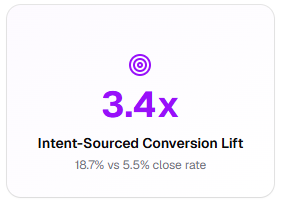
With an 18.7% conversion rate versus 5.5% for cold ICP-match outreach, intent-sourced leads convert 3.4x more often. Building a trigger-led prospecting motion is where the conversion rate gap lives.
Chasing every inquiry instead of targeting contract-ready accounts. Transactional freight leads, such as one-off shipments and spot market rate shoppers, churn fast and rarely build into stable revenue. The outbound motion should target accounts with recurring volume, defined lanes, and a procurement process.
Bad data and wrong contacts. Reaching a general inbox or an administrative assistant instead of the supply chain director wastes campaign budget and damages sender reputation. Clean, ICP-based targeting that includes role accuracy, company fit, and verified contact information improves response rates by 40%.
Stopping after one or two touches. A prospect who is not ready to switch providers today may be the right conversation in 60 or 90 days. It takes six to eight touchpoints to book a meeting in logistics. Campaigns that stop after two touches abandon most of the opportunity the targeting effort created.
Over-relying on referrals and broker networks. Referrals convert better. But they are not scalable or predictable. A pipeline built entirely on word-of-mouth is one bad quarter away from a revenue problem. Outbound gives you control over timing, targeting, and volume in a way referral networks never can.
Treating the campaign as a one-off event. Companies that run logistics outbound consistently for a year capture far more buying windows than those running three-week campaigns. Buyers move on long cycles. Consistent presence is what earns consideration when the window opens.
Logistics is a relationship business with a long memory. Win an account, and it tends to stay won. Lose it, and you may not get a second chance for years.
The companies building predictable pipelines in this sector share the same principles. They target high-fit accounts around their strongest lanes and freight types. They lead with reliability and proven performance rather than price. They reach multiple stakeholders per account rather than one champion.
And they show up consistently enough to be in the conversation when the buying window opens.
For most logistics companies, building and running this outbound motion internally competes directly with the time and attention needed to actually move freight and serve existing accounts. It is one of the most common reasons logistics providers outsource the top-of-funnel to a managed programme while keeping closing and account management in-house.
The goal is to build a predictable pipeline of qualified opportunities around the accounts most likely to buy. If that is what you need, book a call with Whistle and let’s talk about how to build a pipeline around the right accounts.
Outsourced SDR
Whistle installs a fully managed SDR team - outreach, tech, data and reporting all handled - so qualified meetings land on your calendar instead of your to-do list. See how this model works for logistics and manufacturing companies. Live in 10 business days.
Grow my pipeline →
What is logistics lead generation?
Logistics lead generation is the process of identifying and engaging companies that need freight, warehousing, or supply chain services. Specifically, the internal decision-makers who evaluate providers and control budgets. It differs from general B2B lead generation in that buying cycles are longer, switching costs are higher, and multiple stakeholders are involved in almost every purchase.
Who are the real buyers in a B2B logistics sale?
The four roles that typically appear are the Head of Operations or Supply Chain Director, the Procurement or Purchasing Manager, the Logistics or Transport Manager, and the Head of IT or Systems Owner for software purchases. Each evaluates a new provider through a different lens, which is why single-threaded outreach rarely works in logistics.
What channels work best for logistics lead generation?
Email, phone, and LinkedIn are the core three. Email works well because operations and procurement leaders are inbox-driven. Phone works because logistics is time-sensitive and operators are used to taking calls. LinkedIn is most effective for director-level and above. Multi-channel outreach consistently outperforms single-channel across all of these categories.
How long does a logistics sales cycle typically take?
Mid-market and enterprise contract logistics commonly runs three to nine months from first contact to signature. Software deals into large shippers can run longer. Any outbound programme that does not account for this timeline will produce inconsistent results.
What messaging works with supply chain buyers?
Messaging anchored to a specific operational pain the buyer is currently experiencing. Detention costs, capacity gaps, customs delays, or the cost of excess safety stock. Quantified outcomes from comparable shippers. A low-friction ask. Generic claims about competitive rates or digital transformation are the fastest way to get deleted.
What trigger signals should logistics companies watch for?
Contract renewal windows, new facility openings, senior hires in operations or procurement, service failures with an incumbent, and funding rounds for supply chain software buyers. Outreach that lands during one of these moments converts at significantly higher rates than outreach sent on a static, untriggered cadence.
Should logistics companies build in-house SDRs or outsource lead generation?
For most logistics providers, the answer depends on whether the internal team has the bandwidth to run a consistent outbound motion alongside the operational demands of the business. Many outsource the top-of-funnel to a managed programme while keeping account management and closing in-house, because building and sustaining the outbound infrastructure internally competes with the core business.





.jpg)