

Go-to-Market

Lauren Daniels
August 19, 2026

Cold calling is one of the most effective lead generation tactics available to B2B sales teams. Only 24% of sales professionals say they use it regularly.
That gap is worth sitting with for a moment, because it is an execution gap.
Here is what it looks like inside most sales organisations. Account executives spend 30-40% of their time on prospecting activities when they should be closing deals. Cold calling gets started, then paused, then restarted, then quietly abandoned when quarter-end pressure arrives. The activity never becomes consistent enough to produce anything predictable.
The results are there for teams that stick with it. Companies using cold calling generate 50% higher close rates than those relying exclusively on inbound. But that outcome depends on discipline and a specific set of skills that most internal teams do not have and were never hired for.
Which raises the question a lot of sales leaders are circling right now. If cold calling works, and your team is not doing it properly, is it time to bring in people who will?
Despite predictions of decline, cold calling remains effective. Data shows that 69% of buyers accept cold calls from sales reps.
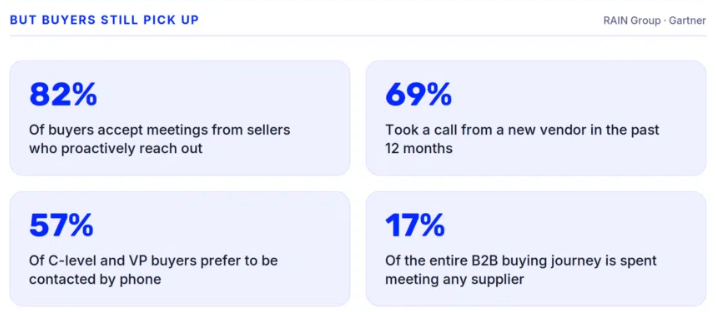
The performance data is harder to argue with than the opinions. Companies using cold calling close deals 5x faster than those relying solely on email, compressing the average sales cycle from six months to two or three.
Revenue contribution is where most teams underestimate the channel entirely. For companies executing it consistently, cold calling generates roughly 40 to 50% of enterprise pipeline. Despite that, it usually sits in the plan as a secondary channel, something reps do when there is time.
Cold calling delivers a cost per qualified meeting of $300 to $500, compared with $800 to $1,500 for marketing-generated leads. Few channels produce that kind of gap.
So why did so many teams walk away from it?
Mostly for reasons that have nothing to do with performance. Cold calling is difficult. Rejection carries an emotional toll. Every hour spent dialling competes with an hour spent closing. Put those together, and the channel starts to feel inefficient, even when the numbers say otherwise.
That perception created the opportunity. Sales teams with dedicated cold callers outperform teams where AEs split their time between prospecting and closing by 2 to 3x on pipeline generation. Specialisation is what separates them.
None of this is a criticism of your account executives. It is a description of what happens when you ask one role to do two jobs with opposing rhythms.
Time competition. An AE spending 30-40% of their time prospecting has only 60-70% left for closing, negotiation, and customer management. The optimal split puts 80% or more into revenue-generating activity. The math does not work.
Skill mismatch. Cold calling asks for resilience to rejection, persistence through low response rates, and efficient navigation of large data sets. Closing asks for something quite different. Both are learnable. They are not the same skill.
Volume inefficiency. AEs average 5-10 dials a day. Effective cold callers average 40 to 80. Volume targets that assume the first number will grow into the second rarely get reached.
Inconsistency. Cold calling is the first activity paused during busy closing periods, prospect meetings, or admin backlogs. Every pause costs momentum, and momentum is most of what makes outbound work.
Emotional toll. Rejection creates real psychological pressure. Given a choice between a cold list and a warm opportunity they feel confident closing, most AEs will choose the warm one. That is a rational decision on their part, and a structural problem on yours.
Opportunity cost. Every hour an AE spends dialling is an hour not spent on pipeline development, deal advancement, or negotiation, where their closing skills create considerably more value.
The financial case is straightforward enough to model before you commit to anything.
Entry-level cold callers cost $35,000 to $50,000 annually. Senior callers with proven track records run $50,000 to $75,000, including benefits and overhead.
Against that, the average cold caller books 8 to 15 qualified meetings monthly and generates $100,000 to $250,000 in attributed pipeline value. Companies that track attribution carefully find 40 to 50% of total pipeline sourced from cold calling activity.
Timing matters when you set expectations internally. A typical cold caller becomes cash-flow positive within 3-4 months as meeting bookings ramp, with full ROI demonstrated within 6-9 months. Anyone promising faster is either lucky or counting the wrong things.
The economics also improve as you scale. Each additional cold caller costs incrementally less, because infrastructure, scripts, data sources, and management become fixed costs spread across a larger team.
Compared with the alternatives, the cost per qualified meeting tells the clearest story:
The compounding effect is what most finance teams miss. Companies hiring dedicated cold callers increase total pipeline by 30 to 50% within the first six months, without a proportional increase in account executive headcount.
The decision to hire cold callers usually becomes obvious once you look at specific conditions rather than general ambition.
Your account executives are drowning in prospecting. When AEs consistently spend 40% or more of their time prospecting instead of closing, cold calling support stops being an improvement and becomes critical.
Pipeline generation is inconsistent. Seasonal revenue fluctuations or an unpredictable inbound flow point to a channel that could provide stability and predictability.
You are expanding geographically. Entering new markets where brand awareness is low is exactly where outbound cold calling accelerates the timeline.
You are launching a new product. Cold calling educates the market efficiently and builds an early adopter base while awareness is still forming.
Your sales team is growing. Hiring additional account executives creates a need for concurrent prospecting capacity. Without it, you have added closers to a pipeline that cannot feed them.
You have data you are not using. Plenty of companies have prospect lists and no execution capability. Dedicated cold calling infrastructure turns a dormant asset into conversations.
Your market is crowded. When buyers face many similar vendors, persistent outreach does what passive inbound cannot.
You sell into enterprise. Enterprise deals require multiple touches and relationship building. Cold calling initiates conversations that internal marketing has no route to reach.
An honest assessment includes the situations where this investment underperforms.
Highly complex consultative sales. Solutions requiring extensive discovery often need warm introductions and pre-qualified meetings rather than cold outreach.
Brand-new markets. Where buyer awareness does not yet exist, educational marketing usually has to come first for cold calling to land.
Extremely low-intent categories. If decision cycles stretch beyond 12 months and early conversations carry limited value, the investment is difficult to justify.
Regulatory constraints. Heavily regulated industries, or markets restricted to opt-in calling, can limit applicability severely.
Operational chaos. Broken sales processes, poor CRM discipline, and weak messaging do not get fixed by adding dials. Cold calling investment tends to get consumed trying to compensate for downstream problems.
Single-buyer sales. Solutions bought by a small group of individual contributors, with no buying committee, rarely justify volume cold calling.
If two or three of these describe your business, fix those first. The channel will still be there.
Both models work. They solve slightly different problems.
Execution is what determines whether the decision pays off.
Volume with quality. Effective cold calling balances reach, 40 to 80 dials daily, with enough research and personalisation to make the conversation relevant. Neither number works alone.
Persistence with respect. Follow up consistently, roughly 8 to 12 touches over three to four weeks, while reading disinterest signals honestly and removing non-responsive accounts.
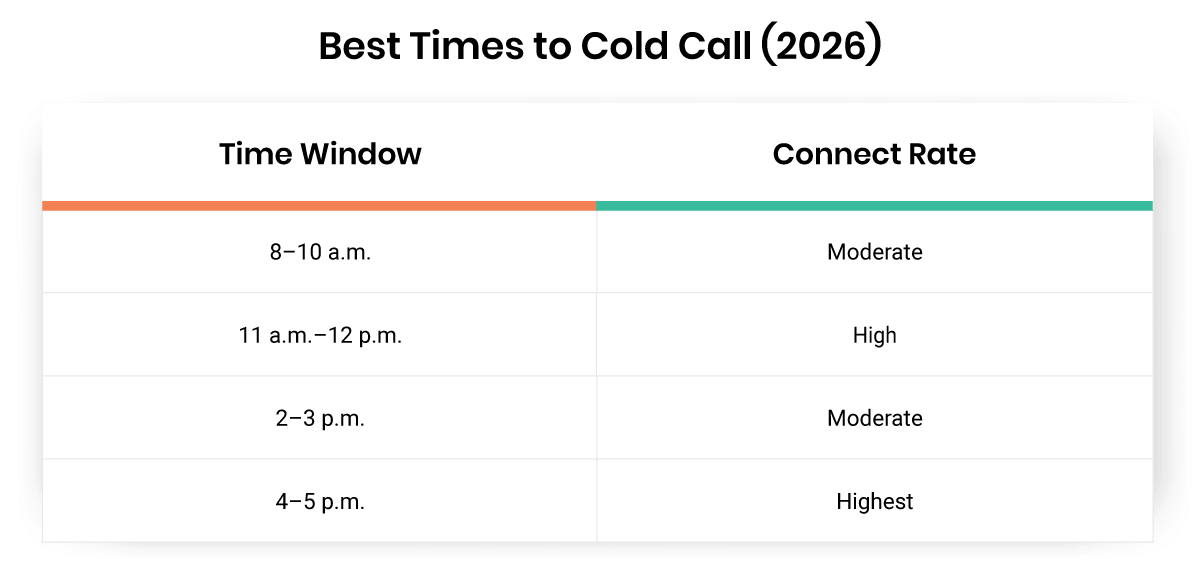
Timing optimisation. Call during prospect business hours when decision-makers are available. Tuesday to Thursday mornings typically yield connect rates of 20 to 30%.
Clear value articulation. Opening statements should lead with the prospect's benefit, not your product's features. The first ten seconds establish whether there is a reason to keep talking.
Objection handling frameworks. Budget concerns, timing questions, competitor comparisons, and simple lack of awareness come up constantly. Prepare confident responses rather than improvising each time.
Meeting quality focus. Qualify for decision-maker presence, budget existence, and timeline alignment so that what reaches your sales team is worth their attention.
Continuous training. Regular coaching, call reviews, practice on new approaches, and recognition of wins keep skills developing rather than plateauing.
Metrics discipline. Track leading indicators such as dials, connects, and voicemails alongside lagging indicators such as meetings booked, pipeline generated, and revenue attributed. One set tells you what happened. The other tells you why.
Most cold calling efforts fail because the right foundation isn’t in place. Here are the key pieces to have ready before the first dial.
Here is what to watch, and the range that indicates a healthy programme.

If outsourcing looks like the better route, the provider decision matters more than the model decision.
Relevant expertise. Look for experience in your industry or a similar sales motion. A generic call centre without a B2B sales background will sound like one.
Team quality and stability. Ask whether you get dedicated resources or rotating callers. Ask about turnover rates and team backgrounds. Consistency on your account is what compounds.
Technology and infrastructure. Confirm CRM integration, quality dialling infrastructure, call recording, and reporting that goes beyond activity counts.
Quality assurance process. How do they monitor calls, deliver feedback to callers, and make sure conversations sound consultative rather than robotic?
Reporting transparency. You want real-time visibility into activity, meetings booked, and pipeline generated. Activity metrics that do not correlate to results are noise.
Pricing alignment. Fees tied to meetings booked and pipeline generated align incentives. Fees tied purely to activity do not.
Cultural fit. Your callers represent your brand. They need to understand your target customers and deliver your value proposition credibly.
The channel is not standing still, and the changes are mostly making it more effective rather than less.
AI-assisted dialling, through predictive dialers and call coaching, is improving productivity without removing the human relationship skills that make calls work. Data enrichment and AI are enabling personalisation at a scale and volume that was not previously possible.
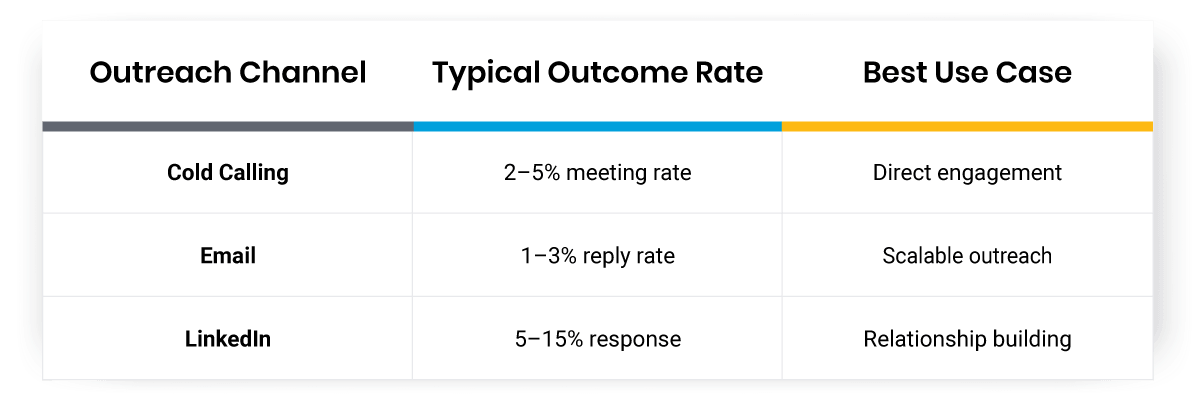
Cold calling is also becoming less of a standalone activity. Teams increasingly coordinate it with email, LinkedIn, and SMS as part of orchestrated outreach programmes, and video calls and messaging channels are expanding how cold outreach happens alongside traditional voice.
On the operational side, compliance automation is reducing manual overhead around do-not-call management, recording consent, and data privacy. And commercially, the market is moving towards outcome alignment, with more providers tying their compensation to qualified meetings and results rather than activity.
A cost per qualified meeting of $300 to $500 runs 40 to 60% below marketing-generated leads or SDR-sourced meetings. Companies that hire dedicated cold callers typically see 40-50% of total pipeline sourced from cold calling within 6-9 months of launch.
None of that happens automatically. Success requires high-volume activity of 40 to 80 dials daily, quality targeting, consultative messaging, real objection handling skill, and follow-up that does not quit after two attempts. The channel works best for enterprise deals, geographic expansion, new product launches, and any situation where your AEs have become the prospecting bottleneck.
Which brings the decision down to two questions. Can your internal account executives be freed up to close? And is there a pipeline generation gap that cold calling could realistically fill?
If the answer to both is yes, the next step is working out which model fits. Whistle can help you assess whether cold calling makes sense for your business. If you decide to build the function internally, we can help you put the right programme and infrastructure in place. Book a meeting to discuss what could work for your business.



%20.jpg)

.jpg)
%20.jpg)