

Go-to-Market

Lauren Daniels
June 17, 2026

Your SDR dashboard shows dials made, emails sent, and meetings booked. What it doesn't show is the quiet struggle happening behind every single one of those activities.
SDR productivity breaks down long before activity metrics ever flag a problem. It happens through lost time, fractured focus, and a slow erosion of confidence in the sales stack.
According to Salesforce’s State of Sales research, sales representatives spend a mere 28% to 30% of their week on actual selling activities. The rest of their time is swallowed by administrative overhead, tool navigation, and data hunting.
When sales development representative (SDR) productivity drops, leadership often defaults to treating it as a capacity problem—assuming they need to hire more heads or buy more technology. In reality, it is an execution problem driven by two invisible pipeline killers: bad data and tool sprawl.
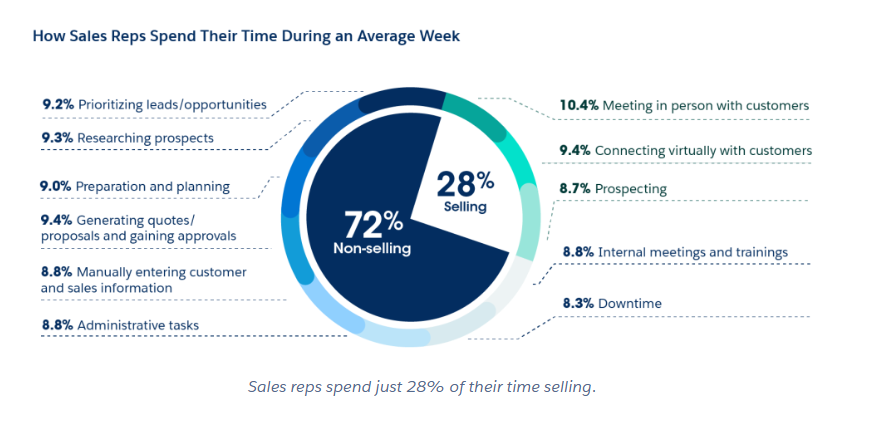
Most modern sales dashboards are built to measure outward volume: number of dials, email volume, and tasks completed. While these metrics look clean on a spreadsheet, they fail to track the effort, friction, and downtime required to generate those actions.
The gap between raw activity and actual execution efficiency shows up in lagging indicators that leadership struggles to diagnose: longer rep ramp times, wide performance gaps between top and bottom performers, and a gradual decline in pipeline quality.
When data quality is poor, it creates a severe flow issue. Every wrong phone number, outdated job title, or missing mobile contact forces a representative to pause, switch tabs, open an alternative tool, and hunt for the correct details.
This downtime between sales actions damages the pipeline far more than a low baseline activity count. It breaks a rep's momentum and replaces confident execution with constant hesitation. Once an SDR stops believing that the data in front of them is accurate, call reluctance creeps in silently—even while their automated email cadences keep the dashboard looking healthy.
In sales leadership, bad data is usually categorized strictly as a compliance or data quality issue. From an execution standpoint, however, bad data is a workflow problem that disrupts human rhythm.
Research from ZoomInfo indicates that sales professionals spend roughly 27.3% of their time dealing with inaccurate contact data. When more than a quarter of a representative’s day is spent navigating bad records, the sales process suffers structural damage.
Over time, sales teams don't just lose isolated minutes; they lose overall momentum and belief. The spreadsheet says they are hitting their daily activity counts, but the human execution behind those numbers is fragmented and defensive.
Most modern SDR technology stacks were never intentionally designed—they accumulated. Over time, leadership layers a CRM with a dialer, multiple data enrichment tools, various Chrome extensions, LinkedIn Sales Navigator, internal spreadsheets, and a wave of new AI tools.
While each software purchase promises to add leverage, tool sprawl actually introduces massive cognitive load. More software does not equal more pipeline if every added tool requires more micro-decisions per hour from your representatives.
The Cognitive Load Trap: Reps end up spending more time navigating interfaces, copy-pasting text, and logging details across different systems than they do speaking directly to prospects.
This creates a heavy friction layer that traditional analytics software completely misses. AI prospecting tools often add to this noise rather than removing it. Instead of simplifying the outreach motion, they present representatives with an overwhelming number of options, variables, and personalizations to evaluate before sending a single message.
When reporting capabilities improve while actual execution speed slows down, it means leadership is getting better dashboards at the direct expense of the representative's daily workflow.
Because dials are being tracked, emails are leaving the system, and daily tasks are technically being marked as complete, sales leaders often assume the outbound engine is functioning perfectly.

What remains invisible to leadership is the systematic leakage happening between the metrics. The table below outlines how this hidden friction transforms day-to-day rep behavior into direct pipeline damage:
Because standard reporting software tracks output rather than internal flow, managers cannot coach what they cannot see. When pipeline targets begin to slip, organizations frequently respond by buying more tools or pushing for higher activity volume, treating a clear execution bottleneck as a capacity shortage. The result? Activity counts stay high, but connection rates fall, conversation quality drops, and the qualified pipeline steadily degrades.
While bad data and tool sprawl affect sales organizations globally, Europe, the Middle East, and Africa (EMEA) sales development teams experience these operational bottlenecks much faster than their North American counterparts.
Because EMEA leaders cannot simply throw more bodies at a broken process, maximizing execution efficiency within a clean, tightly integrated stack is a baseline requirement for survival.
High-performing outbound teams do not look for magic tools or silver-bullet software patches. Instead, they ruthlessly protect their representatives' focus and cognitive velocity by designing an environment built entirely around predictable execution. They understand that a rep’s value lies in their ability to have meaningful business conversations, not their capacity to manage a complex IT infrastructure.
Top sales organizations use fewer tools and ensure the team adopts them deeply, rather than spreading attention across six or seven distinct platforms that each do one job partially. They actively remove choices from the representative's desk. When a stack is overly complex, reps waste hours managing data handoffs between systems, troubleshooting sync errors, and logging the same activity in multiple places. High-performing leaders audit their technology with a simple rule: if a tool does not directly decrease the time between actions or demonstrably improve conversation quality, it gets cut. By narrowing the toolkit down to a few essential, deeply integrated systems, they eliminate the friction of context switching and allow reps to achieve mastery over their daily workflow.
Instead of expecting SDRs to guess which mobile number or email address is correct, leadership maintains clear, firm opinions about which data sources are trusted and standardizes the workflow around them. Leaving data validation to individual reps is an expensive operational mistake; it forces your highest-leverage outbound assets to spend their mornings cross-referencing contact records across three different browser extensions. Elite teams remove this guesswork by establishing a strict "single source of truth." They determine which provider offers the highest verified accuracy for their specific target market and lock that path in. Reps open a record, see a phone number, and dial it with absolute confidence, entirely removing the pre-call hesitation that kills daily volume.
Rather than chasing noisy, broad third-party intent data that creates false urgency and leads to untargeted blasting, high-performing teams prioritize clear, first-party trigger events—such as verified job changes, key leadership movements, and targeted company events. Generic intent data often flags account-level spikes that are impossible for an SDR to contextualize, leading to generic messaging that buyers ignore. Conversely, hard trigger events give reps a concrete, unarguable reason to reach out. When a previous user of your software takes a new leadership role at a target account or a prospect company announces an expansion into a new territory, the narrative hook is already written. High-performing teams build their sequences around these high-probability events, turning cold outreach into highly relevant, timely business conversations.
Great SDR leaders view the calling environment as a space for focus, not just executive compliance. They build a clean system architecture where the software keeps the representative in a steady operating rhythm, removing manual data entry and preventing them from breaking focus between actions. They recognize that a rep who is "in the zone" delivers a completely different energy on a live call than a rep who is stopping for three minutes between dials to update CRM fields. These teams configure their environments so that call logging, disposition tagging, and next-step scheduling happen automatically or with a single click. By optimizing for human momentum, leadership ensures that reps spend their energy mastering the quality of the live conversation, rather than just hitting a raw number of dials on a spreadsheet.
If your team's pipeline is slipping despite high activity metrics, you need to actively audit your sales stack and remove the operational friction slowing down your reps.
Review your data bounce rates, connection failures, and "wrong number" dispositions over the last 90 days. Focus investments heavily on securing high-accuracy direct-dial mobile numbers and verified business email addresses to eliminate representative hesitation and pre-call data hunting. When reps are forced to dial generic corporate switchboards or unverified extensions, their connect rates plummet, and their call reluctance spikes. By guaranteeing data accuracy at the source, you protect your team's mental energy, allowing them to focus entirely on execution rather than data verification.
Enable CRM-native prospecting views and workflows that consolidate your dialer, email cadences, and account insights into a single panel. Eliminate manual copy-paste work, constant browser tab-switching, and external tracking spreadsheets so reps can execute their core outbound sequences out of a single primary interface. Minimizing the physical steps required to move from one prospect to the next drastically reduces the micro-distractions that break a representative's concentration, allowing them to build a smooth, repeatable prospecting rhythm.
Implement automated job change tracking and automatic database cleaning rules directly within your data ecosystem. Ensure that outbound lead lists stay updated in real time, filtering out professionals who have moved companies or changed internal roles. When account hygiene is automated, representatives can launch targeted campaigns confidently, knowing their targets are active and the messaging remains highly relevant. This removes the administrative burden of list scrubbing from your SDRs, giving them back hours of active selling time each week.
Deploy modern, integrated dialing configurations that automatically handle call routing, drop voicemails with a single click, and sync dispositions directly to your records. Your system must minimize manual post-call logging and protect the representative's natural conversational flow, ensuring analytics and compliance features capture data quietly in the background. A streamlined calling workspace keeps the rep focused on the prospect's tone and objections, rather than forcing them to battle a clunky interface between conversations.
Evaluate your entire sales technology stack and remove 30% to 50% of your underutilized single-feature tools, niche browser extensions, and redundant platforms. Stacks built on software sprawl often mask execution inefficiencies under the guise of "added features." Lowering the absolute number of tools your team must interact with drastically reduces the cognitive load that kills execution speed across the floor. By simplifying the toolkit, you make onboarding faster, lower software overhead, and ensure your team achieves true mastery over their core workflow.
SDR productivity is fundamentally an issue of human flow and mental focus. While your operational dashboards may look perfectly healthy because they measure surface-level activity counts, your sales pipeline degrades when friction clogs the space between those metrics.
Bad data breaks momentum by forcing constant hesitation, causing your representatives to second-guess their leads and lose faith in their tools. At the same time, tool sprawl adds heavy cognitive load, forcing reps to manage complex software setups rather than engaging with buyers. High-performing sales organizations fix this by simplifying their technology infrastructure, standardizing their data sources, and designing a sales environment built for momentum over raw compliance.
Want to optimize your sales stack for real pipeline growth?
Building an efficient, scalable outbound engine requires aligning clean data, clear workflows, and sharp team execution.
At Whistle, we help business-to-business organizations audit their sales systems, eliminate tool friction, and build high-performing go-to-market strategies that drive predictable revenue performance.



.jpg)

%20.jpg)