
B2B Insights

Lauren Daniels
June 4, 2026

87% of sales teams are experimenting with or have fully implemented AI, according to Salesforce's State of Sales report. Yet 95% of enterprise AI pilots produce zero measurable revenue impact, per MIT's NANDA research group, which analyzed 300 public deployments and surveyed 350 practitioners. Near-universal sales AI adoption and near-universal failure are happening at the same time. That is the central tension of AI in tech sales in 2026.
The gap between teams using AI and teams benefiting from it comes down to four failure modes: stale data feeding bad outputs, over-scoping across too many use cases at once, undertraining on tools that need weeks of iteration to perform, and shadow AI usage that makes results invisible to leadership.
Gartner predicts 60% of AI projects lacking AI-ready data will be abandoned through 2026. Most teams are not starting with data readiness. They are starting with tool procurement.
When implemented correctly, the lift is significant. Sales teams using AI generate 77% more revenue per representative than those that do not, according to Gong's analysis of enterprise sales across thousands of organizations. Bain's Technology Report 2025 found that sellers currently spend only 25% of their time actually selling, and that AI could effectively double active selling time by automating the administrative work surrounding every deal.
The use cases that deliver reliable ROI fall into 6 categories:
Each has a different maturity level, different data requirements, and a different timeline to optimization.
The hype zones are real, too. Fully autonomous AI sales tools work for transactional deals below $10,000. For complex, multi-stakeholder B2B sales, the hybrid model consistently outperforms both full automation and purely human execution.
Over-automating outbound without human review produces generic sequences that damage sender reputation and burn deliverability. Hallucinations in regulated industries remain a credibility risk.
The playbook for the 5% that succeed is consistent: audit your process before buying tools, fix your data layer first, pick one narrow use case, train for six or more weeks, QA daily for ninety days, then scale.
Companies that purchase AI sales tools from specialized vendors succeed 67% of the time. Internal builds succeed only a third as often, per MIT's research. AI in tech sales is not a shortcut. It is a compounding investment, and the compounding only starts when implementation is done right.
The most common starting point for AI in tech sales is a CRM with 8,000 contacts. Your AI scoring model has been trained on that data. What the model does not know is that 2,400 of those contacts changed roles in the last six months, 900 emails no longer resolve, and 1,100 records belong to companies that have been acquired, downsized, or shut down.
Your AI produces confident outputs from unreliable inputs, and your reps chase leads that do not exist in the form the model thinks they do. This pattern is the most common source of failed AI in B2B sales deployments.
This is not a technology problem. It is a data problem, and it precedes almost every failed AI in tech sales initiatives. Gartner reports that 85% of AI projects fail due to poor data quality or lack of relevant data. Teams invest in AI sales tools before they invest in what feeds them.
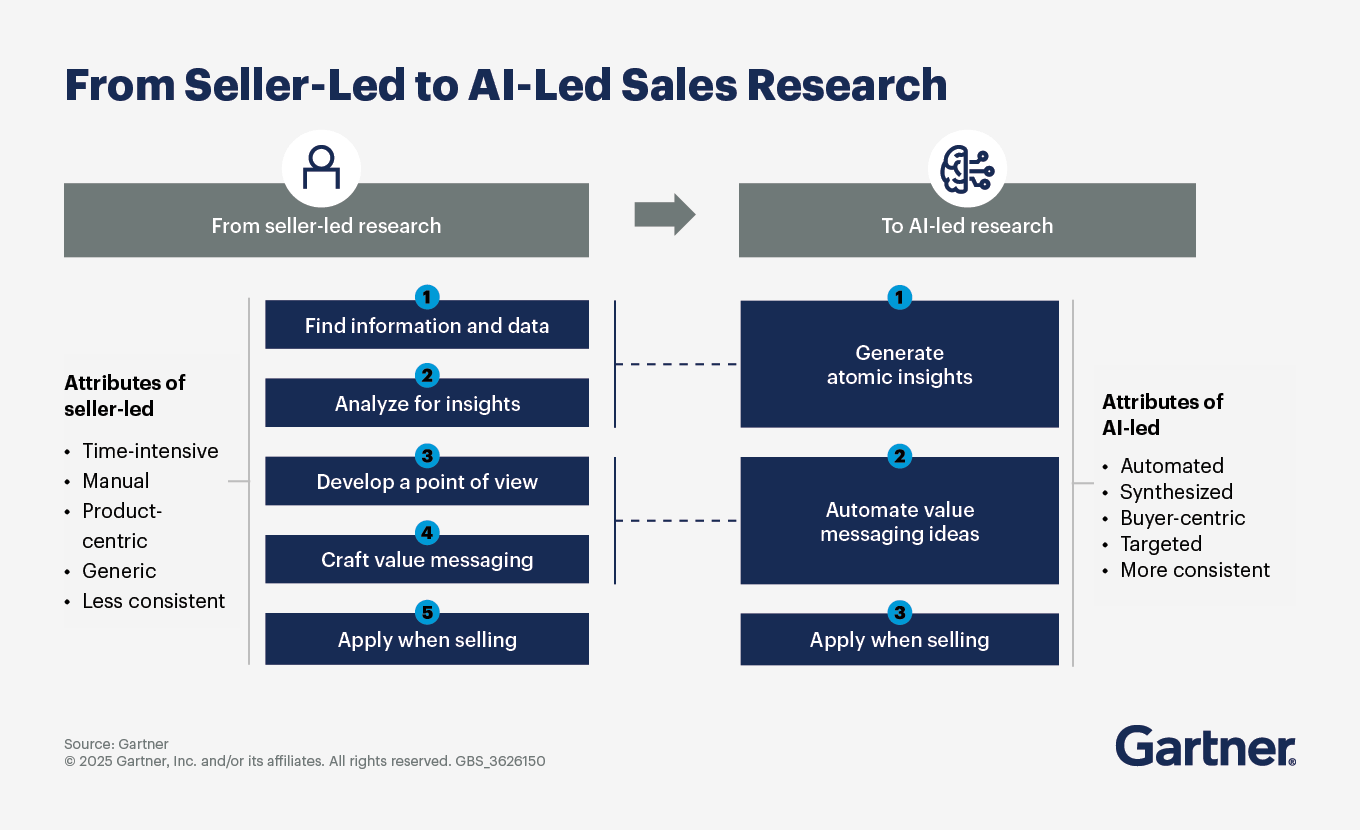
Around 47% of sales reps now spend 30 to 60 minutes a day operating AI tools, roughly the same time they previously spent on CRM. When AI adds a workflow step instead of removing one, it creates a net drag. The AI sales tools are running. The productivity is not improving. Teams are getting busier, not better.
The question going into any AI in tech sales initiative is not which tool to buy. It is whether the underlying data, process, and governance are ready for a tool to run on top of them.
The promise of AI in tech sales is not that machines replace salespeople. It is that salespeople get back the time they currently spend on everything other than selling. Sales reps spend only about a quarter of their working hours in actual selling conversations. The rest is research, logging, sequencing, scheduling, and administrative overhead that requires time but not judgment.
Gong Labs analyzed over one million deals across 1,418 organizations and found that deals where reps followed AI-recommended actions closed at 50% higher rates. That is not a marginal improvement. Bain's research points to 30% or better improvement in win rates when AI is deployed effectively. McKinsey estimates generative AI will unlock $0.8 to $1.2 trillion in incremental productivity across sales and marketing as a whole.
The teams realizing those numbers in AI in B2B sales share one characteristic: they chose to redesign their workflows around AI rather than simply layer it on top of existing ones. A scoring model built for AI for sales teams plugged into a broken qualification process produces faster bad decisions. The same model plugged into a redesigned qualification process produces faster good ones.
| AI Use Case | Primary Benefit | Typical Timeline to ROI | Data Dependency |
|---|---|---|---|
| Lead scoring and prioritization | Reps focus on highest-intent accounts | 4-8 weeks with clean CRM data | High: complete firmographic and behavioral data |
| Signal-based outbound prospecting | 15-25% reply rates vs. 3-5% for generic cold email | 6-10 weeks | High: verified contacts refreshed regularly |
| Conversation intelligence | Coaching at scale, win-rate improvement | 8-12 weeks of call volume | Medium: improves with more recorded calls |
| AI-assisted email personalization | 10% higher open rates, double reply rates | 4-6 weeks | Medium: needs prospect research inputs |
| Pipeline forecasting | Catch slipping deals before commit calls | 10-14 weeks of historical data | High: requires accurate CRM hygiene |
| research on AI sales forecasting implementations found a 398% ROI over three years with less than a six-month payback period for properly configured deployments. Deal coaching surfaces risk signals mid-cycle: single-threaded deals, stalled next steps, missing economic buyers. These are patterns that experienced managers recognize in reviews. AI surfaces them automatically across every deal in the pipeline, not just the ones that come up in the one-on-one. Why 95% of AI Sales Pilots FailThe number is from MIT's NANDA research group, and it is specific: 95% of organizations deploying generative AI in sales saw zero measurable P&L impact. This is AI in tech sales' defining challenge. The research analyzed 300 public deployments, interviewed 150 practitioners, and surveyed 350 employees. Not low returns. Zero. Four failure modes account for nearly all of the failures. The Utilization GapMore than 70% of B2B organizations have adopted AI sales tools, but fewer than half fully utilize them. Teams buy AI sales tools, run a demo, and then revert to existing workflows because the tool was never integrated into the daily process. Adoption without utilization is an expense, not an investment. The Productivity ParadoxWhen AI adds a step rather than removes one, it creates a net drag. Reps are spending 30 to 60 minutes a day operating AI tools, which is one of the most overlooked costs in AI in B2B sales programs. That time previously went to prospecting or call preparation. Bain calls this the micro-productivity trap: piecemeal usage that produces small gains in isolated tasks but never compounds into revenue impact because the workflow design has not changed. Vaporware and OverpromisingSome AI sales tools demo capabilities that do not exist reliably in production. The training data is thin, the automation requires constant intervention, and 43% of executives cite AI hallucinations as a top concern. In regulated industries like fintech and medtech, an AI-generated message that references the wrong product, regulation, or company context creates credibility damage that is hard to recover from. Shadow AI and Governance GapsReps using unsanctioned tools to draft emails, research accounts, or summarize calls create a measurement problem. Leadership cannot optimize sales AI adoption metrics that they cannot see. Shadow usage means the data feeding models are ungoverned, outputs are untracked, and the gap between what is being used and what is measured widens every week. How to Build an AI Sales Program That CompoundsThe teams that succeed with sales AI adoption follow a consistent six-step sequence. None of it is glamorous. All of it is necessary. Audit your process before buying anythingMap where reps currently spend time across the full sales cycle. This is where AI for sales teams delivers disproportionate leverage. Identify the highest-friction, lowest-judgment tasks. Those are the starting points, not the most sophisticated use cases. Fix your data layer firstClean CRM data, verified contact records, and a defined refresh cadence are prerequisites. AI sales tools are only as reliable as the foundation beneath them. If your contact database refreshes every six weeks, your AI is targeting a portrait of the market from six weeks ago. Buy from specialized vendors, not build internallyMIT's research found that purchasing AI tools from specialized vendors succeeds 67% of the time, versus one-third for internal builds. Unless your organization has a dedicated ML team and the runway to build and iterate, use proven tools. Pick one narrow use case and get it rightResearch and first-touch email drafting are the most common starting point for AI for sales teams. Lead scoring is a close second. Sales AI adoption fails most often when teams try to prove too many things at once. Do not attempt to automate the full AI in B2B sales cycle in the first quarter. Train for six or more weeks before judging resultsAI SDR tools need at minimum 200 iterations to approach top-rep performance. Evaluating results in week two is like reviewing a new hire after their first day. The optimization curve is real, and it requires time. QA daily for ninety days, then scaleDaily audits for the first ninety days are non-negotiable for AI for sales teams, catching errors before they compound into deliverability damage or pipeline distortion. Only after one use case produces measurable, documented results should AI for sales teams add the next. For B2B tech companies building or scaling an outbound function, Whistle works with sales teams to integrate AI tools into SDR workflows that are already producing pipeline, rather than replacing the human layer that closes deals. Our approach to AI in B2B sales pairs AI-powered prospecting signals and data enrichment with vetted SDRs trained to use those inputs effectively, ensuring that your AI investments produce qualified meetings rather than activity metrics. Explore more from our blogUnlock the B2B sales playbooks, outreach strategies, and closing techniques we’ve refined across more than 1,000 successful campaigns. Not Sure Which Service Is Right for You?Let’s figure it out together. Book a quick call and we’ll walk you through the best-fit options based on your goals, team structure, and current setup. Latest posts Demo contentInterviews, tips, guides, industry best practices, and news.  UX review presentationsHow do you create compelling presentations that wow your colleagues and impress your managers? Read post  Migrating to Linear 101Linear helps streamline software projects, sprints, tasks, and bug tracking. Here’s how to get started. Read post  Building your API StackThe rise of RESTful APIs has been met by a rise in tools for creating, testing, and managing them. Read post |