

Go-to-Market

Lauren Daniels
August 13, 2026

Selling into biotech and life sciences is a fundamentally different exercise from selling into most B2B markets. The buyers, researchers, lab managers, procurement leads, and clinical directors are trained to scrutinise evidence. They do not respond to generic cold email sequences. They do not fill in contact forms for mid-funnel content that does not teach them something meaningful about their specific problem.
Sales cycles run between 6 and 18 months. Buying committees span 6 to 10 people per deal. And unlike most B2B categories, the triggers that create genuine purchase intent in biotech are often external events: NIH grant approvals, clinical trial phase transitions, system mergers, EHR upgrade cycles. Outreach that is not timed to those signals tends to land in the wrong window.
The broader data confirms the complexity. B2B buying committees now average 11.2 stakeholders for deals over $50,000, up from 9.7 in 2024, and median sales cycles sit at 121 days for mid-market and 218 days for enterprise accounts.
In biotech, those figures stretch further. Sales cycles in healthcare technology average 12 months and can involve up to nine stakeholders, with the most effective lead generation teams using trigger-based prospecting aligned to real-time signals like grant approvals and clinical trial phases, rather than volume-based approaches.
The agencies that get results in this space know the difference between a CMIO and a CNO. They know which outreach channel reaches a Director of Radiology versus a Lab Manager. And they run coordinated multi-stakeholder campaigns rather than single-threaded cold calls.
The 6 agencies below are worth evaluating for biotech lead generation in 2026.
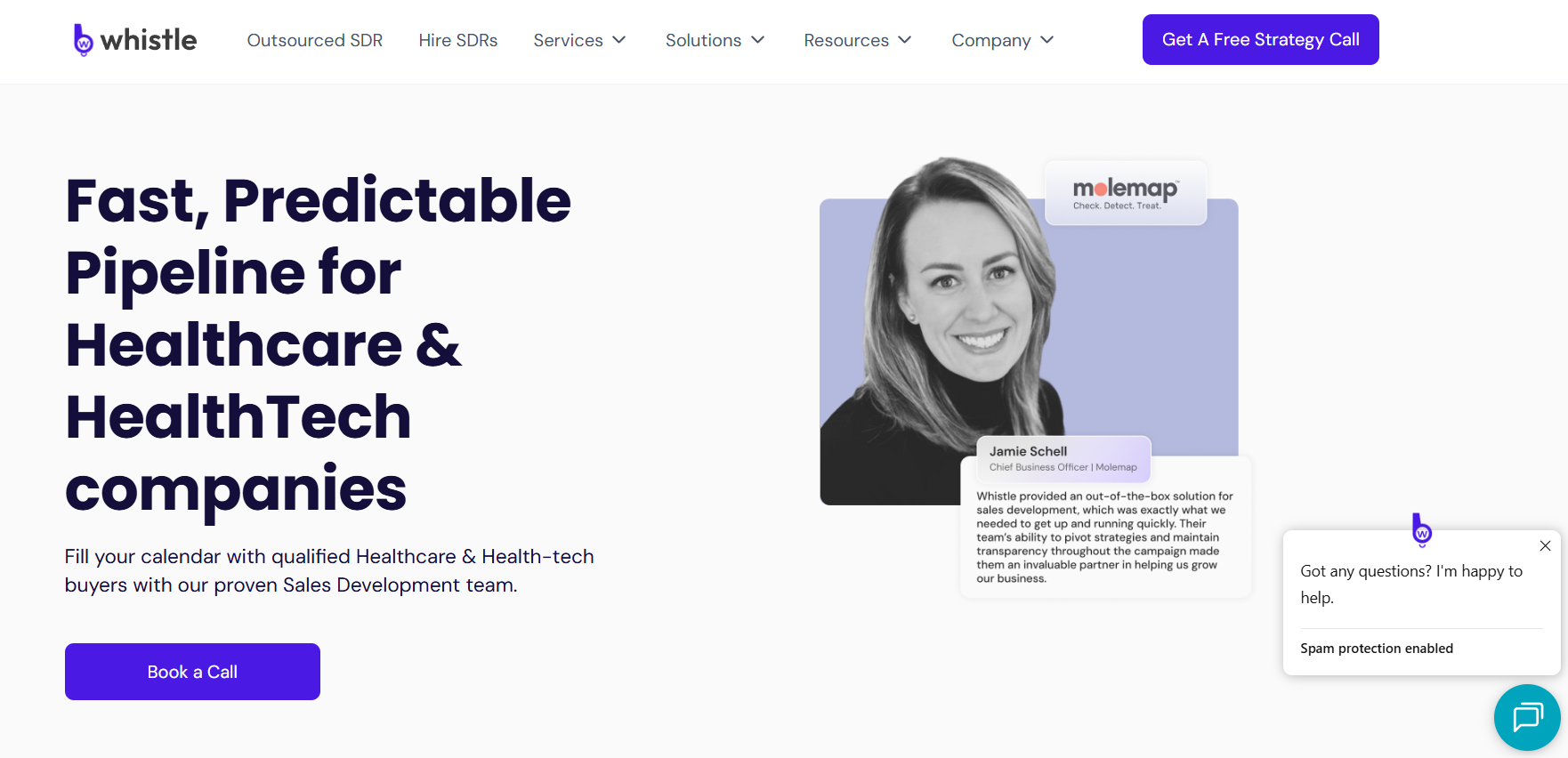
Best for: Biotech, medtech, and health IT companies that need a multi-channel SDR function running in weeks, not months.
Biotech pipeline problems are almost always prospecting problems. The product is good, the value is clear internally, but the right committee never hears about it the right way. Whistle's model addresses that directly: vetted SDRs running coordinated outreach across cold calling, cold email, and LinkedIn as a single sequenced campaign rather than three independent activities.
The advantage lies in coordinated, persona-specific outreach. A Lab Manager, Procurement Head, Clinical Director, and IT buyer each require different messaging and channels to engage effectively.
Whistle assigns SDRs with biotech industry expertise, ensuring outreach is tailored to the right buying personas instead of relying on generic sales pitches.
Engagements go live within days. SDRs integrate directly into your CRM, so pipeline visibility is continuous and handoffs to your internal closers are clean. Across 800+ campaigns and 200+ clients, Whistle has generated more than $15 million in monthly pipeline opportunities. Clients see qualified meetings within the first 14 business days on average.
Companies using outsourced SDR pods generate 3x more weekly touches per prospect compared to solo internal SDRs, which matters specifically in biotech where buying committees are extensive and consistent multi-stakeholder coverage is what keeps a deal moving through a 12-month cycle.
Key services: Outsourced SDR, cold calling, cold email, LinkedIn outreach, SDR talent placement, RevOps support.
Ideal for: Biotech, medtech, SaaS, and health IT companies that need qualified pipeline without the ramp time or overhead of building an internal SDR function.
Best for: Biotech and pharma vendors that need a calling-led US appointment-setting program with experienced telesales reps.
SalesRoads has been running US-based B2B appointment setting for over 18 years. Their reps average well over a decade of experience, and their client history includes biotech-to-pharma campaigns where they built pipeline from a standing start. The model runs on custom playbooks, discovery sessions, and weekly KPI reviews rather than dial volume, which is the right structure for a compliance-heavy, relationship-driven selling environment.
The channel mix is phone and email. If LinkedIn social selling or a heavy inbound component is part of the requirement, SalesRoads is not the fit. Their strength is high-quality calling into US healthcare accounts, which is a legitimate priority for many biotech vendors whose buyers are unreachable by email.
Pricing sits at a premium for a calling-only operation, which reflects the seniority of the reps they deploy.
Key services: US-based B2B appointment setting, custom campaign playbooks, weekly KPI reporting, phone and email outreach.
Ideal for: Biotech and life science companies that need experienced US callers working niche segments like pharma procurement or clinical decision-makers.
Best for: Biotech and medtech vendors that need to reach hard-to-call clinical and lab decision-makers by phone, at a lower entry point.
Superhuman Prospecting runs US-based W2 callers through a proprietary human-to-human calling methodology. They have a dedicated healthcare practice with published campaign examples in imaging and radiology, including outreach to Directors of Radiology and diagnostic imaging decision-makers at hospitals and medical facilities.
What separates them from generic calling shops is a real-time supervision dashboard that surfaces call outcomes, decision-maker conversations, and conversion analytics. For biotech vendors running phone-led campaigns, that level of transparency is not standard. Most calling services offer end-of-week summaries. Superhuman Prospecting gives live visibility into what is actually happening on the phones.
Entry-level packages start under $1,000 per month, making it one of the lower-risk ways to test calling outreach in a new biotech vertical before scaling to a larger multi-channel program.
Key services: US-based cold calling, healthcare-dedicated practice, real-time reporting dashboard, flexible calling subscriptions.
Ideal for: Biotech vendors testing phone-led outreach in clinical or imaging segments who want live campaign visibility without a large upfront commitment.
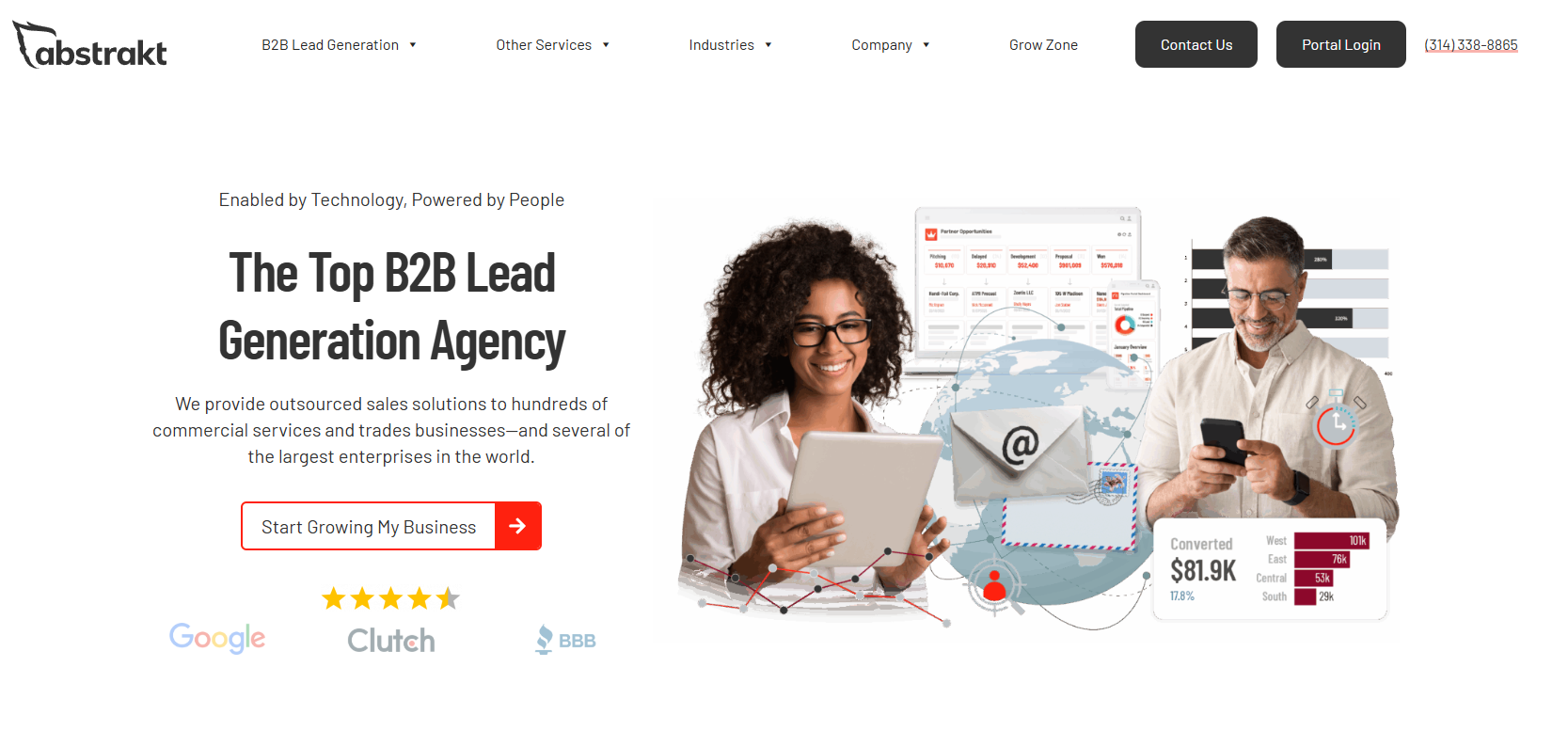
Best for: Healthcare and biotech service companies that want combined outbound SDR and inbound lead flow under one partner.
Based in St. Louis and founded in 2009, Abstrakt is a full-service US growth agency that pairs outbound appointment setting with inbound SEO, content production, creative, and Salesforce-based RevOps. Healthcare sub-sectors including senior care, behavioral health, and hospital services are part of their vertical playbook.
The real-time partner portal gives clients visibility into outbound activity and appointments as they happen. For biotech companies that also have an inbound content requirement alongside outbound prospecting, Abstrakt removes the need to manage two separate vendors.
The trade-off is focus. Abstrakt runs playbooks across 100+ industries. If the requirement is a team that lives exclusively in biotech and knows the buying landscape in depth, a specialist is a better fit. Abstrakt's strength is programmatic breadth, not vertical depth.
Key services: Outbound appointment setting, inbound SEO, content, creative, Salesforce-based RevOps, real-time partner portal.
Ideal for: Biotech service companies that need a long-term growth partner covering both outbound prospecting and inbound content, rather than a specialist team in a single vertical.
Best for: Biotech teams that want one partner managing the full buyer's journey from data and marketing through SDR, sales, and customer experience, built inside their existing CRM.
Founded in Austin in 2006, EBQ supplies managed teams across the complete buyer's journey. Their differentiator is CRM-native delivery: they work directly inside the client's Salesforce or HubSpot instance so every activity is tracked in the system the client already uses. Proprietary call cadences and an internal rating system are layered on top to improve contact and conversion rates over time.
For biotech companies that have already invested in a CRM infrastructure and want an outsourced partner to operate inside it rather than run parallel tooling, EBQ's integration-first model is useful. The trade-off is that their public review base is limited, so independent third-party validation of healthcare-specific results requires direct reference checking.
Key services: Data and marketing, SDR and appointment setting, full-cycle sales, customer experience, CRM-native delivery inside Salesforce and HubSpot.
Ideal for: Biotech and health IT companies that want a single partner across the full revenue lifecycle, operating inside their existing CRM rather than introducing separate outreach infrastructure.
Best for: MedTech and biotech vendors who want an intent-led outbound program with a published SQL guarantee.
MarketJoy positions itself as a healthcare and MedTech lead-generation agency. Their prospecting targets roles like CIOs, CMOs, and procurement heads, and their outreach uses intent signals to prioritise accounts showing active buying behaviour before contact is made.
The differentiator is a published SQL guarantee: MarketJoy commits to delivering an agreed-upon number of sales-qualified leads and continues working at no additional cost if it falls short. For biotech teams under board pressure to show pipeline accountability, that kind of commitment removes some of the risk from the initial engagement decision.
The honest caveat is third-party review volume. MarketJoy's Clutch profile has fewer verified reviews compared to the higher-volume providers on this list. The SQL guarantee is the draw here. Ask for healthcare and biotech client references before committing.
Key services: Intent-based prospecting, healthcare and MedTech specialist outreach, multi-channel campaigns, SQL guarantee.
Ideal for: MedTech and biotech vendors that want intent-led outbound into specific buyer personas with a results commitment built into the contract.
There are a few things worth spelling out for any biotech commercial team evaluating lead generation support, because the assumptions that hold in general B2B do not hold here.
Buyers are trained skeptics. Biotech buyers, including scientists, researchers, medical science liaisons, and procurement specialists, demand evidence-based validation and technical accuracy above all. They are highly skeptical of marketing claims and respond only to content and outreach that demonstrates deep understanding of their specific scientific challenges.
Generic cold email sequences that work in SaaS tend to fail here. The opening line, the angle, and the value framing all need to be technically grounded.
Triggers matter more than timing. The most effective biotech prospecting is about reaching them at the right moment in their buying cycle. Funding events, clinical trial transitions, leadership changes, EHR upgrade cycles, and regulatory milestones all create windows where an outreach lands at the right time. Agencies that monitor and act on those signals outperform agencies that run flat volume-based sequences.
Multi-channel coordination across the committee is the requirement, rather than the nice-to-have. ABM-led programs generate 2.6x more pipeline per marketing dollar than broad-reach demand generation, and in biotech that gap is wider because the buying committee is larger and the single-threaded approach stalls at the first procurement review. Email reaches some buyers. Phone breaks through to others. LinkedIn reaches the senior clinical and IT leaders who do not pick up calls and ignore generic email. Running all three in a coordinated sequence is what keeps a deal moving.
Scientific credibility is a prerequisite for conversion. AI-powered platforms can scale hyper-personalisation while preserving the scientific precision required for biotech credibility. The agencies that succeed in this vertical either hire SDRs with life science backgrounds or invest heavily in vertical training before running a single campaign. The ones that do not tend to produce meetings with the wrong personas at the wrong stage.
These apply to any provider on this list. The answers will help you quickly determine whether the agency has genuine biotech experience or is applying a generic model to a complex vertical.
1. Ask them to describe the difference between a CMIO, a CNO, and a Lab Director, and explain how their outreach approach changes for each. A team with real biotech and healthcare experience answers this without hesitation. A generalist agency that has "worked in healthcare" will not.
2. How do they handle HIPAA-aware outreach? Credible agencies keep protected health information out of messaging, store prospect data securely, and use US-based callers who understand the compliance weight behind each title they are contacting.
3. What are the qualification criteria for a meeting they book on your behalf? Vague answers here mean meetings with unqualified contacts. Push for specific role, seniority, company size, and intent criteria before the campaign launches.
4. What does the reporting cadence look like? Weekly visibility into outreach activity, response rates, and pipeline metrics is the minimum. Monthly summaries obscure early problems that compound quickly in a 12-month buying cycle.
5. What happens to the data, sequences, and contact lists at the end of the engagement? These are assets your team should own. Understand who retains them before you sign.
At Whistle, we run multi-channel SDR programs for B2B companies across biotech, medtech, healthcare IT, and life sciences. The model covers cold calling, cold email, and LinkedIn outreach as a single coordinated sequence, assigned to SDRs with vertical familiarity in your target segment.
Engagements go live within days. Qualified meetings start landing in the first two weeks. Your CRM, your qualification criteria, your pipeline. We run the prospecting function. You run the closing conversations.
If you want to understand what a structured biotech outbound program would look like for your specific ICP and buying committee, book a call with us and we will map it out before you commit to anything.



%20.jpg)

.jpg)
%20.jpg)