

Go-to-Market

Lauren Daniels
June 19, 2026

A fully loaded in-house SDR costs $110,000 to $150,000 in year one once you add salary, benefits, tools, management overhead, recruiting fees, and ramp-period productivity loss. Outsourced sales development runs $36,000 to $84,000 annually for a comparable dedicated engagement, with no recruiting cycle, no ramp delay, and predictable monthly costs. The year-one cost gap between in-house vs outsourced SDR models is 50 to 65%, and that gap widens further when you factor in turnover.
SDR annual turnover averages 35% across B2B companies and 45% specifically for SDR roles, according to a benchmark study of 939 companies. Median tenure sits at 1.9 years, meaning companies invest three to four months ramping a rep only to lose them before the second work anniversary. Each departure costs $35,000 to $55,000 in replacement expenses. For a five-person in-house team, that turnover math alone adds $60,000 to $150,000 in annual hidden costs that never appear in the original budget.
This article compares outsourced sales development against in-house across seven ROI dimensions: total cost, speed to pipeline, scalability, brand alignment, lead quality, turnover risk, and long-term asset value. It breaks down when outsourcing makes the strongest financial case, when building in-house delivers better returns, and how the hybrid model captures advantages from both sides.
The guide also covers how to measure sales development ROI accurately using cost per qualified meeting, pipeline-to-spend ratio, and lead-to-close rate rather than activity volume. Every comparison uses current cost data and performance benchmarks so the in-house vs outsourced SDR decision is grounded in numbers, not assumptions.
The base salary is never the real number. Most revenue leaders anchor on a $55,000 to $65,000 salary figure when budgeting for sales development headcount. The actual cost tells a very different story.
Variable compensation adds $9,000 to $18,000 annually. Benefits, including health insurance and PTO, add another $12,000 to $18,000. Employer taxes and payroll overhead push the loaded compensation figure well above $80,000 before the rep has made a single call.
Then come the costs that never appear on a job requisition. Recruiting fees run 15 to 20% of first-year on-target earnings. For a $76,000 OTE role, that is $11,000 to $15,000. The technology stack, covering CRM licenses, sequencing platforms, intent data, dialers, and sales intelligence tools, runs $300 to $900 per month per rep according to industry benchmarks. Management overhead consumes 15 to 20% of a sales leader's time per direct report, which translates to $15,000 to $18,750 in allocated cost.
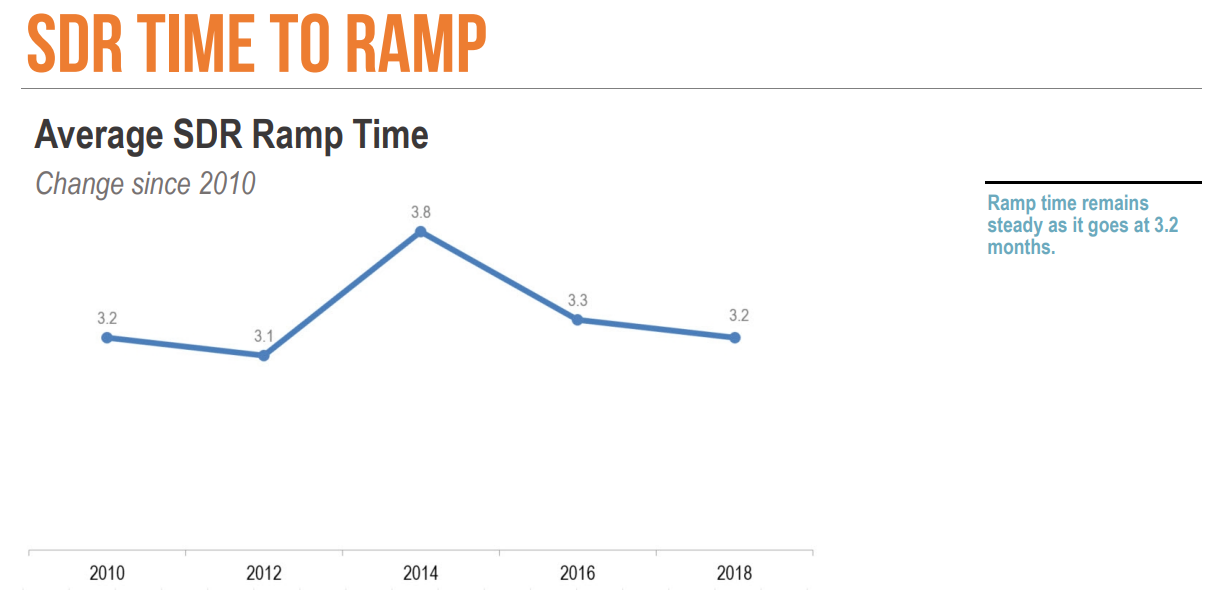
The most expensive line item is the one companies calculate last: ramp time. The average SDR takes 3.2 months to reach full productivity, according to Bridge Group research spanning 434 B2B companies. During those months, salary flows out while pipeline contribution remains minimal. That ramp-period loss adds $10,000 to $15,000 in effective cost before the rep reaches steady-state output.
Add it all together and a single in-house SDR costs $110,000 to $150,000 in year one. That is the comparison number, not the salary. Any sales development ROI calculation that starts with base pay instead of fully loaded cost will produce a misleading answer.
Outsourced sales development pricing varies by scope, but the financial structure is fundamentally different from in-house. You pay for output infrastructure, not for building it.
Most outsourced SDR team engagements run $3,000 to $12,000 per month depending on the service tier. Email-only programs sit at the lower end. Full-service multichannel programs that include calling, email, social outreach, strategy, data, and reporting sit at the higher end. On an annual basis, that translates to $36,000 to $144,000, with the majority of mid-market engagements landing between $60,000 and $84,000.
The cost difference against in-house is significant but not the only advantage. Sales development outsourcing eliminates the recruiting cycle entirely. There is no three-month ramp period. No benefits overhead. No management time consumed by coaching, call reviews, and performance management. The outsourced SDR team arrives with tested playbooks, warm sending infrastructure, and sequencing methodology already in place.
Speed matters in this comparison. An outsourced team is typically operational within two to four weeks. An in-house hire requires 30 to 60 days of recruiting, two weeks of onboarding, and another three months of ramp before reaching full productivity. That is four to five months of salary expense before consistent pipeline contribution begins.
The tradeoff is control. Outsourced sales development gives you predictable cost and speed. In-house gives you deeper product knowledge and tighter brand alignment over time. The ROI question is which tradeoff matters more at your current stage.
The in-house vs outsourced SDR decision is a comparison across multiple dimensions, each with different weight depending on your stage, deal complexity, and growth targets.
| Dimension | In-House SDR | Outsourced SDR Team |
|---|---|---|
| Year-one total cost | $110,000 to $150,000 per rep | $36,000 to $84,000 per engagement |
| Time to first pipeline | 4 to 5 months | 2 to 4 weeks |
| Scalability | Slow, requires new hiring cycles | Fast, add or reduce capacity on demand |
| Brand alignment | High, reps live inside your culture | Moderate, requires structured onboarding |
TurnoverTotal Cost of OwnershipIn-house wins on per-unit economics only after year two, and only if the rep stays. The problem is that most do not. SDR annual turnover runs 35% on average and 45% for SDR-specific roles according to Optifai's benchmark of 939 B2B companies. That means one in three SDRs leaves before you recover the year-one investment. Outsourced sales development absorbs turnover risk within the agency. If a rep leaves, the agency replaces them without disrupting your pipeline or billing. You never pay recruiting fees, ramp-period loss, or knowledge transfer costs on the replacement. Speed to PipelineThis is where outsourced SDR team models create the clearest ROI advantage. An outsourced program generates qualified meetings within weeks. An in-house hire generates nothing for three to five months. For companies in growth mode, entering new markets, or facing quarterly pipeline gaps, that speed differential translates directly to revenue. A quarter of lost pipeline production is not recovered by hiring faster next time. ScalabilityAdding capacity through an outsourced model requires a contract adjustment. Adding capacity in-house requires posting a role, screening candidates, conducting interview rounds, extending an offer, onboarding the hire, and ramping them to productivity. That cycle takes four to six months in most organizations. Reducing capacity follows the same asymmetry. Outsourced sales development scales down without severance, without morale impact on the remaining team, and without the operational overhead of layoff processes. Brand Alignment and Product KnowledgeIn-house SDRs carry your brand voice into every conversation. They attend internal meetings, interact with customers, and absorb product nuance through proximity. Over time, this depth becomes a genuine competitive advantage in complex, consultative sales motions. Outsourced reps depend on the quality of your onboarding. A strong agency invests deeply in learning your product, ICP, and messaging. But they will never replicate the institutional knowledge that comes from sitting inside the organization daily. If your ROI calculation weights brand depth heavily, in-house has a structural advantage here. Turnover and Retention RiskThis dimension alone can shift the entire in-house vs outsourced SDR equation. Bridge Group data shows median SDR tenure at 1.9 years, with internal promotions dropping from 34% in 2020 to just 16% in 2024. SDRs are not leaving because they are unhappy. They are leaving because the path to promotion has narrowed. Every departure restarts the ramp cycle. Three months of onboarding, another three months to reach peak output, then the clock starts ticking on the next exit. For a five-person team with 40% annual turnover, you are perpetually carrying one or two reps who are not yet at full productivity. Sales development outsourcing removes this dynamic entirely. Rep retention becomes the agency's problem. Your pipeline stays continuous regardless of individual rep movement. Lead Quality and ICP AlignmentIn-house SDRs who understand your product deeply tend to qualify leads more accurately over time. They recognize buying signals that outsiders miss. They ask better discovery questions because they have sat through customer onboarding calls and heard objections firsthand. Outsourced sales development programs counter this with process rigor. The best agencies enforce strict qualification criteria, run regular ICP alignment sessions, and track lead-to-opportunity conversion rates that surface quality issues faster than most in-house teams monitor. Long-Term Asset ValueAn in-house team that stays becomes an appreciating asset. Playbooks get refined. Institutional knowledge compounds. The cost per meeting drops as reps become more efficient. If your retention rate is strong, in-house delivers better sales development ROI in year two and beyond. If retention is average, that compounding never happens. You are rebuilding constantly, and the year-two economics look the same as year one. For companies with average or below-average retention, outsourced sales development delivers more predictable returns precisely because it sidesteps the retention gamble. When Sales Development Outsourcing Delivers the Strongest ROI Certain business situations make the financial case for outsourcing nearly unambiguous. Early-stage companies that need pipeline before they can justify headcount benefit most from outsourced sales development. The math is simple: $5,000 to $7,000 per month for a functioning pipeline engine versus $150,000 in year-one cost for an unproven hire. Companies entering new markets or verticals gain a low-risk testing mechanism. Sales development outsourcing lets you validate messaging, ICP fit, and conversion rates in a new segment without committing to permanent headcount. If the segment underperforms, you stop the engagement. No severance, no sunk recruiting costs. Revenue teams with AEs focused on closing but no SDR capacity to fill the top of funnel solve the gap immediately. Outsourced SDR team programs let closers stay focused on high-value deals while the agency handles prospecting at scale. Companies that want to establish pipeline benchmarks before building internally use outsourced programs to learn what good outreach looks like. They measure cost per meeting, response rates, and conversion benchmarks, then replicate internally with proven data instead of guessing. When Building In-House Delivers Better ReturnsIn-house wins under specific conditions that favor depth, control, and long-term compounding. Proven product-market fit is the first signal. Once your messaging works, your ICP is validated, and you know which objections surface in every conversation, a dedicated in-house team carries that knowledge into every call with a level of authenticity that outsourced reps cannot match. Complex, consultative sales motions where deals involve multiple stakeholders and six-figure contract values demand reps who understand your product at the level of a solutions engineer. Sales development outsourcing works for appointment setting in these markets, but the qualification depth often requires an insider. At scale, in-house economics improve dramatically. Once you have proven playbooks, trained managers, and a stable team, the per-meeting cost drops below what most outsourced programs can match. The inflection point typically arrives when you are running ten or more SDRs consistently with below-average turnover. How to Measure Sales Development ROI AccuratelyMeasuring sales development ROI requires tracking pipeline economics, not just activity metrics. Meetings booked tells you volume. Revenue generated per dollar spent tells you ROI. Cost per qualified meeting is the baseline metric. Divide your total monthly spend, whether in-house fully loaded cost or outsourced retainer, by the number of qualified meetings delivered. A healthy benchmark sits between $300 and $700 per meeting depending on deal size and vertical. For companies comparing in-house vs outsourced SDR models directly, this metric should be calculated identically for both. Pipeline-to-spend ratio measures how much pipeline value each dollar of sales development investment creates. Aim for 5:1 or better. That means $5 of pipeline generated for every $1 spent on the outsourced SDR team or in-house function. Lead-to-close rate reveals whether the meetings being booked actually convert. A program that delivers 20 meetings per month with a 5% close rate produces fewer deals than one delivering 10 meetings at 15% close. Quality and quantity must be measured together. Time to first qualified meeting captures the speed advantage that matters most for sales development outsourcing. An outsourced program delivering meetings in three weeks versus an in-house hire delivering meetings in four months represents a revenue acceleration that compounds across every quarter the outsourced program runs. Common Mistakes That Destroy Sales Development ROIEven the right model produces poor returns when execution breaks down. These mistakes apply to both in-house and outsourced sales development programs. Launching without a defined ICP is the most common failure. Agencies and in-house reps alike can only target as well as they are briefed. Vague targeting produces vague leads. The resulting pipeline looks active but converts at rates too low to sustain a positive return on the investment. Choosing an outsourced provider on price alone is a false economy. A $2,000 per month provider that delivers unqualified meetings costs more in wasted AE time than a $7,000 partner that delivers qualified pipeline. The right comparison is cost per qualified meeting, not monthly retainer. Treating the outsourced relationship as vendor management rather than partnership limits results. The best outcomes come when companies share feedback loops, refine messaging collaboratively, and review performance weekly. Sales development outsourcing performs best when the agency operates as an extension of your team, not a separate entity. Skipping onboarding depth guarantees underperformance. Outsourced SDR team reps need detailed briefings on your product, buyer personas, competitive landscape, objections, and differentiation. The quality of your onboarding directly determines the quality of their output. Measuring volume instead of quality is the final trap. More meetings is not the same as more pipeline. Track qualified meetings, opportunity creation rate, and revenue attribution rather than raw activity counts. Building a Sales Development Model That CompoundsThe highest-performing B2B revenue teams in 2026 do not treat in-house vs outsourced SDR as a binary decision. They build hybrid models that capture speed from outsourced sales development and depth from internal teams. The companies that win treat this as a portfolio allocation question, not an either-or debate. Start with outsourced to prove the motion. Use sales development outsourcing to validate your messaging, ICP, and outbound playbook. Measure cost per meeting, conversion rates, and pipeline quality. This gives you proven data before you invest in headcount. Build in-house for strategic accounts. Once your playbook is proven, bring the highest-value motion in-house. Assign internal SDRs to complex accounts that require deep product knowledge, multi-threaded engagement, and consultative qualification. Keep outsourced for volume and expansion. Maintain an outsourced SDR team for cold outbound into new segments, geographic expansion, and top-of-funnel campaigns where process rigor matters more than product depth. This preserves your internal team's focus on high-ACV opportunities. Measure both models identically. Apply the same cost per meeting, pipeline-to-spend ratio, and lead-to-close rate metrics to in-house and outsourced programs. Let the data determine resource allocation rather than assumptions about which model "should" perform better. Review quarterly and reallocate. The right balance shifts as your company scales, your retention improves, and your market position evolves. What works at $5M ARR may not work at $25M. Build the review cadence that keeps your sales development ROI optimized as conditions change. For B2B companies looking to build predictable outbound pipeline without the cost and timeline burden of hiring internally. Whistle provides dedicated, vetted SDR teams that operate as a direct extension of your sales organization, delivering qualified meetings, multi-channel outreach execution, and pipeline reporting tied to revenue outcomes. The result is a sales development engine that scales with your growth targets rather than your headcount plan. Explore more from our blogUnlock the B2B sales playbooks, outreach strategies, and closing techniques we’ve refined across more than 1,000 successful campaigns. Not Sure Which Service Is Right for You?Let’s figure it out together. Book a quick call and we’ll walk you through the best-fit options based on your goals, team structure, and current setup. Latest posts Demo contentInterviews, tips, guides, industry best practices, and news.  UX review presentationsHow do you create compelling presentations that wow your colleagues and impress your managers? Read post  Migrating to Linear 101Linear helps streamline software projects, sprints, tasks, and bug tracking. Here’s how to get started. Read post  Building your API StackThe rise of RESTful APIs has been met by a rise in tools for creating, testing, and managing them. Read post |
%20.jpg)

.jpg)
%20.jpg)