

Go-to-Market

Lauren Daniels
June 2, 2026


SDR leaders can track cost per rep, cost per meeting, and cost per opportunity with relative ease. Financial dashboards are built to capture these metrics, providing a clear view of direct expenditures and surface-level outputs. However, the real damage to the corporate pipeline happens through hidden costs that never appear on a balance sheet. Bad data, tool sprawl, and execution friction quietly drain SDR productivity long before activity metrics show any warning signs.
The visible inputs look stable, but the actual return on those inputs degrades. This structural inefficiency compounds faster for lean teams, particularly those operating in nuanced international markets. High-performing organizations avoid this trap not by demanding more volume but by auditing the invisible gaps where sales momentum dies.
Traditional sales dashboards are designed to measure lagging indicators of effort. They diligently record dials made, emails sent, meetings booked, and tasks completed. While these metrics offer a comforting illusion of control, they completely miss the operational friction that occurs between the data points. They track output, not flow.
When a dashboard shows that a representative made 50 dials in a day, it fails to show the time lost between those calls. It obscures the failed contact attempts caused by outdated records, the repetitive tab switching required to verify an email, and the manual data correction that forces a seller to act as a part-time database administrator. This visibility gap leaves sales leadership blind to the exact moments where execution breaks down.
Traditional dashboards see the 50 dials created and assume the output looks healthy. What they are blind to is the broken flow: the constant tab switching, the manual cleanup, and the lost rhythm occurring between those dials.
This problem amplifies significantly within the EMEA region. Regional data gaps, strict GDPR constraints, leaner headcount, and tools built on US-first assumptions cause execution friction to compound. When a team operates with less operational slack, cognitive overload hits harder. Activity metrics can look perfectly healthy on a manager's screen while pipeline quality quietly degrades and rep belief erodes underneath.
Bad data is typically framed as an accuracy issue, but its real damage is the hesitation it introduces into the daily workflow. Sales development relies on momentum. When a representative has to pause before every call to verify if a phone number is valid or if a prospect is still at the company, the psychological friction destroys their rhythm.
At the individual level, an incorrect phone number or a bounced email is not just a dead end; it is a workflow disruption. The representative stops, switches tabs, opens an alternative data tool, searches LinkedIn, updates the CRM, and attempts to restart their outreach. This process turns a fluid calling session into a series of stop-and-start tasks. Multiple conversations with sales development leaders consistently surface the same finding: the downtime between actions causes far more pipeline damage than low raw activity counts.
Once sales representatives stop believing that their data stack will yield accurate contact information, call reluctance sets in. They begin over-researching accounts as a defense mechanism against bad data, rationalizing an hour of manual verification as necessary preparation. Even if daily activity targets still appear on track due to automated email sequences, the high-value phone conversations that secure real pipeline begin to decline.
In international markets, this issue multiplies. Patchy regional coverage forces representatives to manually waterfall across three or four different enrichment tools. This manual verification loop rapidly depletes a team's core selling time.
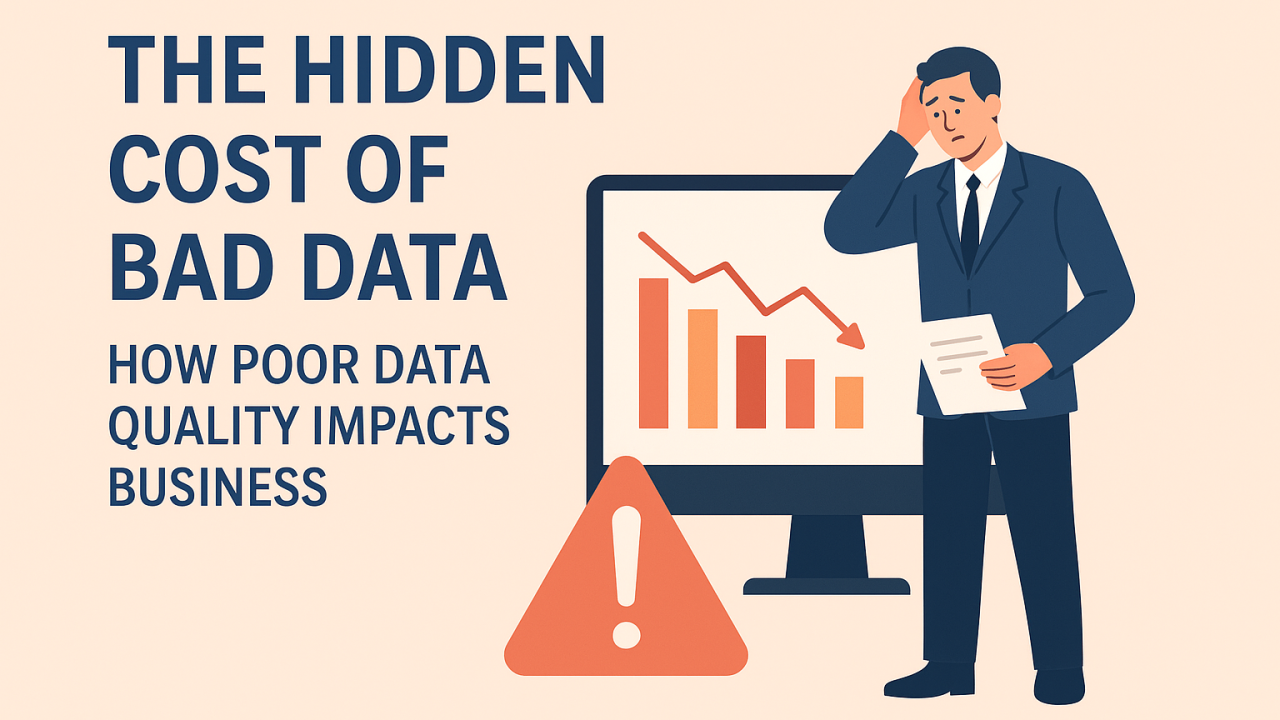
The financial consequences of unaddressed data friction extend far beyond a frustrated sales team. Poor data quality costs businesses trillions of dollars annually in structural inefficiencies across revenue operations, with the vast majority of these losses never directly tracked on an internal P&L statement.
When pipeline figures miss targets, organizations frequently misdiagnose the root cause. The standard response is to assume a volume problem, leading to increased hiring or more aggressive activity quotas. In reality, the business is pouring more resources into a leaky execution engine, compounding the financial waste.
Most sales development technology environments were not intentionally designed; they accumulated. Over time, point solutions are added to solve isolated problems, resulting in layers of integrations built on top of older systems. A typical sprawled stack today requires a representative to simultaneously manage a CRM, a dialer, multiple data enrichment tools, several browser extensions, social networks, internal spreadsheets, and various AI utilities.
In a sprawled environment, the constant jumping between the CRM, dialer, Data Tool A, Data Tool B, browser extensions, and spreadsheets results in more choices, more tab switching, higher cognitive load, and slower execution.
This setup creates a counterintuitive problem: more tools do not create leverage when they introduce more decisions per hour rather than removing them. Software should automate administrative burdens, yet modern stacks frequently do the opposite. Representatives spend more time navigating their internal tech stack than talking to prospective buyers.
Even as generative AI tools promise to streamline operations, they often add noise instead of removing friction. Reporting infrastructure improves, giving management greater visibility into a broken process, but the actual execution slows down. For smaller sales pods, this cognitive load exhausts representatives long before they reach their core outreach objectives.
The structural disconnect in modern sales leadership is that teams respond to a declining pipeline by monitoring the wrong indicators. When conversion rates drop, management frequently doubles down on activity counts. This creates a classic misdiagnosis pattern where a workflow issue is treated as a headcount or coverage problem.
The typical misdiagnosis loop follows a predictable path: pipeline drops, management demands more volume, reps fake flow via high-volume automation, data quality degrades further under the strain, and pipeline drops even more.
Because traditional reporting tracks output rather than flow, leaders miss the friction surrounding each action. They see that a representative completed their sequence tasks, but they do not see the mental fatigue caused by system management. Every layer of friction reduces conversion slightly at each stage of the funnel. While an individual minor drop in connection rates or a slight delay in follow-up speed seems negligible, the cumulative impact across a quarter results in a significant, invisible contraction of the generated pipeline.
Standard sales coaching rarely fixes this issue. Most leadership coaching focuses heavily on call quality, script delivery, and objection handling. While valuable, none of these interventions address the systemic environment where representatives lose hours of productive time simply trying to get a prospect on the phone.
Identifying these hidden costs requires looking past primary activity dashboards. Organizations suffering from data and stack friction typically exhibit clear, systemic warning signs across their operations.
The most effective sales development organizations do not look for a silver bullet tool to solve pipeline deficiencies. Instead, they focus heavily on operational minimalism and execution flow.
Top-performing teams select a lean, integrated set of technologies and invest heavily in complete team proficiency. They recognize that every additional tool added to the browser bar introduces a cognitive tax that distracts from the core objective of building pipeline.
Rather than allowing representatives to guess which database has the best information for a specific market, leading organizations establish strict operational policies. They define exactly which data sources to trust, and in what order, removing the manual waterfalling that slows down outreach. A high-performing flow ensures that a target signal triggers unified data enrichment, leading directly to single-screen execution without unnecessary decisions.
Instead of chasing noisy, broad intent data that often creates false positives and wastes rep time, high-performing teams prioritize real-world triggers and clean first-party signals. They design calling environments specifically around focus and momentum, treating a representative's attention as the most valuable resource in the organization.
Ultimately, strong sales development leaders realize their primary job is decision-making. They systematically reduce the number of choices a seller has to make per hour, allowing them to focus entirely on human-to-human communication.
Reversing the damage of tool sprawl and inaccurate data requires a deliberate, structured approach to engineering the sales workflow.
Organizations must prioritize highly accurate mobile and direct dial data to reduce failed communication attempts and restore team confidence. Implementing CRM-native prospecting helps eliminate the tab switching that fractures momentum. Furthermore, leveraging live job change tracking and automated hygiene tools keeps account records accurate without relying on manual entry from the sales team.
A calling environment should be designed to support focus and coaching opportunities, not just to generate raw volume metrics. Selecting dialers that maintain strong regional call quality is particularly critical for teams tackling international or EMEA markets. The technology should be judged on how effectively it keeps a representative in a flow state rather than how many numbers it can blindly process.
Every tool in the current sales environment must be audited against a single metric: Does this application remove choices or add choices for the representative executing daily activity? Applications that remove decisions and friction should be retained and optimized, while those that add complexity and slow down execution must be eliminated.
Leadership should eliminate or consolidate platforms that have overlapping functionalities, require manual data bridging, or consume more attention than they save. Standardizing this lean stack across the entire team ensures consistent onboarding and more predictable coaching outcomes.
Data hygiene cannot be an afterthought. Teams need to establish regular automated audits that target duplicate records, invalid contacts, and missing fields. Creating strict, standardized rules for lead sourcing, job titles, and company naming conventions ensures reporting accuracy down the line. Finally, sales and marketing leadership must share clear, cross-functional ownership of data quality to eliminate the operational gaps where accountability is lost.
Optimizing the sales development environment is not merely an operational cleanup; it directly impacts top-line efficiency. Removing data friction and stack complexity returns valuable hours to each representative every single week—time redirected entirely toward actual selling activity.
The operational return on investment is clear: clean data combined with a lean stack returns valuable selling hours to the team, resulting in higher quality conversations and more predictable revenue growth.
When contact data is accurate, conversations reach the right decision-makers with the appropriate context, immediately improving meeting hold rates and conversion metrics. Clean CRM data also provides leadership with highly reliable pipeline reporting, leading to more accurate strategic forecasting, better resource allocation, and smarter hiring decisions.
Additionally, reducing systemic frustration directly improves sales team retention. Representatives who trust their tooling and feel consistently productive stay with an organization longer. This stability significantly reduces the heavy recruitment and onboarding costs associated with high turnover. Teams built on clean data and lean stacks scale predictably because new hires inherit a functional, high-velocity system rather than accumulated technical debt.
The true cost of sales development underperformance rarely shows up as a specific line item on a spreadsheet. Bad data does more than just route emails to the wrong inbox; it breaks execution momentum, erodes representative confidence, and creates the subtle hesitation that quietly kills pipeline growth. Tool sprawl increases cognitive load, forcing sellers to spend more time navigating internal systems than engaging with active buyers.
Fixing these invisible gaps starts with an honest look at how your team actually spends their hours. At Whistle, we help revenue teams strip away the data clutter and tool confusion that slow down sales development. By pairing clean regional data with straightforward, focused workflows, we help your reps spend less time fighting their software and more time talking to real buyers. See how we help teams build a cleaner path to pipeline at Whistle.



%20.jpg)

.jpg)
%20.jpg)