

Go-to-Market

Lauren Daniels
May 8, 2026

Sales outsourcing pricing varies widely by model, scope, and stage of optimization. Most B2B companies spend $2,500 to $15,000 or more per month, but the real story is in cost per meeting over time. In year one, mid-market and enterprise companies typically pay $3,000 to $5,000 per qualified meeting as they refine ICP, messaging, and channels. Costs usually drop to around $2,000 in year two and $1,000 in year three, with mature programs reaching about $250 per meeting after sustained optimization.
Sales outsourcing costs generally fall into three models. Retainers range from $10,000 to $50,000 or more per month, depending on scope, from small teams handling basic outreach to full-scale programs with specialized roles and strategy support. Pay-per-performance models charge $300 to $600 per meeting or 15 to 25 percent of closed revenue. Hybrid models combine a $2,500 to $5,000 base with $150 to $300 per meeting or 5 to 10 percent in performance bonuses. Sales outsourcing cost to outsource sales proves lower than in-house when factoring true expenses: a single in-house SDR costs $8,000-$12,000 monthly fully loaded (approximately $100,000+ annually), while a two-person SDR function with a manager runs $18,200-$36,100+ monthly, including tools, data, and overhead.
In-house hiring costs $10,000-$20,000 per recruit with three months to hire plus three months to ramp, creating a six-month gap before productivity begins. Outsourced teams start producing within 2-4 weeks. Service-specific outsourced SDR pricing per month 2025 varies: top-of-funnel appointment setting optimizes fastest from $3,000 per meeting to $500-$1,000 within 12 months, full-funnel SDR services run $500-$700 per appointment for mid-level targets and $800-$1,000 for C-suite, project-based campaigns cost $10,000-$50,000, and RevOps consulting ranges $15,000-$75,000 for comprehensive process optimization. AI SDR platforms disrupt traditional pricing at $500-$3,000 monthly with a cost per lead of around $39 versus $262 for human SDRs, representing 85% cost reduction. 45% of teams now run hybrid AI-SDR models combining AI volume with human relationship-building. Critical success factor: expect 60-90 days minimum for fair evaluation, as judging results earlier undermines optimization potential.
Hidden risks include domain damage from poor data, integration overhead with your CRM, and performance drop-offs without strong feedback loops. With sales teams spending about 70 percent of their time on non-selling work, specialized partners can significantly speed up optimization.
The optimization curve matters more than the starting price. Sales outsourcing costs should drop by about half in year two and another 25 percent in year three. In the end, pricing models matter less than provider quality, optimization capability, and specialization. The CFO asks a simple question: "How much will outsourcing sales cost us?"
The simple answer hides the real answer.
Most agencies quote monthly retainers or per-meeting rates. Year one for mid-market B2B starts at $3,000-$5,000 per qualified meeting. That number makes executives wince until they compare it to the alternative.
In-house SDR costs $8,000-$12,000 monthly, fully loaded, takes six months before producing results, and requires you to solve email deliverability, data decay, and messaging optimization yourself. Outsourced teams start producing within 2-4 weeks. The question changes from "how much does it cost" to "how fast can we optimize the cost down."
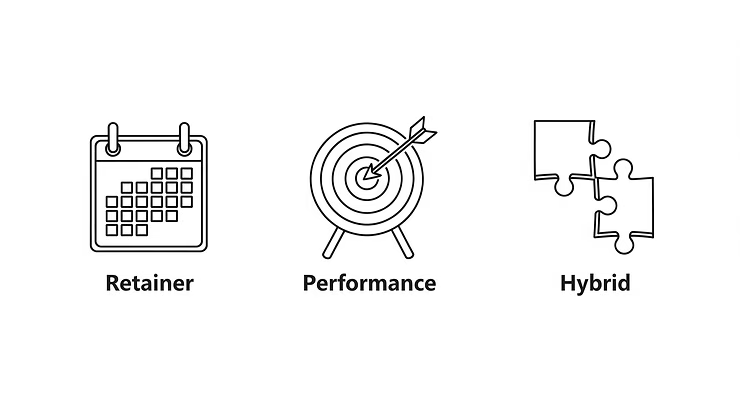
Every sales outsourcing pricing model appeals to different psychological triggers. Strip away the positioning, and they all cost roughly the same initially. Whether you choose retainer, pay-per-appointment, or revenue share, expect $3,000-$5,000 per qualified meeting in year one. The models differ in payment timing and optimization incentives, not fundamental economics.
Sales outsourcing pricing in retainer models range $10,000-$50,000+ monthly depending on scope and scale. $10,000-$15,000 monthly typically includes 1-2 dedicated BDRs, basic tool stack covering email, CRM, and prospecting tools, account management, standard messaging and template optimization, and single-channel outreach usually focused on email.
$20,000-$35,000 monthly expands to 3-5 dedicated team members with specialized roles, advanced tool infrastructure, and deliverability management, multi-channel campaigns combining email, LinkedIn, and cold calling, custom ICP research and list building, A/B testing across messaging, timing, and channels, plus regular strategy calls and campaign optimization. $35,000-$50,000+ monthly includes full specialized teams with BDRs, copywriters, data researchers, and deliverability specialists, enterprise-grade tool ecosystem, omnichannel orchestration across multiple touchpoints, custom automation and workflow development, industry-specific messaging and positioning, advanced analytics and attribution tracking, and dedicated customer success with strategic consulting.
The psychological appeal is stability. Finance teams love predictable costs. Sales leaders appreciate consistent pipeline development. When providers have guaranteed revenue, they invest in a long-term strategy that leverages quick wins. Initial email campaigns showing strong response rates become foundations for omnichannel strategies, adding LinkedIn and cold calling to the same audience, signaling opportunities for testing adjacent market segments or investing in more sophisticated automation. Providers without guaranteed revenue stop at the quick win. They will not risk reinvesting insights in broader optimization. Retainers optimize sales operations faster because testing and refinement never pause. Testing whether LinkedIn outreach works better than cold calling for your ICP requires solid 6-8 weeks of data to draw meaningful conclusions. Companies that pause service after a couple of weeks revert to email-only campaigns, wasting time and increasing overall cost.
Pay-per-appointment feels safer but carries hidden premiums most companies miss. Sales outsourcing cost still starts around $1,000-$2,000 per qualified meeting, just with different payment timing. Ten meetings at $2,000 each equals $20,000 monthly, the same price range as retainers. But you sacrifice predictability. Providers cannot plan long-term optimization without guaranteed revenue. Common structures include $300-$600 per qualified appointment or 15-25% commission on closed deals.
The psychological appeal: risk shifts to the provider.
Providers build performance risk into pricing. When assuming performance risk, they make conservative choices that slow optimization. Why test bold approaches when safe, proven methods guarantee payment? This model appeals to risk-averse companies wanting to test the waters. The irony: this same mindset is matched by the provider. Conservative approaches yield conservative outcomes. You pay premium prices for average performance. Pay-per-meeting models incentivize volume over quality. Unless you define "qualified meeting" with surgical precision upfront, you get exactly what you pay for: meetings, not pipeline. Calendars fill with appointments that AEs reject as unqualified.
Hybrid models combine reduced monthly retainer with performance-based bonuses.
Hybrid models combine reduced monthly retainer with performance-based bonuses. Outsourced SDR pricing per month 2025 in hybrid arrangements typically runs $2,500-$5,000 monthly retainer plus $150-$300 per qualified appointment or 5-10% commission on closed deals. The base retainer covers provider costs and ensures they can invest in your success. Performance bonuses keep them motivated for results. This balance prevents both set-and-forget service delivery and pure volume-chasing behavior. Most companies eventually land on hybrid approaches. Engagements often start with pay-per-appointment to prove viability, transition to retainer once tactics prove effective, then add revenue share components as relationships mature.
Revenue share models promise deepest alignment but require the most transparency and trust. These typically combine base fees with a percentage of closed deals. The psychological appeal: providers only win when you win.
This model only works when you have mature sales metrics and are willing to share complete pipeline visibility. The barrier is not CRM access. Providers get that in retainer models anyway. Most companies do not know their own numbers well enough to determine revenue share. What percentage can you afford when you lack an accurate understanding of annual contract value, sales cycle length, or customer lifetime value? From the provider's perspective, there is no incentive to commit upfront because they have not seen your sales process work. They pay BDR salaries out of pocket while hoping your sales team closes deals months later. Since most BDRs earn 70-80% base salary with only 20% commission, revenue share should only cover the 20% incentive.
Revenue share models only work for mature sales organizations with proven metrics. If your sales process is broken, even perfect appointments will not convert.
Top-of-funnel appointment setting has the fastest optimization potential. It is most systematized with clear metrics and established best practices. Expect to start at $3,000 per meeting, but potentially bring it down to $500-$1,000 within 12 months. Full-funnel SDR services add complexity and extend cost-cutting timelines. You are not just booking meetings but qualifying prospects at different funnel stages and nurturing relationships, resulting in leads with much higher buying intent.
Cost reduction is slower due to increased variables, but starting costs are similar. $500-$700 per appointment for mid-level targets, scaling to $800-$1,000 for C-suite meetings. Project-based campaigns typically run $10,000-$50,000, with comprehensive strategy and automation pushing costs to $200,000+. A $200,000 comprehensive program typically generates 150-300 qualified appointments over 6-12 months. Assuming a conservative 8-12% conversion rate and a $75,000 average deal size, you look at $1M-$3M+ in potential pipeline value. If you achieve 10% close rate, you generate 5-10x ROI for the initial investment.
RevOps consulting addresses gaps preventing sales teams from converting meetings into deals. Most companies find that booking appointments is only half the battle. If the handoff process, lead scoring, or sales enablement is broken, even perfect appointments will not convert. RevOps services typically range from $15,000 to $75,000 for comprehensive process optimization. Omnichannel support scales with campaign complexity while reducing cost. Starting with only email campaigns limits optimization potential. At $1,000 per appointment with just one channel, you quickly hit a ceiling. Adding LinkedIn or cold calling initially increases short-term costs. You might pay $1,250 per appointment during the first 30 days as teams integrate new channels. But once channels work together, cost-per-appointment drops below the single-channel baseline.
In-house true costs extend far beyond salaries. Recruitment runs $10,000-$20,000 per hire. Add salary, benefits, tools, training, and management overhead. Single in-house SDR costs $8,000-$12,000 monthly, fully loaded, approximately $100,000+ annually. A two-person SDR function with a manager, tech stack, and data can run $18,200-$36,100+ monthly. Sales outsourcing cost via outsourced teams often proves lower, starting at $30,000-$96,000 annually when accounting for everything included. Opportunity cost averages six months of ramp time while competitors are fully operational. Hiring takes three months, ramping takes another three. That is six months before the first in-house SDR is fully productive. The outsourced team starts producing in two to four weeks.
When do they master any of these skills? How long before they learn what optimizing for cost looks like? Realistically, never. Outsourced teams have specialized expertise. If they did not have proven playbooks, you would not have heard of them. While you're in-house hire googles "how to improve email deliverability," outsourced specialists are writing the articles in search results, backed with examples from past clients. A mixed model of in-house and outsourced is typically best. In-house teams provide company knowledge and cultural alignment. Outsourced partners bring specialized skills and modern playbooks that leverage what is already working.
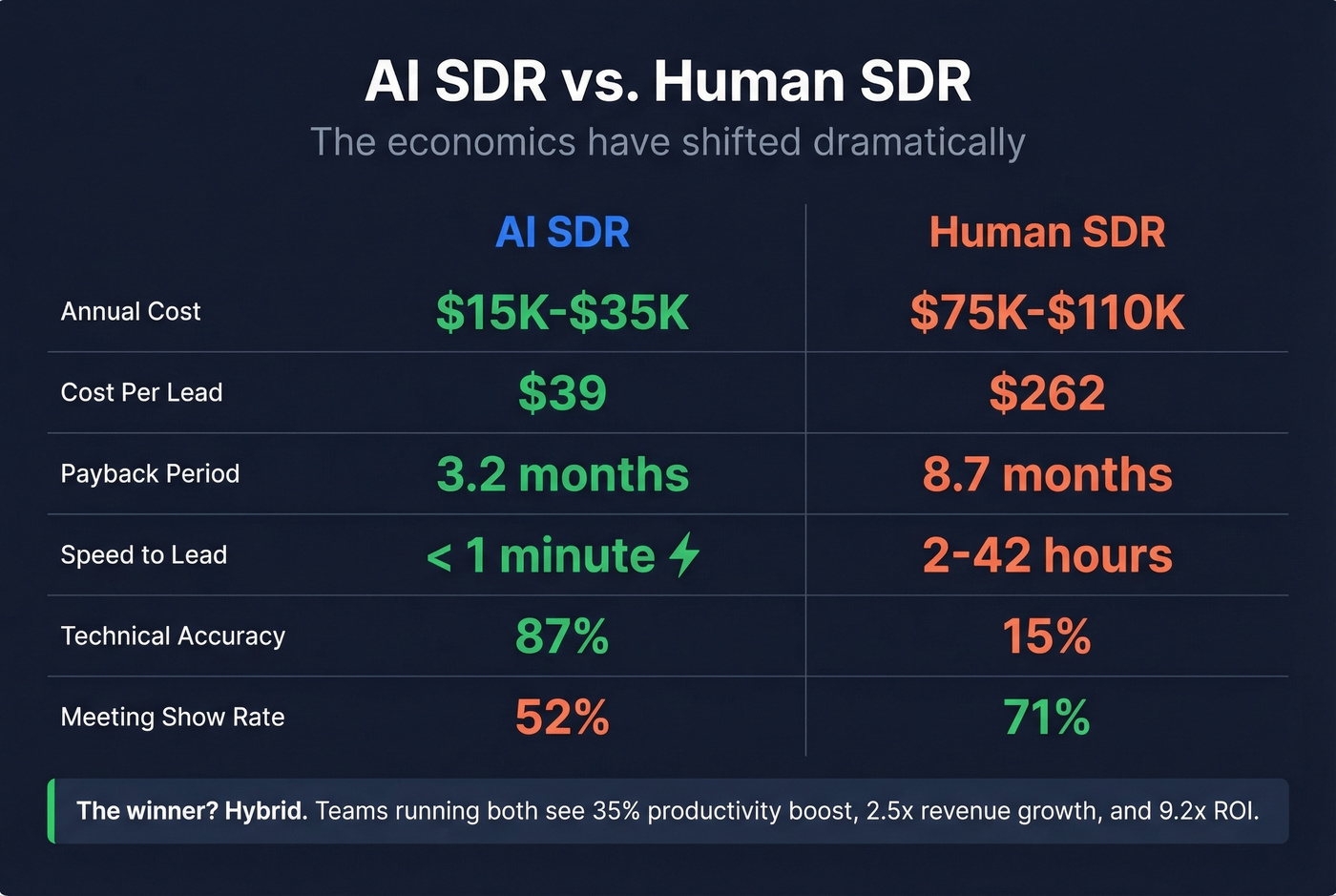
If the average deal size is under $15,000, you probably do not need a $10,000 monthly agency. An AI SDR paired with verified data will get you 80% of the way there at 20% of the cost. Fully loaded human SDR costs $75,000-$110,000 annually. AI SDR platform runs $15,000-$35,000 annually, some as low as $500 monthly. Cost per lead drops from roughly $262 for humans to $39 for AI. Payback period compresses from 8.7 months to 3.2 months.
Responding within 1 minute increases conversion rates by 391%. Human SDRs average 2-42 hours. AI responds instantly, every time. 45% of teams were already running hybrid AI-SDR models as of late 2025. That number is higher now and climbing fast. Pure AI is not the answer. The experiment found human SDRs generated $147,000 in revenue versus $56,000 for AI. Meeting show rates were 71% for humans versus 52% for AI. Humans win on relationship-building and complex deal navigation. The hybrid model outperforms both. Teams running AI for volume and research alongside humans for relationships see 35% productivity improvement, 2.5x revenue growth, and 9.2x ROI.
Build your budget around the optimization timeline, not just the monthly cost.
Choose based on optimization readiness, not cost.
Most companies use a mix. They start with pay-per-appointment, move to retainer once it works, then add revenue share over time. Focus on partner quality over pricing. The right partner sets realistic goals and guides decisions, regardless of model.
Most buyers focus on the wrong signals. Case studies, testimonials, and years in business do not reliably predict outcomes.
What actually matters:
Red flags: No AE acceptance tracking, vague KPIs, hidden data sources, weak deliverability practices, and no pilot option.
Green flags: Transparency, clear optimization timelines, industry-specific strategy, and focus on core strengths.
Bottom line: Ask how they have improved results for similar clients with specific tactics, not general claims. If they cannot explain it, they cannot deliver it.
Expect 60-90 days minimum for fair evaluation. Year-one per-meeting costs typically run $3,000-$5,000 but can drop 50%+ by year two as messaging and targeting sharpen. Judging the outsourced team in week two is like judging a new hire on the first day.
In-house SDR takes 3-6 months to become productive. A good agency can start delivering results within 2-4 weeks. For companies needing a pipeline now (post-funding, pre-board-meeting, entering a new vertical), that speed difference is worth the premium. The companies that succeed with outsourced sales view it as an investment in growth, not a cost center. They focus on ROI metrics, not just monthly fees.
When evaluating sales outsourcing pricing, ask yourself: What is the cost of not having a consistent pipeline? How much is a delayed go-to-market strategy costing you? What is the opportunity cost of building this capability in-house?
Sales outsourcing cost analysis should never focus solely on price per meeting. The real question is how quickly you can optimize those costs down and how that compounds over time. A $5,000 per meeting cost that drops to $2,000 by month 12 outperforms a $2,000 per meeting cost that never improves because the partner is not investing in your success.
For organizations looking to apply sales outsourcing insights to build internal pipeline capabilities, Whistle provides training frameworks that teach SDRs how to execute the multi-touch sequences, qualification approaches, and systematic follow-up that outsourced teams use to compress optimization timelines. Our approach treats sales outsourcing pricing as context, not negotiation targets.
The goal is to build internal capabilities that match or exceed outsourced performance through structured outreach, consistent multi-channel engagement, and real value delivery. This creates a sustainable pipeline whether you outsource, build in-house, or use a hybrid model as you scale.



%20.jpg)

.jpg)
%20.jpg)