

Go-to-Market

Lauren Daniels
April 28, 2026

Remote sales teams have moved from a tactical option to a core part of how modern businesses grow. The appeal is clear. You can build a pipeline, enter new markets, and maintain momentum without taking on the cost, hiring risk, and long ramp times that come with building an in-house team.
But outsourcing sales does not remove complexity. It shifts where that complexity sits.
One of the first decisions companies face is who should actually represent them in market. Do you work with a sales agency that brings structure, process, and a full team behind the scenes? Or do you partner with an individual sales representative who operates independently and moves with speed?
At a distance, the trade-off looks straightforward. Agencies offer scale and consistency. Independent reps offer flexibility and lower upfront cost. In reality, the implications run deeper than that surface comparison.
This decision influences how your pipeline is built day to day. It affects how closely messaging stays aligned to your brand, how opportunities are qualified, and how much internal effort is required to maintain performance. It also determines how easily your sales motion can adapt when strategy shifts or market feedback challenges your assumptions.
Get this right, and sales become a controlled, repeatable function that supports growth. Get it wrong, and you either spend more time managing than progressing, or more money without seeing the return you expected.
An independent sales rep operates as a self-employed professional. They set their own terms, manage their own workflow, and typically work across multiple clients at the same time.
That structure creates a very specific operating model. You are not plugging into an organisation. You are engaging a single operator who brings their own systems, habits, and approach to selling.
That autonomy is where both the appeal and the limitations sit.
Independent sales reps often come with a wider practical skill set than a narrowly defined role in a larger organisation. Many have built and run their own sales activity end to end, which means they are comfortable moving across prospecting, pipeline management, and live deal conversations without relying on handoffs.
In practice, this can make them highly adaptable in the field. They tend to be resourceful in how they find and engage prospects, and they are usually comfortable working without heavy structure or supervision.
Some also bring established industry relationships. In certain markets, that network effect can shorten the time it takes to generate early conversations, particularly when trust and familiarity play a role in buying decisions.
However, this breadth is not the same as consistency. The way one independent rep operates can differ significantly from another, even within the same sector. That variability is something businesses need to account for early.
The financial structure is one of the main reasons businesses consider independent reps in the first place.
Most operate on a commission-based model, sometimes with a small retainer depending on seniority and complexity. This keeps fixed costs low and ties spending directly to output, which is particularly attractive for early-stage companies or those testing new markets.
It also changes the risk profile. Instead of committing to a fully loaded salary or agency contract, you are effectively paying for performance as it happens.
There is a trade-off embedded in that structure. Commission-only arrangements can create uneven focus, especially if the rep is balancing multiple clients or prioritising higher-value opportunities elsewhere. The alignment is financial, but not always exclusive.
For straightforward products with clear value propositions and shorter sales cycles, this model can be efficient. It works best when the path from outreach to close does not require multiple stakeholders or complex coordination.
One of the more practical advantages of working with an independent sales representative is speed.
There is no internal hierarchy to navigate. No layered approvals. No dependency on broader team resourcing. Decisions about messaging, targeting, and outreach cadence are made directly between you and the rep.
This makes iteration faster. If something is not working, it can be adjusted immediately rather than being escalated through multiple layers of account management.
That responsiveness can be particularly useful in early testing phases, where positioning and market feedback are still being refined. It allows businesses to move quickly without being constrained by process.
The same simplicity can become a limitation as complexity increases. Without structured oversight or shared systems, maintaining consistency over longer cycles becomes more dependent on individual discipline than organisational design.
For businesses with a straightforward sales process, clear product-market fit, and the internal capacity to stay close to execution, independent reps can offer a practical and cost-efficient way to generate pipeline without building a full sales function.
The most obvious benefit is cost. Without agency overhead or management layers, you avoid intermediary fees and reduce upfront financial commitment.
There is also greater control over how the engagement is structured. Compensation, targets, and expectations can be negotiated directly, allowing for a tailored approach that fits your specific goals.
Independent reps tend to operate with a high degree of adaptability. They can adjust schedules, priorities, and tactics quickly, which is useful when your go-to-market approach is still evolving.
Many experienced reps are also highly relationship-driven. Their success depends on maintaining a strong reputation, which often translates into a more personalised approach with prospects.
For businesses with a simple product, a clear target audience, and a short sales cycle, an independent rep can deliver meaningful results without the need for additional infrastructure.
The flexibility of independent reps can also introduce inconsistency.
Each rep brings their own sales process, tools, and working style. Without clear alignment from the outset, this can lead to fragmented messaging or uneven execution.
Oversight is another consideration. Unlike agencies, independent reps do not come with built-in management structures. Monitoring pipeline activity, tracking performance, and maintaining accountability often falls back on your internal team.
There are also operational risks to manage. Contracts need to clearly define deliverables, expectations, and protections around intellectual property. In some cases, businesses implement additional systems to track activity and ensure visibility.
The commission-based model can create further complexity. While it reduces upfront cost, it also introduces income uncertainty for the rep. This can affect focus and long-term commitment, particularly if they are balancing multiple clients.
In short, the model works best when you have the capacity to actively manage and guide the engagement.
Sales agencies operate very differently. Instead of relying on a single individual, they provide access to a structured team that typically includes business development representatives, account executives, and sales leadership.
That structure changes the nature of execution.
Agencies offer a more comprehensive approach to sales. Rather than focusing on one part of the funnel, they can support the full cycle, from prospecting through to closing and account development.
They also bring depth. If a campaign requires new capabilities, whether in messaging, targeting, or operations, those skills are usually available within the existing team. There is no need to source additional talent mid-project.
Consistency is another defining advantage. Agencies rely on established processes, quality control frameworks, and shared systems. This creates a more predictable experience across outreach, qualification, and pipeline development.
Perhaps most importantly, the expertise is pre-validated. Instead of vetting individuals one by one, you are working with a team that has already been tested across multiple clients and use cases.
Working with a sales agency reduces the operational load on your internal team in a way that goes beyond execution alone.
You are not responsible for managing individual contributors, resolving day-to-day performance issues, or building sales processes from scratch. The agency brings an established operating model, which means execution is already structured before the engagement begins. Your role shifts toward direction and oversight rather than active management.
That structural difference has a direct impact on consistency. Sales agencies rely on defined processes that govern how prospects are targeted, how messaging is delivered, and how leads are qualified. This reduces variation across outreach and ensures that performance does not depend on the habits or interpretation of a single individual.
Agencies are also better equipped to handle complexity. When the sales motion involves multiple touchpoints, longer cycles, or coordination across roles such as prospecting, qualification, and closing, a structured team becomes more effective than a standalone contributor. Work is distributed across specialists rather than concentrated in one person.
There is also a level of operational assurance that comes from working with a team that has been tested across multiple clients and industries. Established systems and playbooks reduce variability and shorten the time it takes to reach stable performance.
In practice, this translates into a more controlled and scalable approach to pipeline generation.
For businesses looking to scale in a controlled and predictable way, this model offers a clear advantage.
The benefits of a sales agency come at a cost.
Agencies are typically more expensive than independent reps due to their structure, resources, and management layers. For smaller projects, this cost may not always be justified.
Flexibility can also be more limited. Once a contract is in place, making changes to scope or direction often involves formal renegotiation. This can slow down decision-making and introduce additional costs.
Scope creep is another factor to consider. Work that falls outside the original agreement is usually billed separately, which can increase total spend over time.
Communication can feel less direct as well. Instead of working with the individuals executing the work, you are often engaging through an account manager or team lead.
These trade-offs do not negate the value of agencies, but they do require careful consideration, particularly for businesses that prioritise speed and adaptability.
The pricing structures reflect the differences in how each model operates.
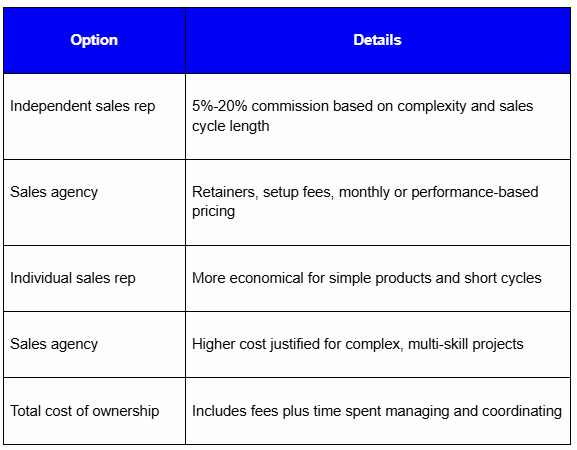
Independent sales reps typically work on a commission basis, often ranging between 5% and 20%, depending on the complexity of the sale and the length of the cycle. This keeps upfront costs low and ties compensation directly to performance.
Sales agencies use more structured pricing. This can include retainers, setup fees, and ongoing monthly or performance-based charges. While the cost is higher, it reflects the broader scope of services and resources involved.
The real comparison goes beyond fees. Total cost of ownership includes the time and effort required to manage, coordinate, and support the sales function. In many cases, what appears cheaper on paper can become more expensive when internal resource demands are factored in.
An independent sales rep is often the right choice when simplicity and speed matter most.
If your budget is constrained and you need to minimise fixed costs, this model provides a low-risk way to test market demand. It is also well-suited to straightforward sales processes that do not require multiple roles or complex coordination.
Businesses that can offer hands-on management tend to get the most from independent reps. Regular check-ins, clear direction, and active oversight help maintain alignment and performance.
Flexibility is another key driver. If your positioning, pricing, or target audience is still evolving, working with an individual allows for faster adjustments.
For early-stage companies or new product launches, this approach can provide a practical starting point.
Sales agencies become more valuable as complexity increases.
If your sales motion requires multiple skill sets, such as prospecting, qualification, account management, and operations, a structured team is far more effective than relying on a single individual.
They are also a strong fit when consistency matters. Businesses operating across multiple markets or targeting enterprise clients benefit from standardised processes and controlled execution.
Internal capacity is another consideration. If you do not have the time or resources to manage sales activity closely, an agency provides built-in oversight and accountability.
For companies focused on predictably scaling pipeline generation, the structured approach of an agency often delivers stronger long-term results.
Choosing between a sales agency and an individual sales rep requires a clear assessment of your current situation.
Start with complexity. If your sales process involves multiple stages, stakeholders, or specialised roles, a single rep is unlikely to cover everything effectively.
Then consider budget, not just in terms of fees, but in terms of internal time. Managing an independent rep requires ongoing involvement, which carries its own cost.
Oversight is another critical factor. If you cannot dedicate time to monitoring performance and guiding execution, the structure of an agency becomes far more valuable.
Timeline also plays a role. Independent reps can often start quickly, while agencies take longer to onboard but deliver greater consistency over time.
Finally, align the decision with your growth stage. Many businesses begin with independent reps and transition to agencies as their sales function becomes more complex.
The decision between sales agencies vs individual sales reps is not about choosing a universally better option. It is about understanding what your business needs at its current stage.
Sales agencies offer structure, consistency, and depth. They are well-suited to complex sales environments where predictability and scale matter.
Independent sales representatives provide flexibility, speed, and lower upfront costs. They are often the right fit for simpler sales motions and early-stage growth.
The difference lies in how much support, oversight, and coordination your sales function requires.
The most effective approach is grounded in clarity. Assess your goals, understand your constraints, and choose the model that aligns with both. Done well, that decision becomes less about cost and more about building a sales engine that can sustain growth over time.



%20.jpg)

.jpg)