

Go-to-Market

Lauren Daniels
June 3, 2026

Most sales development representatives hear the phrase "we are going ABM" and immediately brace for impact. They treat account-based marketing as a marketing-led project that simply exists to restrict their outbound volume and shrink their target lists. When executed correctly, however, an ABM SDR strategy does not limit productivity; it sharpens focus. It replaces cold, repetitive outreach with highly contextual entry points, making conversations significantly easier to start.
Data confirms the economic value of this shift. Transitioning to a unified account-based model can increase pipeline conversion rates by 14% and raise marketing qualified lead to sales accepted lead conversion by 25%. Despite these figures, many programs stall out early. The breakdown rarely stems from poor intent data or incorrect list building. Instead, the strategy fails because it is handed down from marketing in isolation, without direct SDR input on targeting, messaging, or day-to-day execution.
SDR leaders who actively build cross-functional alignment report stronger pipeline quality, faster account progression, and cleaner account executive handoffs. Moving from high-volume outbound to account-based execution requires restructuring how a team spends its time, interprets behavioral signals, and defines performance.
An account-based marketing SDR motion is a highly coordinated, multi-channel approach. Representatives prospect into pre-agreed target accounts with the full benefit of marketing context supporting every touchpoint. Traditional sales development models measure success through raw input volume, pushing reps to hit arbitrary daily outreach numbers. An ABM framework shifts that focus entirely to account penetration and buying committee engagement.
While traditional outbound focuses on high volume inputs sent to a broad target list to hit low conversion rates, ABM outbound pairs marketing context with targeted accounts to secure real buying committee engagement.
Before an outbound team sends a single email or places a call, leadership must define three operational pillars: the specific accounts to target, the precise ABM model that applies to each account, and the exact role the representative plays within each tier.
This tier focuses heavily on account expansion and relationship depth. The representative works closely with account executives to open doors to new stakeholders within large enterprise organizations that already have some familiarity with the brand.
This model typically clusters 10 to 15 geographically or vertically similar accounts. The sales development objective here is to mirror the account executive's strategic approach, expanding outreach across multiple personas within the target buying committee.
This approach covers a broader set of target ideal customer profile accounts. Representatives drive new top-of-funnel pipeline volume while benefiting from automated marketing air cover and active digital campaigns.
Sales development reps running outbound campaigns must know precisely which model applies to each account on their list. Without this clear distinction, internal resources are misallocated, research time is wasted on low-value targets, and the overall quality of the pipeline drops.
Forrester found that aligned organizations achieve 2.4 times higher revenue growth than their misaligned peers. Yet, despite the clear financial incentives, only 8% of companies report possessing strong alignment between their sales and marketing teams.
The most frequent operational failure occurs when leadership implements an ABM SDR strategy but refuses to abandon old volume-based metrics. When marketing aims for high-quality account penetration, but the SDR team is still measured on high-volume daily dials, the alignment fails, forcing reps back into generic spray-and-pray habits that produce low-quality meetings that account executives ultimately reject.
Alignment also shatters when data flows in only one direction. Marketing teams often push lists of intent data down to the outbound team without establishing a clear process to receive feedback from the field. If an SDR uncovers a new priority initiative or a recurring objection during a live call, that qualitative insight must travel back up to marketing.
Assigning more than 25 to 30 target accounts per representative for active account-based outreach forces shallow research. When a list grows too large, the outreach reverts to the same spray-and-pray behavior that ABM is designed to replace. Without a tight, structured feedback loop, intent signals grow stale, and both teams rapidly lose confidence in the shared strategy.
Managing multiple tiers simultaneously requires clear differentiation in daily rep behavior. The framework below outlines how sales development teams should adjust their focus and activity based on the target account tier.
To make this tiered system work, representatives must commit to a minimum of 30 minutes of deep account research before initiating contact at any tier. No cold outreach should occur without a clear understanding of the broader buying committee context. Reps need to map out the economic buyer, the technical buyer, the end-user buyer, and the likely internal champion before drafting their first piece of communication.
Account executives typically spend roughly 80% of their prospecting time focused entirely on one-to-one and one-to-few accounts. Sales development representatives, by contrast, spend the majority of their time navigating one-to-many lists while supporting high-value accounts with foundational intelligence gathering.
To maximize efficiency, leaders should assign account-based marketing SDR pods by specific industry verticals rather than distributing generic, randomized lists. Vertical specialization allows representatives to develop deep domain expertise. They learn the distinct language, regulatory pressures, and operational challenges of a specific sector, which naturally leads to deeper domain knowledge, shared persona understanding, and higher outbound conversion rates.
Capping active accounts at 20 to 30 per representative for intensive ABM outbound work is non-negotiable. If a representative is forced to manage hundreds of accounts simultaneously, research quality drops immediately, and the outreach becomes completely generic.
The primary goal for an SDR within an ABM strategy is to expand the known buyer group. If an account executive has established contact with five individuals inside a target account, the representative’s job is to locate, research, and engage 10 more adjacent stakeholders. Leadership must review time allocation on a weekly basis. If a representative becomes over-indexed on a single tier, the account load must be rebalanced before pipeline coverage in other tiers begins to suffer.
True sales and marketing alignment cannot exist without a continuous, two-way operational feedback loop. Marketing teams must push real-time intent data down to the outbound team, and representatives must systematically push qualitative call insights and messaging feedback back to marketing.
In this two-way operational loop, marketing pushes intent data and asset air cover down to support SDR execution, while the SDR team returns live call insights and objections to enable marketing optimization.
Without this structured exchange of information, marketing teams end up refining their campaigns in isolation, completely separated from the realities of live prospect conversations. When this happens, alignment degrades within weeks.
Organizations should formalize this cadence by embedding it directly into the sales stack. Representatives should log specific messaging notes, unexpected objections, and persona responses after every meaningful account interaction. Marketing teams can then review these aggregated notes weekly before updating campaign assets, ad copy, or content offers.
Holding joint weekly reviews focused on account engagement, messaging conversion, and cold accounts improves pipeline quality faster than any single software tool. This feedback loop must be treated as critical core infrastructure. The practical utility of intent data degrades rapidly when the communication loop is kept informal, ad-hoc, or skipped entirely during busy weeks.
Developing a sharp outbound strategy requires understanding the difference between intent data and behavioral signals. First-party intent originates entirely within your own digital ecosystem; it tracks activities like website visits, explicit demo requests, and direct whitepaper downloads. Third-party intent, by contrast, monitors research activity across the broader web, flagging when individuals at a specific company are reading articles related to your category.
Behavioral signals are concrete, verifiable, real-world events. These include executive job changes, recent funding rounds, hiring trends, and the adoption of new technologies within a prospect's stack. These events give representatives a clear, logical reason to reach out to an account right now.
Relying on a single data source for ABM outbound creates blind spots. Triangulating first-party ecosystem data with third-party web surges and verifiable real-world signals produces a much stronger foundation for daily account prioritization. Currently, only 25% of B2B companies utilize dedicated intent or signal data tools. Representatives who learn to systematically triangulate these distinct data sources hold a massive competitive advantage in the market.
As a rule of operational discipline, teams should trust first-party data and verifiable behavioral signals first. Treat anonymous third-party intent surges as a helpful prompt to search for corroborating evidence, rather than an automatic trigger to blast an account with emails.
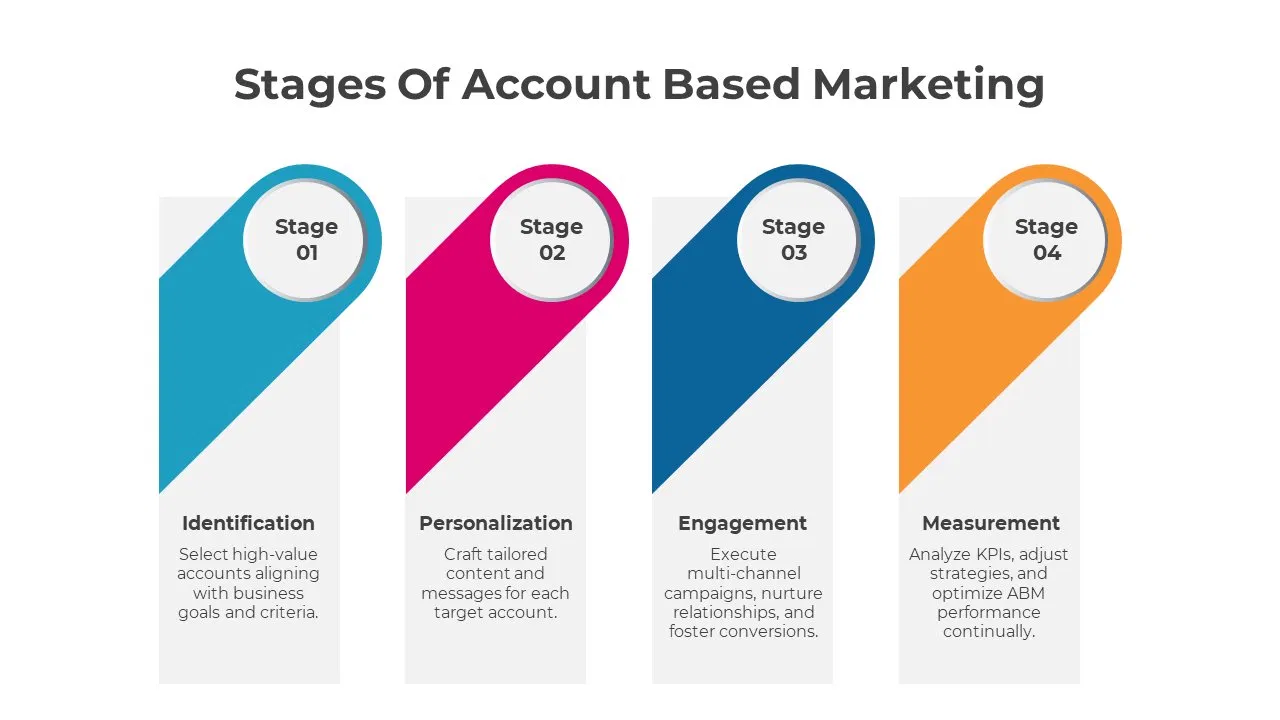
Personalization in an ABM outbound motion does not mean spending hours completely rewriting every single email from scratch. Doing so destroys operational efficiency. Instead, practical personalization means identifying the exact reason for reaching out to this specific individual, at this specific account, at this precise moment.
Before starting any outreach sequence, a representative must be able to answer three foundational questions:
Buyer-layer sequencing is critical to maintaining credibility. Sending the exact same message to an economic buyer, a technical buyer, and an end-user buyer signals a total lack of fundamental account research. A successful sequencing strategy engages the user buyer with day-to-day workflow friction hooks, delivers integration or security context to the technical buyer, and introduces high-level fiscal impact and risk mitigation to the economic buyer.
Outbound sequences should be structured to target the persona most likely to respond first. Representatives can then use that initial conversation to gather internal context, map the internal power structure, and secure warm introductions to the broader buying committee. To keep the process moving, cap initial account research at 30 minutes per account before the first touchpoint, using that window strictly to lock in the trigger event, the persona map, and the relevance hook.
Evaluating an account-based team using legacy volume metrics like total calls made or total emails sent completely undermines the strategy. High-volume targets incentivize representatives to prioritize speed over quality, encouraging them to target easy-to-reach, low-value contacts simply to hit their daily numbers. A sophisticated ABM SDR strategy relies on deep, account-centric key performance indicators rather than legacy KPIs that reward activity over quality.
This metric tracks the percentage of target accounts with at least one buying committee member actively engaged in a meaningful conversation. Organizations should aim for a coverage rate of 60% or higher across their target account list.
This KPI measures the percentage of target accounts where two or more buying committee members are simultaneously engaged. Reaching a multi-layer penetration rate of 30% or above is a clear leading indicator of genuine account opening, proving the team is moving past isolated, one-off meetings.
In a properly aligned ABM SDR motion, the sales acceptance rate should reach 40% or higher. This stands in stark contrast to traditional, volume-heavy outbound programs, where acceptance rates frequently hover around 10% because of poor targeting and misaligned expectations.
Finally, sales leadership must track total sourced opportunity value alongside raw meeting volume. An account-based approach is designed to produce a smaller number of total meetings, but with significantly larger contract values and higher conversion velocities. This shift in deal size is the ultimate proof point for leadership when justifying the strategy to executive stakeholders.
Transitioning away from a volume-first model requires changing long-standing cultural habits within a sales organization. Several common structural mistakes regularly derail ABM programs before they have a chance to generate meaningful revenue.
An ABM SDR strategy succeeds when marketing and sales development teams share a unified target account list, a structured operational feedback loop, and clearly defined success metrics for every tier. Aligned organizations grow revenue 2.4 times faster because they stop treating pipeline generation as a fragmented, volume-driven numbers game.
Moving away from high-volume outbound toward targeted, account-based outreach requires a deliberate reduction in list sizes, a commitment to mapping the buying committee, and a shift toward quality-based key performance indicators. Behavioral intent data only strengthens your outbound motion when representatives are trained to triangulate multiple sources and validate anonymous web surges against real-world business triggers before reaching out.
Sales development leaders who invest heavily in the marketing feedback loop, vertical pod specialization, and account narrative training build a repeatable pipeline that closes faster and at a significantly higher average deal size.
Fixing these execution gaps starts with an honest look at how your team actually spends its hours. At Whistle, we help revenue teams strip away the data clutter and tool confusion that slows down sales development. By pairing clean regional data with straightforward, focused workflows, we help your reps spend less time fighting their software and more time talking to real buyers. See how we help teams build a cleaner path to the pipeline at Whistle.



%20.jpg)

.jpg)
%20.jpg)